




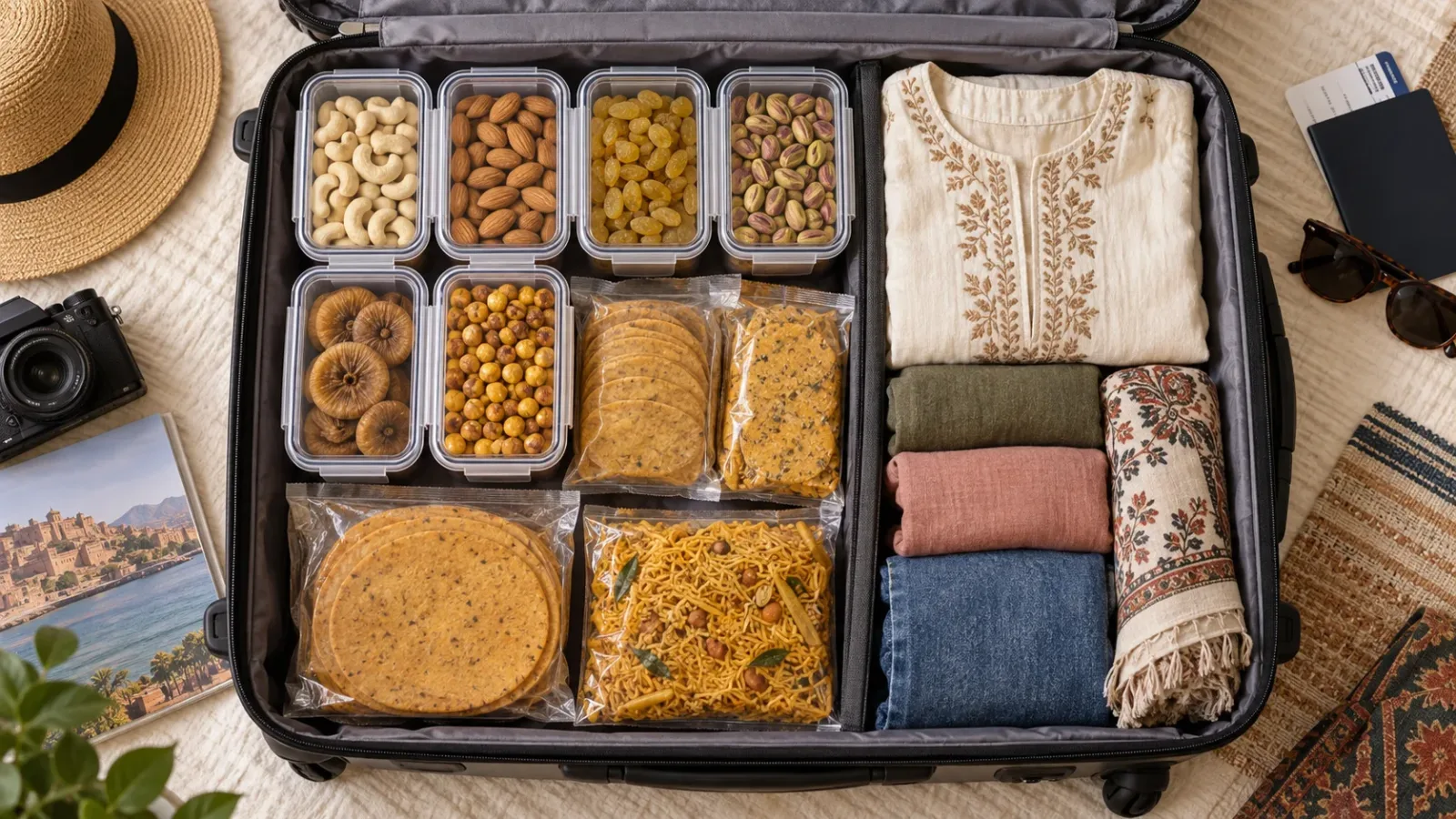
- Cabin bag
- IndiGo allows "Dry foods" and dry "Sweets" in the cabin and bans oily foods from both bags. Air India does not name dry fruits; unlisted is not permission.
- Checked bag
- IndiGo allows "Dry foods" in the hold and sends pickles, ghee and raw rice/pulses to checked only. Air India does not name dry snacks at all; unlisted is not permission. Its checked-baggage cap on ghee/oil is 5 kg/l per passenger.
- Declare at landing
- The US, Australia and New Zealand require food to be declared on arrival; Great Britain works through unrestricted and restricted lists instead. "The airline allowed it" settles nothing at the border.
- Australia ban
- Australia bans cumin, coriander and fennel seeds and dried chillies outright under khapra beetle actions. Nuts: approved species only - commercial packs qualify if roasted, blanched, fried or boiled, shelled and vacuum sealed, or tinned; permitted raw nuts need a phytosanitary certificate.
- Last checked
- Rules checked 25 Oct 2026 on the IndiGo, Air India, US CBP, Australia DAFF, NZ MPI and GOV.UK pages linked below.
Every Indian household sends its love abroad the same way: a careful arrangement of cashews, kaju katli, khakhra and something fried that your mother insists will survive the flight. Airport security and foreign customs are both waiting to have opinions about this care package.
Short answer: the airline is rarely the problem. IndiGo's restricted-items table explicitly allows "Dry foods" and dry "Sweets" in both cabin and checked baggage, while "Oily foods" are banned from both. Air India's restricted-baggage page does not name dry fruits or snack mixes at all, and unlisted is not permission; the screener's decision on the day is final. The stricter test waits at the destination. The US, Australia and New Zealand make you declare food on arrival; Great Britain instead sorts personal-use food into an unrestricted list and restricted categories. And Australia flatly bans some Indian kitchen staples. Checked on 25 October 2026 against the IndiGo and Air India pages and the four countries' official guidance, all linked below.
What the airlines say
IndiGo's dangerous-goods table is the friendlier read. Its food rows, as published:
- "Dry foods": allowed in cabin and checked baggage.
- "Sweets": allowed in both, with the condition "(Dry)".
- "Oily foods": not allowed in cabin or checked.
- "Pickles": cabin no, checked yes, "if properly packed prevent from damage".
- "Ghee": cabin no, checked yes.
- "Raw Foods (Rice/Pulses)": cabin no, checked yes.
Air India's restricted-baggage page does not name dry fruits, nuts or snack mixes anywhere. Unlisted is not permission; it only means no row prohibits them, and the officer at the checkpoint decides on the day. What the page does say about Indian food staples:
- "All spices in powder/physical form including chilly": cabin no, check-in yes.
- "Ghee (clarified butter)/cooking oil": allowed on both; cabin under the LAG liquid restrictions, checked baggage limited to 5 kg/l per passenger.
- "Pickle": allowed on both; chilly pickle is check-in only.
- Copra and crushed dry coconut: prohibited.
One cabin rule covers everything oily or pasty regardless of carrier: at Indian airport security, liquids, aerosols and gels (the LAG rule, whose examples on Air India's page include oils) must be in containers of 100 ml or less, all fitting one 1-litre transparent resealable bag. A dry snack is not a LAG. A jar of anything floating in oil is.
The stricter test: customs at the destination
The airline decides what flies; the destination country decides what enters. Three of the four destinations Indian travellers ask about most, the US, Australia and New Zealand, require declaring food on arrival; Great Britain controls food through unrestricted and restricted lists rather than a declaration line. Either way, "the airline let me carry it" is not an argument any of them accepts.
United States
US Customs and Border Protection: "All agriculture items must be declared and are subject to inspection by a CBP Agriculture Specialist at ports of entry." Declared items in non-commercial quantities that turn out to be prohibited can be abandoned at the port of entry. Undeclared prohibited items are confiscated and can draw a civil penalty. CBP lists meats, fresh fruits and vegetables, plants, seeds and soil among the prohibited or restricted categories.
Australia
Australia is the strictest read on this list. By law, you must declare if you are carrying certain food, plant material or animal products; a biosecurity officer assesses declared goods on arrival.
On nuts, the Department of Agriculture says only approved species are allowed in, and commercially prepared and packaged approved nuts qualify if they are blanched, roasted, fried or boiled; shelled and tightly vacuum sealed; or packed in small confectionery tins sealed under vacuum. Permitted raw nuts must arrive with a phytosanitary certificate and can face mandatory treatment; all nuts must be declared and may be inspected.
The part that catches Indian kitchens: cumin, coriander and fennel seeds and dried chillies/capsicum are not permitted and will be destroyed, under the khapra beetle urgent actions, unless a listed exclusion applies. Some dried, ground spices may be allowed under specific BICON import conditions. Goods that fail are treated, exported or destroyed at the importer's expense.
New Zealand
Same shape, its own paperwork: declare food on the NZ Traveller Declaration, expect a biosecurity inspection on arrival, and MPI states clearly that clearance is not guaranteed. Fresh fruit and vegetables are not allowed at all. Dried and highly processed plant products are mostly allowed if they are identifiable, cannot be grown from the product, and are clean of contamination. Unground tea, herbs, roots and spices must be commercially manufactured and packaged, in their original unopened packaging, which quietly rules out the dabba of home-blended masala.
United Kingdom
Great Britain allows a personal-use list from any country without restriction: bread, cakes without fresh cream, biscuits, chocolate and confectionery (not made with a lot of unprocessed dairy), pasta and noodles not mixed or filled with meat, packaged soups, stocks and flavourings, and processed and packaged plant products. GOV.UK's restricted side covers meat, dairy, fish and other animal products, along with fruit, vegetables, nuts and seeds; the exact rule for those depends on the country you are arriving from, so check your specific item and origin on GOV.UK before you fly.
So what goes in the bag
- Commercially sealed, labelled packs travel best: Australia and New Zealand's conditions are written around commercially prepared and packaged food. A homemade mix has no such category to qualify under; declare it and let the officer decide.
- On IndiGo, dry snacks and dry sweets are explicitly fine in either bag; oily foods are not carried at all. On Air India, spice powders, ghee beyond the cabin liquid limit, and chilly pickle all belong in checked baggage.
- For Australia, leave the cumin, coriander, fennel and dried chillies at home. For New Zealand, skip fresh produce and keep unground spices in unopened commercial packaging. For the US, Australia and New Zealand: declare the food. For Great Britain: check the restricted list for your exact item and origin before you pack.
Two jars deserve their own deep dives: homemade pickle on an international flight and ghee or oil in checked luggage.

A Miranda House graduate and lawyer who traded courtrooms for slow travel. Cheshta travels with the batches we host ourselves, with a soft spot for travelling alongside elders.
Planning your next trip?
We'll handle insurance, hotels, airport assistance and the itinerary — the same way we do it for every trip.
Questions on this article
asked by readers, answered by us
Was this helpful?
one tap, no sign-up