



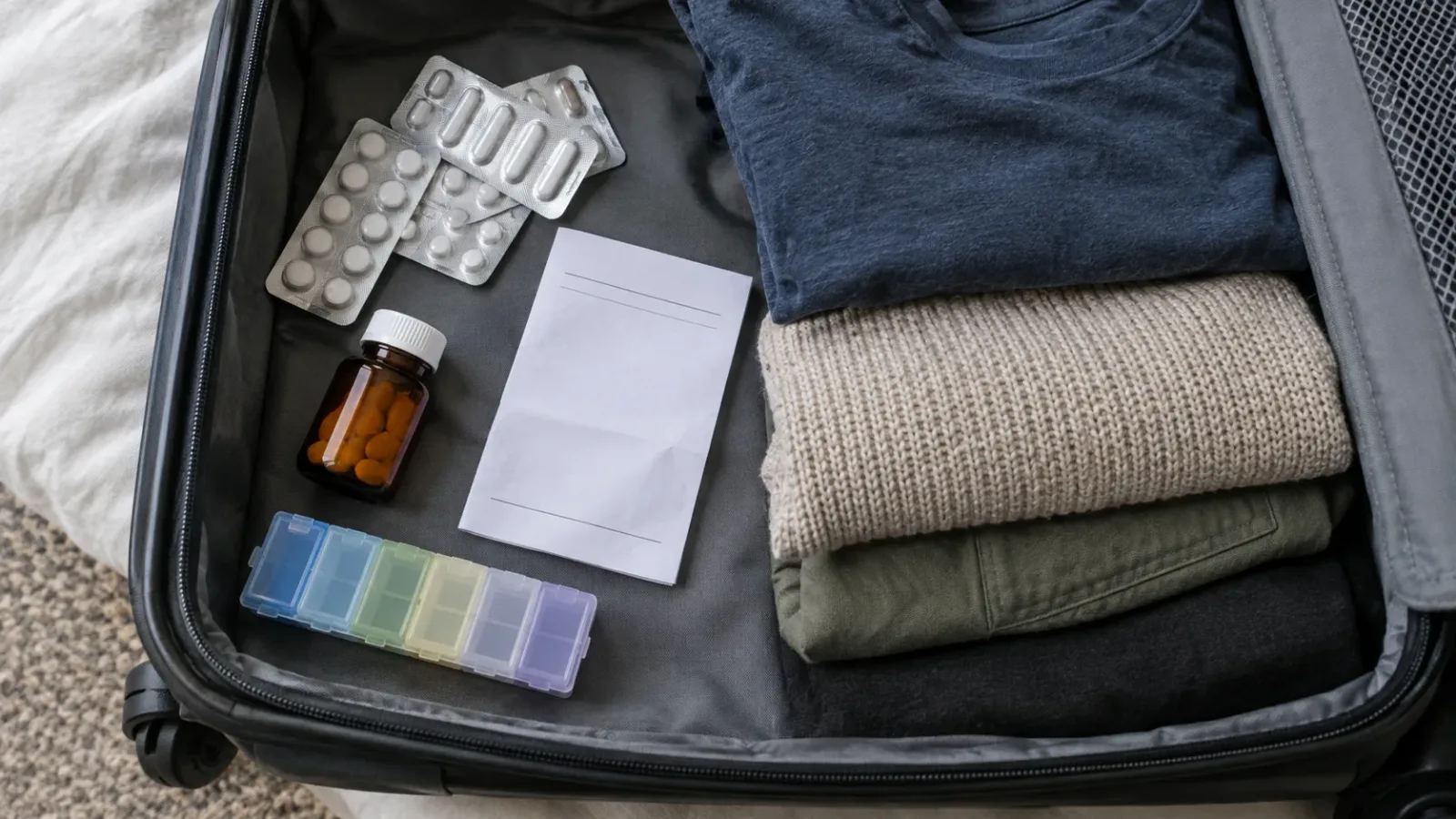
- Original packaging
- Not demanded by name; proof is the real ask
- IndiGo
- Medicines both bags with proper prescription
- Air India
- Liquids over 100 ml if journey-essential
- Paperwork
- Label name should match boarding pass
- TSA pattern
- US rulebook, not Indian checkpoint permission
The short answer: neither of the two cited carrier pages, Air India's and IndiGo's, checked on 24 October 2026, explicitly states an original-packaging requirement for medicines, but both make proving the medicine yours and genuine your job. Air India's liquids rule asks for proof of authenticity, says the name on a prescription label should match the boarding pass, and says prescribed medication can require a doctor's note. IndiGo allows medicines in both bags with a proper prescription. So the strip, bottle or box your pills came in is not a stated requirement; it is simply the easiest proof you can carry. Loose pills in an unlabelled pouch are the version of this that can turn a checkpoint into a conversation.
Nobody wants to travel with a pharmacy. Here is what the rules actually ask for, and how much of the original packaging that really means.
What Air India and IndiGo actually require
IndiGo's dangerous-goods table has a "Medicines" row marked allowed in both cabin and check-in baggage, with one condition: proper prescription. A separate "Non-prescribed medicines" row is cabin yes, check-in no, an odd split worth knowing if you carry over-the-counter pills. Air India's restricted-baggage page does not list medicines among its banned items at all; its rules for them sit inside the liquids section. Neither page uses the words "original packaging". The requirement that shows up instead is proof: a prescription, a label, a doctor's note.
Liquid medicines: labels and supporting documents
For syrups, drops, sprays and anything pourable, Air India's liquids rule, checked on 24 October 2026, allows medicines over 100 ml, prescribed or over the counter, if they are essential for the journey and the quantity is no more than the journey needs. Then come the conditions: proof of authenticity can be requested, the name on a prescription label should match the boarding pass, and prescribed medication can require a doctor's note. A label with your name on it lives on the original bottle. That is the sense in which packaging does quiet work without being the rule: the original labelled container answers most of those questions in one object, and the prescription or doctor's note covers the rest. Packaging is the practical identification aid here, not the only accepted proof.
Pills and tablets: the practical answer
Pills are not liquids, so the 100 ml framework does not touch them. What touches them is IndiGo's prescription condition and the general checkpoint reality that an officer can ask what a loose tablet is. The clean version: keep pills in their original strips, because the strip carries the medicine name, the manufacturer and usually the batch, and carry the prescription or a doctor's note that ties your name to the medicine. The messy version is a week's worth of mixed pills in an unmarked box: nothing on the cited pages certifies it, the officer has no label to read, and the long conversation that can follow is entirely avoidable. If you carry a pill organiser for the days of the trip, keep the original strips along as the proof behind it.
The international pattern
The US TSA's item page for medications in pill form, checked on 24 October 2026, marks them allowed in both carry-on and checked bags, with the usual note that the officer on duty has the final decision. The TSA also allows medically necessary liquids over 100 ml in reasonable quantities when declared at the checkpoint. Useful as a pattern, but it is an American rulebook, not permission at an Indian checkpoint. The Indian carriers' own pages are the ones that decide your flight.
Common questions
Can I carry medicines without original packaging on a flight in India?
Neither of the two cited pages, Air India's and IndiGo's, checked on 24 October 2026, states an original-packaging requirement by name. IndiGo's condition is a proper prescription; Air India asks for proof of authenticity and matching names on labels and boarding passes. Original strips and bottles are the simplest way to satisfy those conditions, so travel with them when you can.
Can I carry loose pills in a pill organiser through airport security?
Nothing on the Indian carrier pages forbids it, but nothing certifies it either: an organiser has no label, so it cannot be the proof of what the pills are. Carry the prescription or original strips alongside it, especially for prescription medicines.
Do I need a prescription for over-the-counter medicines on a flight?
IndiGo's table has a separate "Non-prescribed medicines" row marked cabin yes, check-in no, so over-the-counter items belong in your cabin bag on IndiGo. Air India's liquids rule treats over-the-counter medicines like prescribed ones for quantity: enough for the journey, with proof of authenticity if asked.
Can I carry liquid medicine over 100 ml in cabin baggage?
On Air India, yes, if it is essential for the journey, in journey-sized quantity, and you can show proof of authenticity; a doctor's note can be required for prescribed medication. The general 100 ml rule has this explicit medical exception. Keep the medicine accessible, since inspection is how this gets settled at the checkpoint.
Should medicines go in cabin or checked baggage?
Both carriers allow prescribed medicines in both, but IndiGo's non-prescribed row is cabin-only, and the cabin keeps your medicines reachable and out of the hold's temperature swings. Carry them in the cabin with the paperwork, and your doctor's advice settles anything specific to your medicine.
Sources checked on 24 October 2026: Air India: restricted baggage, IndiGo: dangerous goods, TSA: medications (pills). The airport screener has the final word on the day.

A Miranda House graduate and lawyer who traded courtrooms for slow travel. Cheshta travels with the batches we host ourselves, with a soft spot for travelling alongside elders.
Planning your next trip?
We'll handle insurance, hotels, airport assistance and the itinerary — the same way we do it for every trip.
Questions on this article
asked by readers, answered by us