




If your international card stops working during a trip, separate the security problem from the next essential payment. Use your issuer's genuine support route to establish what is blocked and why. Meanwhile, work out a verified way to cover the next meal, local journey and confirmed accommodation. Do not keep retrying a compromised card, assume a phone wallet bypasses the block, or plan around guaranteed emergency cash.
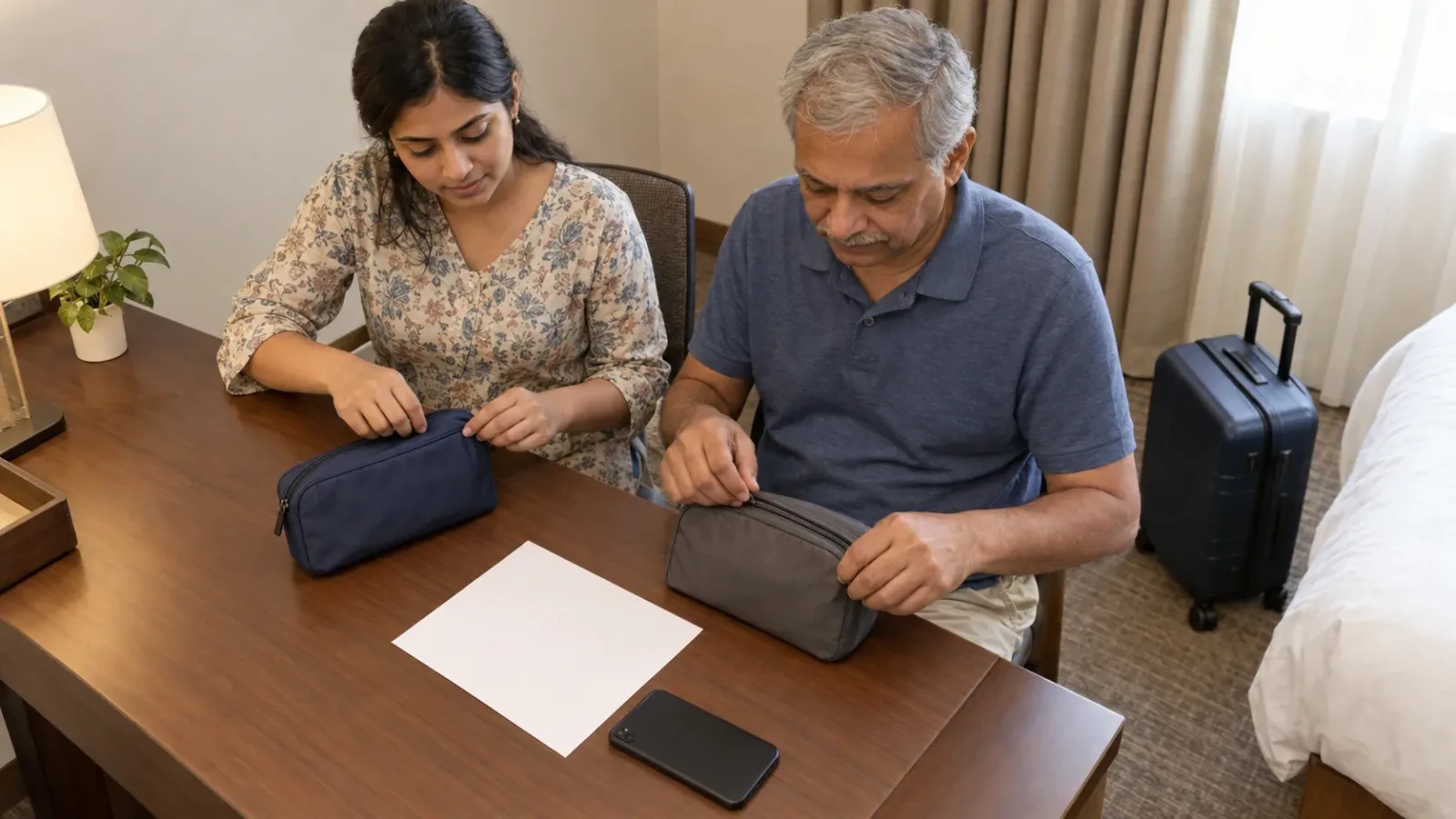
AI-generated fictional photograph of a father and daughter organising separate plain travel pouches at a hotel desk. No real card, account, cash or banking screen is shown.
Ask what is actually blocked
Tell the issuer the exact transaction, location, amount, currency, time and error, and whether the card is physically with you. Distinguish a declined purchase, an international-use setting, a limit, a temporary freeze you applied, a security restriction, and a lost or stolen card. These are different questions; the terminal's "declined" message is not a complete diagnosis.
Wise's declined-card guidance lists several possible causes and asks customers to inspect the actual activity entry. Its freeze guidance distinguishes a customer freeze from a security restriction that the customer cannot simply unfreeze. Those are Wise examples, not your bank's menu or proof that a particular problem is only a setting.
HDFC Bank's debit-card controls page describes separate domestic/international and ATM/POS/contactless/online controls. It is an issuer-specific reason to check the relevant category, not advice to enable every category or raise every limit. If a card is missing or misuse is suspected, use the issuer's genuine blocking and reporting process rather than re-enabling it just to finish a purchase.
Plan the next essential payment before the whole holiday
Write down what must be paid before you can reasonably reach the bank or another verified option: getting safely to the confirmed accommodation, essential food and necessary communication. Ask the actual merchant what forms of payment it accepts. A hotel deposit, settled bill and incidental hold are different obligations, so ask how a proposed replacement payment affects earlier charges or holds.
Use the amount and currency actually quoted for that next step, not a fixed worldwide emergency budget. Defer optional shopping or activities while access is uncertain. This is a short continuity plan, not a fund for every emergency or a suggestion to delay urgent local help. Do not promise a merchant payment by a time you cannot meet; explain the issue through its established channel and ask what supported arrangement is available.
Count independent routes, not the number of cards on a screen
For each possible backup, ask whether it is usable now, accepted here, adequately funded, and accessible without the failed card, account, phone or wallet. A different issuer or account can reduce a shared point of failure, but does not guarantee acceptance. A second card stored in the same lost wallet is not available merely because it exists. A new transfer into an account you cannot access may not solve the next payment either.
A phone wallet containing the frozen card is not automatically a separate payment source. Wise explicitly says its frozen card cannot make new payments through a mobile wallet or withdraw cash from an ATM. Other issuers and token arrangements need their own confirmation; do not test a security block by repeatedly trying the same underlying card in another app.
The FCDO finance guide, updated 21 October 2026, recommends more than one way to pay and checking destination acceptance. We use that as general preparation advice, not British consular eligibility or a promise of financial assistance for Indian travellers. Keep a modest usable cash reserve and an independently accessible payment route where practical. Check the actual currency, denominations and any applicable border rules separately.
Let family help through a verified, agreed arrangement
If a companion can pay, agree the amount and merchant first and keep the receipt and reimbursement record. Do not take their card or credentials without permission. If someone at home can help, first establish a supported way for their payment or transfer to reach the intended recipient, what the recipient needs to collect it, fees, currency and delivery time. Sending money to the same blocked card without checking access is not a complete plan.
Family support is a choice, not an automatic right to spend another person's money. Confirm any hotel or transport third-party-payer conditions with the actual provider before relying on a remote purchase. Do not send OTPs, PINs, passwords or CVV in a family chat or to a person claiming to unblock the card.
Ask about emergency services, but do not budget them as guaranteed
Visa's emergency-cash page describes reporting a lost or stolen card, requesting cash, receiving authorisation and pickup instructions, and presenting identification. Its timing is tied to issuer approval and its page lists excluded destinations. This is not a guarantee that every blocked Indian card qualifies, that cash is available in your location, or that the service costs nothing.
Mastercard's FAQ describes assistance with emergency replacement and cash advances, with replacement requiring issuer authorisation. It also warns that a credit-card ATM withdrawal is a cash advance that can carry fees and immediate finance charges. Do not assume emergency cash, a debit-card withdrawal and a credit-card cash advance have the same cost or conditions.
Ask your issuer or the genuine network service about your specific eligibility, amount available, total charges and interest, currency conversion, required documents, collection point or delivery address, actual timing and what the replacement can do. Keep a short fallback for the period before confirmed availability. No card, cash or free service has been arranged by this article.
Close the failed attempt before creating a second payment problem
If the first attempt has a debit or pending authorisation, keep its reference and ask the merchant and issuer to identify its actual status. A decline message alone should not make you pay twice blindly. If you use a backup for a genuine unpaid bill, ask for the receipt and how the earlier attempt will be reconciled. Track any release, reversal or refund separately; no universal arrival period is established here.
Save the issuer case number, current card status, next action, essential-payment arrangement and where the backup is accessible. Recheck the plan when the phone, accommodation or card changes. Parents should know the genuine support route and their agreed helper, without having to share banking credentials.
Reviewed 14 November 2026 using the six primary pages linked above. Only the FCDO passage had the stated current update date; exact current revision dates were not established for the other passages. No particular account, block reason, overseas acceptance, emergency-service eligibility, fee, conversion rate or restoration time was tested. This is a practical planning guide, not authority to unblock a card, borrow or transfer money.

A Miranda House graduate and lawyer who traded courtrooms for slow travel. Cheshta travels with the batches we host ourselves, with a soft spot for travelling alongside elders.
Planning your next trip?
We'll handle insurance, hotels, airport assistance and the itinerary — the same way we do it for every trip.
Questions on this article
asked by readers, answered by us
Was this helpful?
one tap, no sign-up