




- Place
- Charaideo, Assam
- Context
- Tai-Ahom royal necropolis
- Focus
- Mounds and sacred landscape
- Chambers/climbing
- Permission not established
- Reviewed
- 17 November 2026
Reviewed: 17 November 2026. Selective heritage outline, not a ticket or access guarantee.
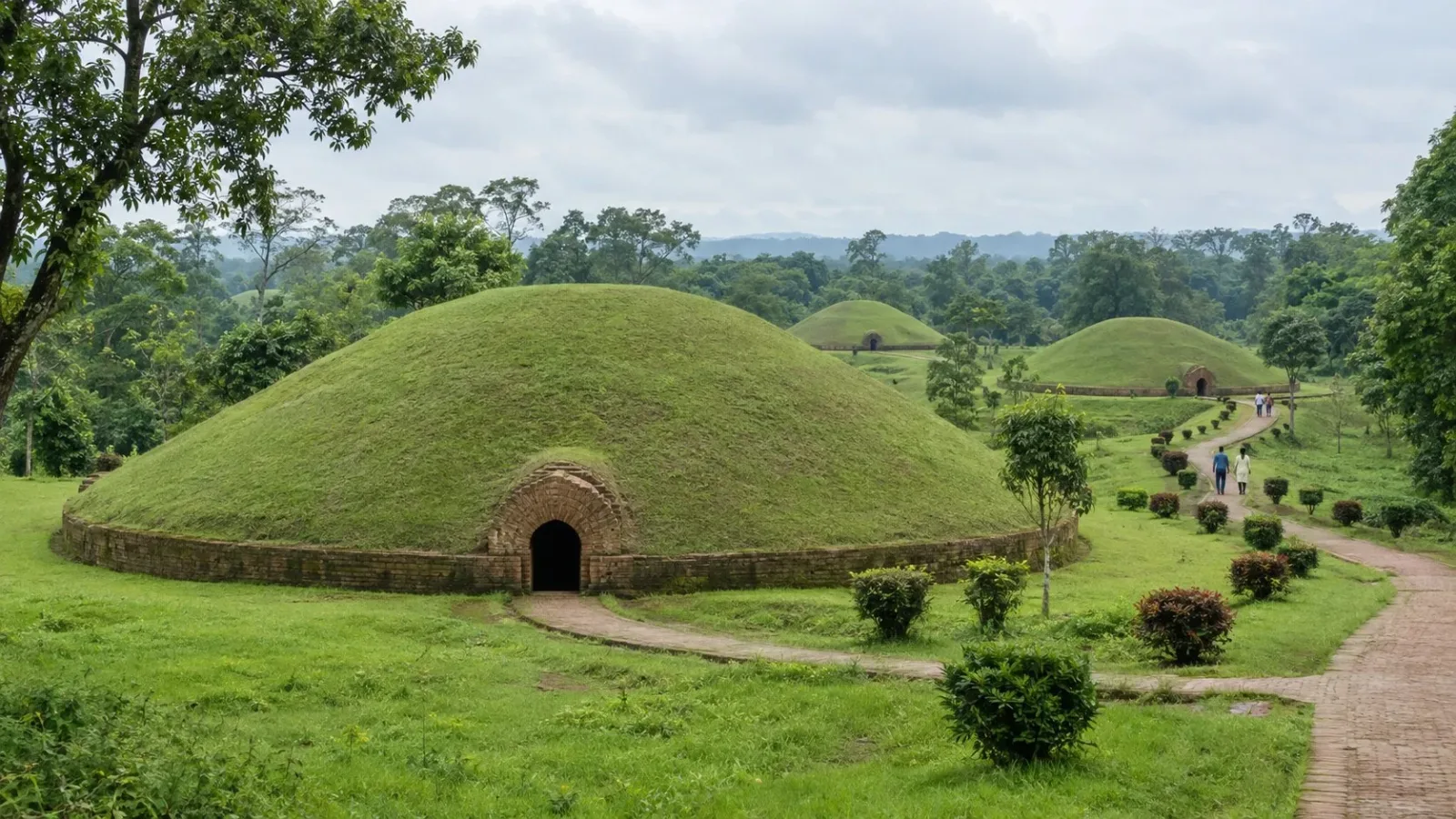
AI-generated fictional Charaideo moidam landscape-inspired scene, not an exact monument layout, current visitor route or access record.
At Charaideo, the moidams are better understood as parts of a sacred burial landscape than as a sequence of mounds to climb. UNESCO's property description connects Tai-Ahom royal burials with built vaults, earth mounds, surrounding walls and a landscape shaped by hills, trees and water. The setting belongs to the meaning of the place.
Understand mound and vault together
The property statement describes an earth mound built over a hollow vault, with a shrine above and an octagonal surrounding wall. This helps explain why the visible earth form is only part of the funerary architecture. It is not simply a natural hill or an invitation to enter a hidden chamber.
The source also describes changes in materials and design over time. Do not assume every mound is identical or that every described component survives in the same condition at each one. This article gives no numbered burial inventory, chamber route or exact reconstruction of an individual moidam.
Include trees, water and terrain
The UNESCO account explains how the Tai-Ahom shaped the necropolis in relation to natural topography, planted sacred trees and created water bodies. Read the mounds with that wider setting, rather than crop the landscape out of the idea of the monument.
This is a cultural relationship, not a guarantee of shade, a waterside path or a visitor activity at any water body. Nor does it mean every tree can be identified or every feature approached from today's public route. Keep interpretation separate from practical access.
Respect a continuing sacred place
The source identifies Charaideo as a royal necropolis with continuing Tai-Ahom ritual associations. Treat it as a place of burial and belief, not a backdrop for a climbing challenge or sensational stories about grave contents.
A reference to continuing rituals does not establish a performance schedule, permission to observe or an invitation to participate. Confirm any restrictions around ceremonies, photography and particular areas. No ritual experience, demonstration or guide service is booked or promised by this article.
Check the permitted way to visit
Confirm current admission, opening, last entry, closures and visitor areas before travelling. Ask which paths and viewpoints are permitted, whether any mounds or structures are restricted, and what photography rules apply. A structural description of a vault does not establish chamber entry; a shrine on top does not establish permission to climb.
Check the whole route for your group: actual gate, drop and collection, walking, surfaces, steps, rest points, toilets and assistance. UNESCO mentions a project to improve visitor infrastructure, but that is not confirmation that particular facilities are complete, working or on your route.
Choose a respectful, selective visit from the areas actually open. This guide does not add a Sivasagar day-trip timetable or promise step-free access, shade, a ceremony or a fixed visit length. The burial landscape can be understood without entering a chamber or reaching a mound top.
Frequently asked questions
Are the mounds simply natural hills?
The cited property description explains earth mounds built over vaults as part of Tai-Ahom funerary architecture.
Why do trees and water matter?
They form part of the sacred landscape described with the necropolis, not merely optional scenery.
Can I enter a burial chamber or climb a mound?
No such permission is established here. Confirm current visitor areas and restrictions directly.
Does a continuing ritual mean a scheduled visitor performance?
No. The source's cultural description supplies neither a performance booking nor an invitation to attend.
Does this article reserve a guide or transport?
No. Confirm the actual provider, language, meeting point, fee and return separately. A heritage description does not book a service.
Is there a fixed visit duration for every traveller?
No. This is a selective editorial outline. Check your group and actual route before adding further stops.
Official sources and limits
Official heritage descriptions support the named structures and architectural features, not current opening, final fees, combined ticket scope, services or continuous accessible routes. Verify the actual visit separately.

A Miranda House graduate and lawyer who traded courtrooms for slow travel. Cheshta travels with the batches we host ourselves, with a soft spot for travelling alongside elders.
Planning your next trip?
We'll handle insurance, hotels, airport assistance and the itinerary — the same way we do it for every trip.
Questions on this article
asked by readers, answered by us
Was this helpful?
one tap, no sign-up