




Reviewed 18 November 2026. An editorial comparison of landscape forms using district, national tourism and park descriptions. Not a ranking, route or assessment of present water conditions.
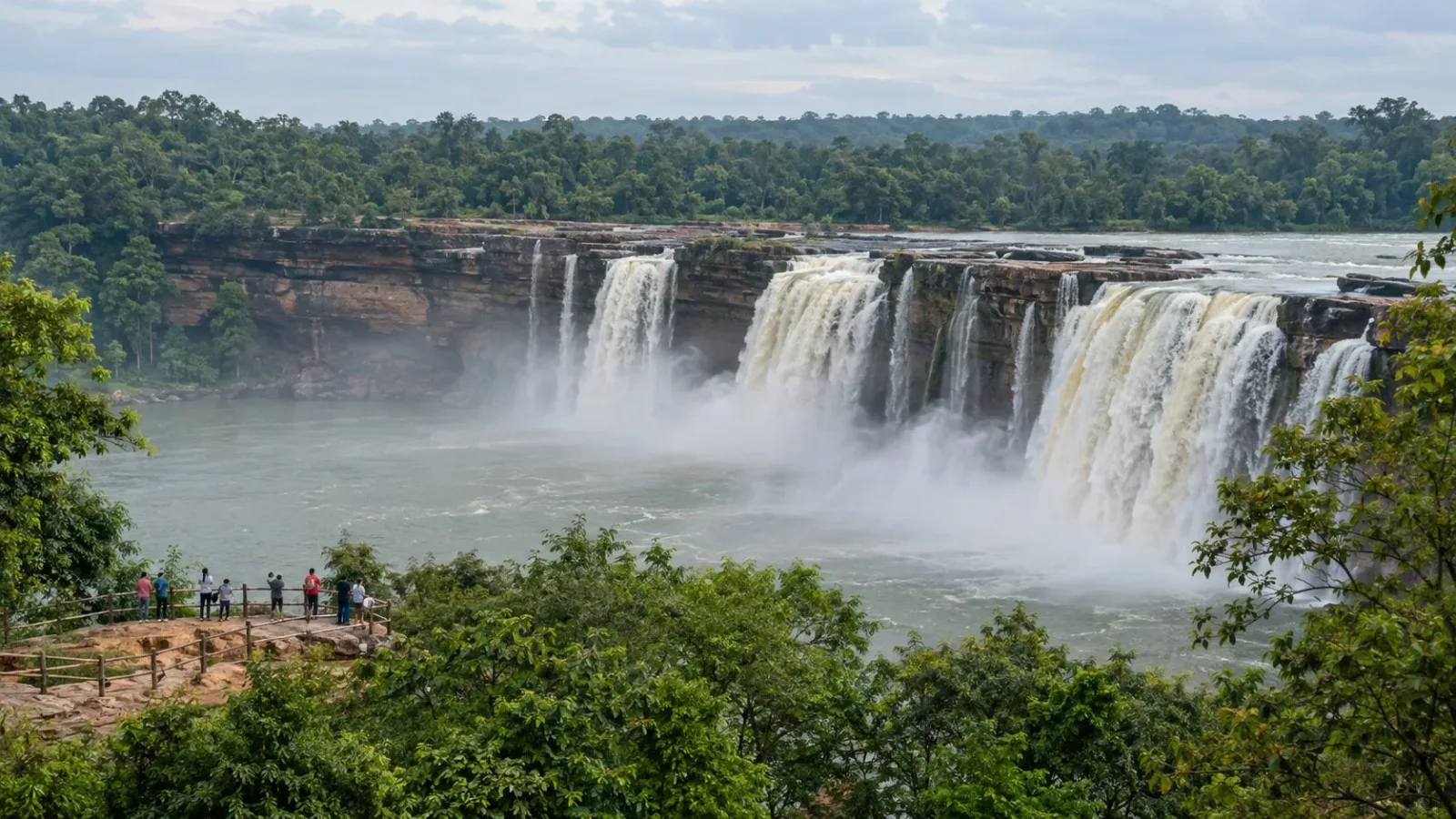
AI illustration: fictional broad waterfall inspired by Chitrakote. Not an actual location, person, safe viewing position or present water condition.
Choose the shape that interests you
Our suggestion is Chitrakote for a broad curved river drop, or Tirathgarh for water descending across step-like rock. These are different landscape subjects, not a contest to name the better waterfall.
Ask which form makes you curious. The overall curve and the ledges within a cascade invite different attention, even though both involve falling water.
Chitrakote: the river and the curve
Bastar district and Incredible India place Chitrakote on the Indravati and describe a horseshoe-like shape. The national account also calls it a giant curved waterfall.
Choose it for the relationship between the river, the edge and the curve of the drop. The larger composition is a clearer reason than collecting a famous nickname or a measurement record.
Tirathgarh: water divided by rock
The Forest Department’s park page describes water falling over sedimentary rocks arranged in a step-like manner, with rock structures partitioning the waterfall. The park’s separate tourism account likewise describes several steps.
Choose it if the parts that shape the cascade interest you. The rock is part of the form, not simply a background behind the water. This is the park accounts’ description, not a geological field assessment.
Natural steps are the subject
The stepped description concerns the natural rock formation. It is not a description of visitor stairs, a route down the waterfall or a numbered itinerary.
You do not need a fixed count of levels to understand the contrast. A photograph can emphasise one portion while a written account describes a larger cascade; neither is a present-condition survey here.
Choose a subject, not a superlative
Our recommendation is Chitrakote for the broad curve and Tirathgarh for the ledges-and-water relationship. These are editorial preferences about the subject, not an official hierarchy.
For a group, ask which description each person finds more interesting. One person may prefer the larger composition while another wants to understand layered detail. No tallest or widest label is needed to make that choice.
If both appeal, keep different questions
Let Chitrakote answer the broad-curve question and Tirathgarh the stepped-rock question. One can also be enough as the main interest; this comparison is not a compulsory circuit.
Check official visitor information separately before any visit. No approach, descent, activity, admission, timetable, current water effect or viewing-position recommendation is established by this landscape guide.
Sources
Questions people ask at the gate
Which choice is suggested for a broad curve?
Chitrakote, described on the Indravati with a horseshoe-like form by district and national tourism accounts.
Which choice is suggested for rock ledges?
Tirathgarh, whose park descriptions emphasise step-like rocks and a divided cascade.
Does stepped mean visitor stairs?
No. The comparison describes the natural rock arrangement, not visitor infrastructure or a descent.
Is a fixed count of levels needed?
No. The useful contrast is the water-and-rock relationship rather than a single level count.
Is one officially ranked better here?
No. The recommendations are editorial choices by landscape interest, not an official ranking.
Must both be part of a circuit?
No. One can be the main interest, and no combined route, activity or present visitor arrangement is established.
Next walk starts at a new gate.
Was this helpful?
one tap, no sign-up

A Miranda House graduate and lawyer who traded courtrooms for slow travel. Cheshta travels with the batches we host ourselves, with a soft spot for travelling alongside elders.