




Reviewed 18 November 2026. A focused defensive-architecture guide using ASI and official tourism descriptions. Check current official visitor information.
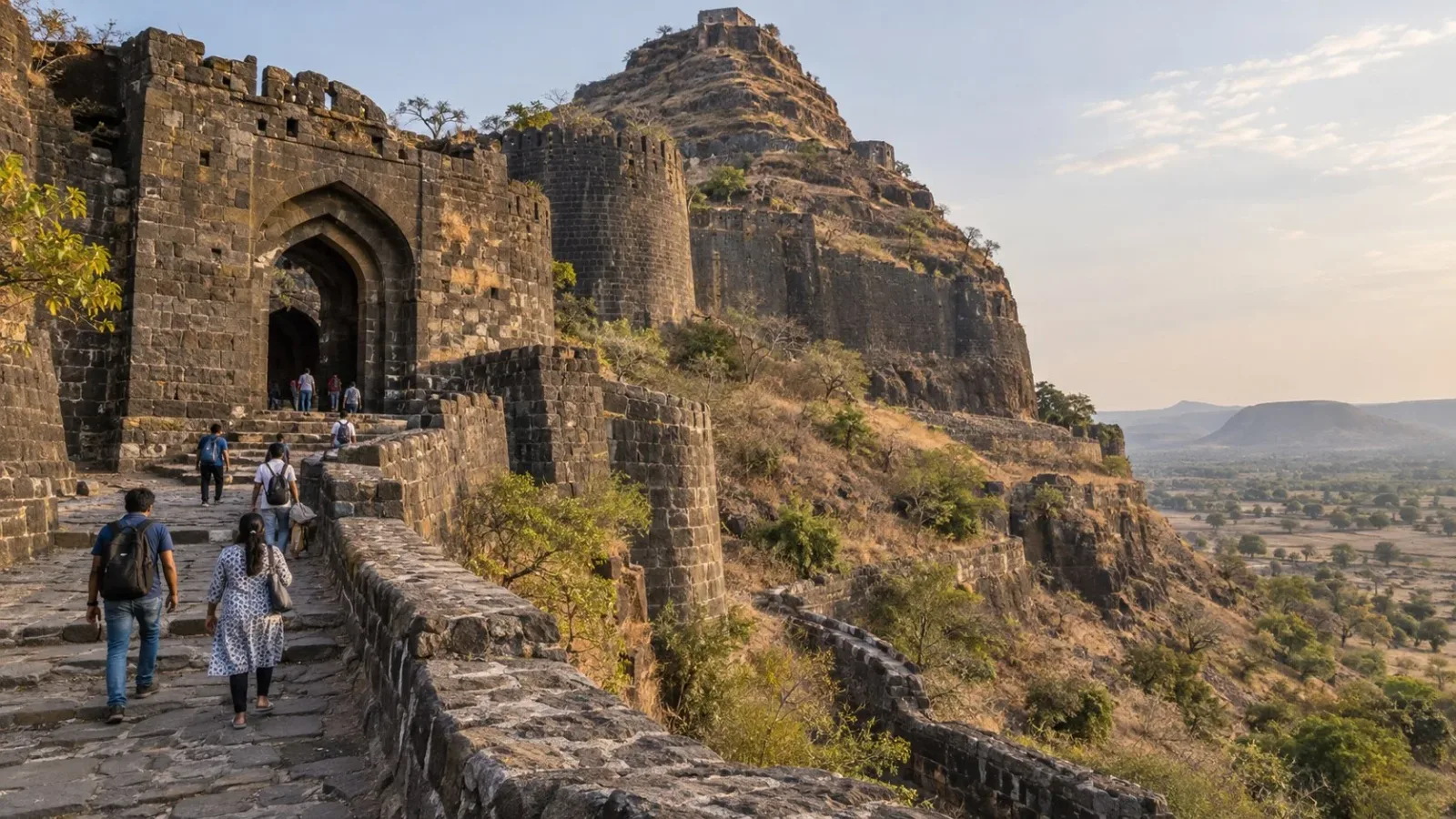
AI illustration: a fictional hill fort scene inspired by Daulatabad. Not an actual location, person, route inspection or service.
Give the fort one architectural question
How did several barriers work together? Make that your Daulatabad subject rather than treating every named feature as a task to complete. The district also records the older name Deogiri.
Our suggestion is a focused look at the relationship between land and built defences. Check current official visitor information and keep a meal, a break and the return.
Begin with the hill and enclosing walls
ASI describes Daulatabad on a conical hill, with encircling fortification walls. Consider the shape of the hill and the way walls divide and enclose space.
A wall is not an isolated ornament in that description. Its relationship with terrain and other barriers is the useful architectural question, without needing a precise boundary measurement.
Read gates, bastions and moats together
The ASI circle account describes moats, lofty gates and bastions as parts of the defensive system. A gate is an opening through a barrier; successive barriers can require further controlled openings.
Look for the relationship between an entrance and the surrounding wall in reliable interpretation. Understanding that relationship matters more than inventing a dramatic explanation for every stone or recess.
Keep the fort’s changing phases separate
ASI records enlargement and additions as the fort passed between dynasties. Its account names Yadava, Sultanate, Bahmani, Nizam Shahi, Mughal, Maratha and Hyderabad phases within the wider history.
That does not make every structure the work of one founder or one year. This guide does not choose between conflicting foundation and capital-transfer dates in the reviewed accounts.
Notice administration and water storage as other subjects
ASI lists a court building, a hall of public audience, tanks, cisterns, a hammam and palace structures alongside the defences. The historical site had administrative, domestic and water-related functions too.
A tank can prompt a question about storing water; a court building can prompt a question about administration. The list gives historical subjects, not a statement about present services.
Finish with relationships, not a list of completed structures
Choose one relationship to remember: hill and wall, wall and gate, or defence and another historical use. A focused interpretation can be enough without attaching every regional sight to the outing.
Ellora, Bibi Ka Maqbara or another destination can be a separate choice. Check current official visitor information and keep food, rest and the return in the plan.
Sources
Questions people ask at the gate
What is the suggested main subject?
How the hill, walls, moats, gates and bastions formed connected defences.
What older name does the district record?
Deogiri.
How does ASI describe the hill setting?
A conical hill with encircling fortifications.
Was every structure built in one phase?
ASI records enlargement and additions under successive dynasties, not a single unchanged building campaign.
Were defences the fort’s only historical function?
No. ASI also records court, audience, water-storage and domestic structures.
Must another destination be added?
No. Choose a focused subject, check current official visitor information and keep food, rest and the return.
Next walk starts at a new gate.
Was this helpful?
one tap, no sign-up

A Miranda House graduate and lawyer who traded courtrooms for slow travel. Cheshta travels with the batches we host ourselves, with a soft spot for travelling alongside elders.