




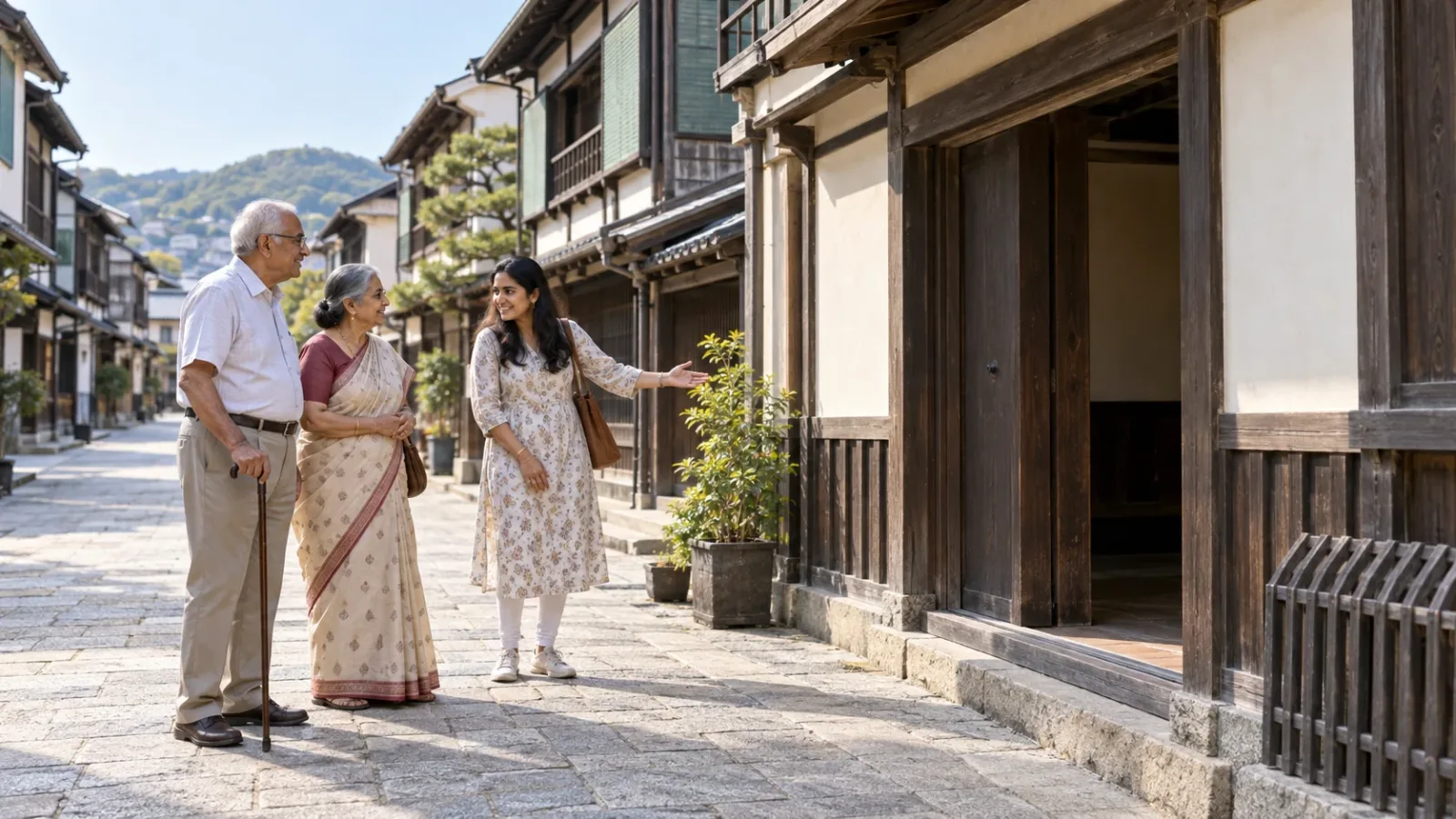
At Dejima in Nagasaki, parents may be comfortable on the outdoor street but still need a different way into an upstairs room. “Wheelchair available” does not settle that route. Decide which interiors matter, ask about the current barrier-free course and agree on an easy version of the visit before entering.
Ask for the route to a room, not just a yes to access
The Nagasaki City access page describes ramps and elevators for some buildings at this reconstructed historic trading-post site. It does not establish that every doorway, floor or exhibition can be reached in the same way. The operator’s English leaflet marks a barrier-free course with arrows, lifts, toilets and rest areas. Use the actual map with staff rather than treating a level-looking street as an all-room guarantee.
Pick a small number of rooms that interest your parents. At the entrance, ask which route reaches each one today, whether it includes a rear approach or lift and where the party can regroup if someone stays downstairs. A shorter visit is a valid choice; seeing every floor is not the admission ticket’s obligation.
The upstairs tatami room has a specific condition
The city access page describes an upstairs route to the Kapitan Room using a lift in the adjoining Hettle Room and a connecting passage. Its English room names can differ from other translations, so show staff the page or point to the room on the leaflet rather than relying only on the name.
For the tatami room, that page says shoes are not permitted and gives wheelchair users two options: transfer to a provided chair at the entrance, or clean their chair’s tyres before moving into the room. Do not turn that into an instruction that everyone must transfer. Equally, do not promise that bringing your own chair means rolling straight inside without a check.
Ask whether the relevant lift, connecting route and room are open on your date and how staff handle the tyre-cleaning option. If a transfer would not suit your parent, explain that before deciding. This article has not inspected the lift, measured your chair or booked assistance.
A free loan chair is not a reserved chair
The operator facilities page lists free loan wheelchairs and a stock of seven, available through information points. The operator FAQ also describes free stroller and wheelchair loans. These are published facilities, not confirmation of stock when you arrive or a guarantee of chair dimensions and suitability.
If the visit depends on a chair, ask about availability, collection point, return arrangements and whether any advance arrangement is possible. An accompanying person’s ability to push, an older visitor’s comfort and a powered chair’s actual route should not be inferred from the word “rental”. No equipment has been reserved here.
Current admission is not the old city-page price
The current operator admission page lists adults at ¥1,100 and elementary, junior-high and senior-high school students at ¥550, with no group discounts. It also says re-entry is not possible. The city access page still displays older, lower prices, so do not use its tariff while using its access description.
The operator’s concession wording and table are not fully aligned: the English introductory wording mentions a waiver with a Japan-issued disability certificate, while the table distinguishes local and non-local holders. Do not promise an Indian disability card, an overseas senior card or age alone earns a free or reduced ticket. Ask the operator about the exact evidence and current category before paying.
Twenty-one hundred closing does not mean every service runs that late
The operator homepage lists the exhibition area from 08:00 to 21:00, last entry 20:40, and warns that maintenance can make some facilities unavailable. Restaurant and shop hours are shorter and separately listed. A late entry therefore does not establish an open restaurant, shop or a complete set of usable interiors.
An independent family visit account discusses doorway steps and different ways through the reconstructed buildings. It is useful context for asking about the route, not a current lift inspection. Its planning estimates and gate details should not override operator instructions for your actual arrival.
The current Japanese visitor page lists the Main Gate Bridge entrance until 21:00, with last entry 20:40, but the Water Gate only until 18:00. Confirm the gate you should use for the chosen arrival and departure, especially if a nearby drop-off is important. Do not just tell a driver “any Dejima gate”. This article has not checked a particular day’s gate operation, parking place or vehicle access, and it does not give a tram or transport rule.
Plan food and rest before the no-re-entry visit
The FAQ allows eating and drinking on garden benches and the lawn, but not eating in the Restored Zone except for special events; eating while walking is prohibited. That is not permission to snack in every room. Take leftovers and rubbish away as requested.
The FAQ identifies outdoor benches and indoor rest spaces, but a second-floor rest space is not an automatic accessible seat. Ask which rest area works along your selected route. Do not rely on a named space remaining open because it appears in an older leaflet.
The restaurant is a separate service, not a meal included with entry. Check the operator’s current notices for date-specific restaurant schedules as well as dietary needs and seating if parents need a dependable lunch. Since ordinary re-entry is not allowed, leaving for food should not be planned on the assumption that the same ticket will bring everyone back inside.
Toilet symbols are not a transfer-space measurement
The facilities page lists an accessible toilet near the western entrance and an accessible/ostomate provision in the central area. The leaflet also has toilet symbols. Ask staff which is open and reachable on your route, and explain any space or assistance needs rather than assuming all marked toilets have the same layout.
Choose a daytime visit if you want more room to ask these questions and change the plan; that is a planning suggestion, not a promise of staff availability, quieter conditions or a fixed visit length. If a particular upstairs room cannot work, the outdoor setting and selected accessible rooms may still be enough for the family.
Keep the wider Japan plan separate
The site is at 6-1 Dejima-machi, Nagasaki, not a working port tour or a boat excursion. The accessible route discussed here is for the historic visitor site. A performance, costume rental, live Hindi guide or a private tour is not established by admission.
For a longer holiday, use The Trip Keeper’s Japan trip page and describe the rooms, language and mobility support that matter. Entry, chair reservation, transfers, meals, interpreter or personal assistance are not implied to be included. Last checked 9 November 2026. Hero: AI-generated fictional family in a generic historic street, not proof of a particular Dejima entrance, ramp or room.

A Miranda House graduate and lawyer who traded courtrooms for slow travel. Cheshta travels with the batches we host ourselves, with a soft spot for travelling alongside elders.
Planning your next trip?
We'll handle insurance, hotels, airport assistance and the itinerary — the same way we do it for every trip.
Questions on this article
asked by readers, answered by us
Was this helpful?
one tap, no sign-up