




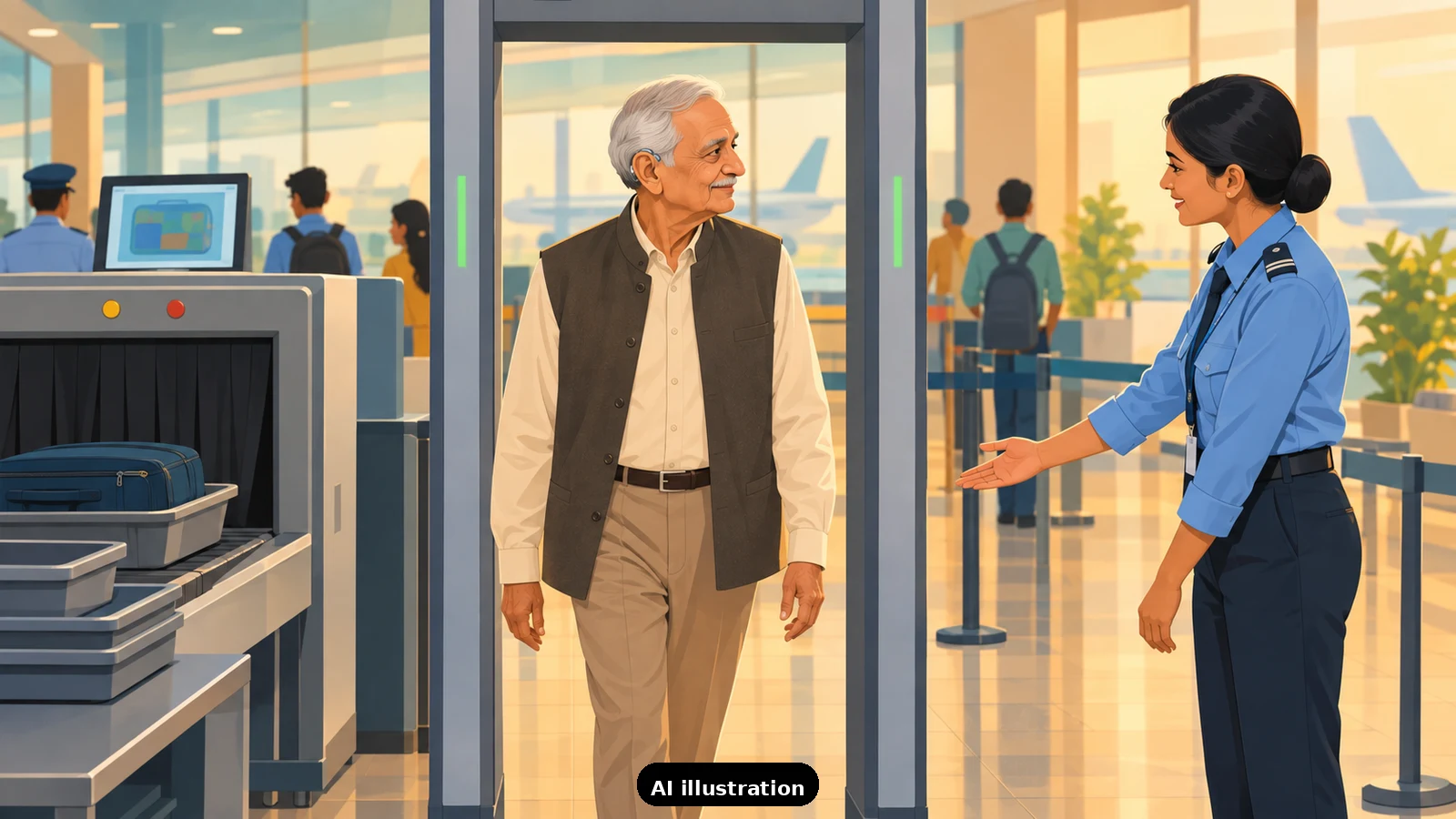
Short answer: no. A senior wearing hearing aids walks through Indian airport security with the aids in their ears. The Bureau of Civil Aviation Security (BCAS) has a Standard Operating Procedure for screening passengers with special needs and medical conditions (laid out through Circular 23/2005), and assistive medical devices like hearing aids are explicitly part of it. The CISF, which runs the checkpoint at most Indian airports, is trained to screen passengers wearing them - you are not asked to take them off, and you should not drop them into the X-ray tray either.
Will the hearing aid set off the metal detector? Usually not. Hearing aids contain tiny amounts of metal, and modern door-frame detectors at Indian airports are calibrated to ignore small personal items of that size. If the frame does beep, the officer resolves it with a quick hand-held wand or a visual look at the ear - a thirty-second step, not an interrogation. Full-body scanners, where installed, are also safe for hearing aids: the imaging does not damage the device, and the device does not confuse the imaging.
The one habit that makes it smooth: tell the officer first. Before your parent walks through the frame, a quiet word to the CISF officer - 'saab, hearing aid hai' - changes the whole interaction. The officer knows what to expect, will wave the passenger through or do a brief hand check, and nobody gets startled by a beep. For seniors who get anxious at checkpoints, this small announcement is the difference between confusion and a calm two minutes. If the officer does want a closer look, the passenger can point to the aid; removal is the last resort, not the default, and a private screening can be requested if needed.
Why the tray is the wrong place for a hearing aid. It is tempting to treat it like a watch or phone, but do not. A hearing aid in an open tray can fall through the rollers, get crushed under stacked trays, or simply walk off in the checkpoint rush - and a good pair costs serious money. Airport and audiology guidance is consistent: keep the aids on your ears through the whole screening. The same logic applies to cochlear implants, which carry their own documentation, but for ordinary hearing aids the ears are the safest storage at the airport.
Batteries and the flight itself. Spare hearing-aid batteries - zinc-air button cells or the small lithium cells in rechargeables - are permitted in cabin baggage, and cabin is where they belong, not checked bags. Once aboard, hearing aids do not interfere with aircraft systems, so there is no rule requiring them off during takeoff or landing. Keeping them on is actually the safer choice: your parent hears the safety briefing and the crew's instructions.
A small kit for senior travellers. Pack in the cabin bag: spare batteries or the charging case, the cleaning brush and wax guard, and a soft pouch for the aids during the flight if your parent takes them out to sleep. A short note or the audiologist's card naming the device helps on the rare day an officer wants documentation. None of this is mandatory - it just turns an unfamiliar airport into a routine one.
How we prep senior travellers at TripKeeper. When we plan a trip for parents or grandparents, the airport walk-through is part of the plan: what happens at the belt, what to tell the officer, and what stays in the ears. If you are sending a senior family member off on a flight and want that preparation done properly, send us a trip-planning inquiry.

A Miranda House graduate and lawyer who traded courtrooms for slow travel. Cheshta travels with the batches we host ourselves, with a soft spot for travelling alongside elders.
Planning your next trip?
We'll handle insurance, hotels, airport assistance and the itinerary — the same way we do it for every trip.
Questions on this article
asked by readers, answered by us
Was this helpful?
one tap, no sign-up