



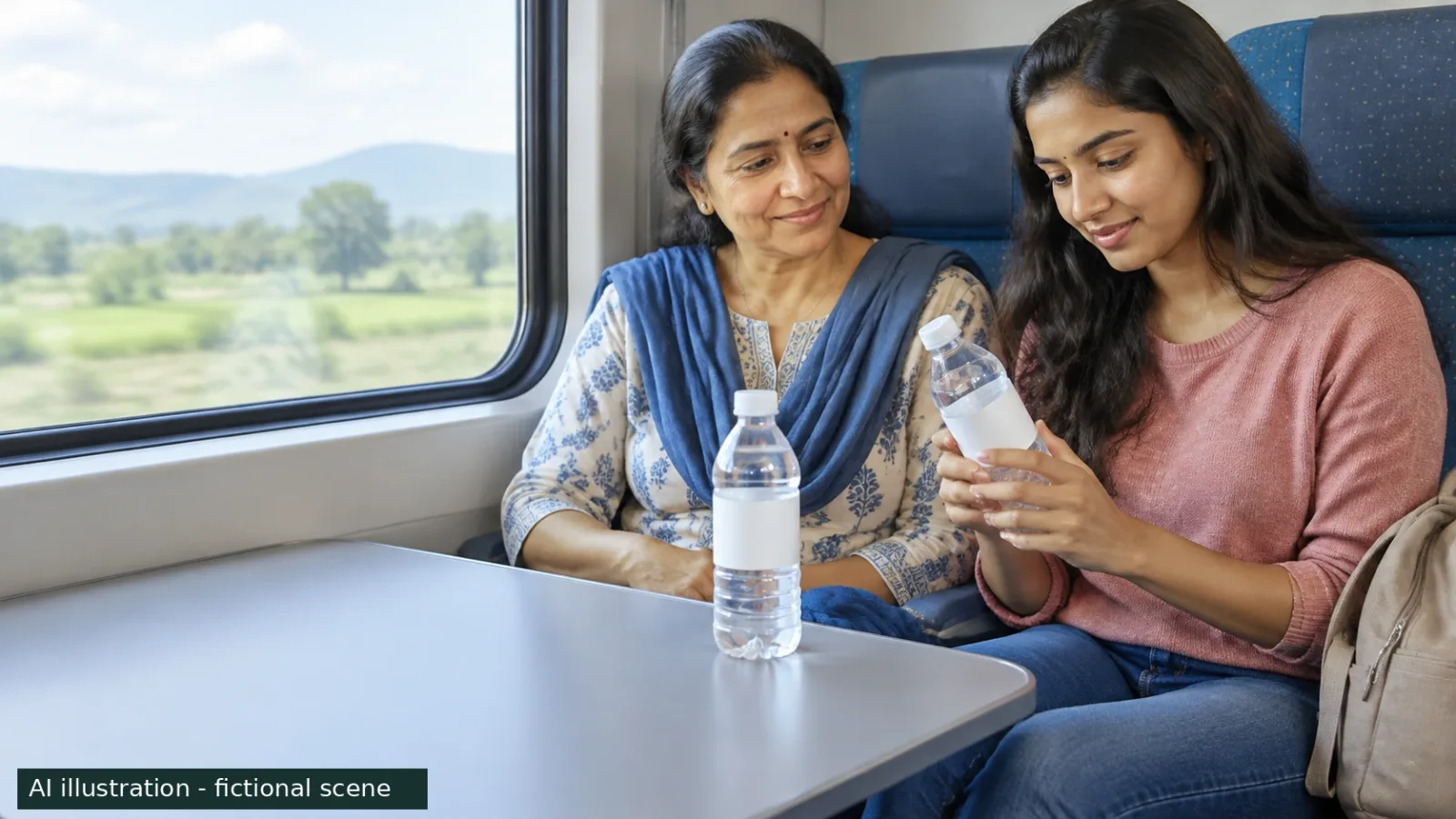
AI illustration: fictional travellers check unbranded water bottles in a generic coach. This is not a tested product, actual train interior or water-quality inspection.
Plan drinking water before the train starts, then check the actual supply rather than assuming the next tap, seller or stop solves it. A bottle brand, a railway maintenance programme and a safe refill at this moment are different pieces of evidence. This guide gives a procurement routine, not a guarantee that every station or onboard tap is safe.
Take a usable starting supply
Our editorial suggestion is to start with drinking water you can identify and carry comfortably, with enough flexibility for the actual journey and possible delay. This article sets no litres-per-person target. If a traveller has a prescribed fluid limit or other health needs, use their clinician’s advice rather than a generic travel quantity.
CDC’s travel-water guidance, dated 23 April 2025, says that where tap water could be unsafe, travellers should use commercially bottled water from an unopened factory-sealed container or adequately disinfected water. It also says to avoid tap water unless reasonably certain it is safe. This is general health guidance, not a finding about a particular Indian railway tap.
Know what the railway sources actually establish
In a 22 July 2026 Lok Sabha answer, the Ministry of Railways says Rail Neer and other approved packaged drinking-water brands are sold on trains and at stations. It also describes treatment and regular testing of station drinking-water supplies. That statement does not prove stock, a working dispenser or the condition of an individual bottle on your journey.
IRCTC’s Rail Neer introduction identifies Rail Neer as its branded packaged drinking water and describes processing, purification and bottling. The page includes older plant figures, which this article does not use as current capacity or coverage evidence. Do not treat a familiar label as proof that a bottle has not been opened or refilled.
Check the container before accepting it
Use the CDC factory-sealed-container guidance for the purchase decision. Our editorial check is to inspect the label and unopened closure before accepting a bottle and to reject an item if its origin or seal is doubtful. A quick visual check is not a laboratory test or a guarantee against contamination.
Keep each traveller’s bottle identifiable and within easy reach. If the supply is running low, ask the railway staff or an authorised catering outlet about the actual available option early, rather than leaving a parent alone while searching during a short stop. This guide establishes no bottle price, included allowance or free refill.
Ask about a refill point, not any nearby tap
The 24 August 2026 railway drinking-water drive announcement describes inspections, cleaning, disinfection, repairs and testing across tanks, filters, coolers, vending machines and taps. It specifically includes checking for cross-connections between potable and non-potable systems. This is a dated maintenance action plan, not certification that every listed facility has completed the work.
Our suggested question is: “Where is the drinking-water point, and is it working now?” Ask the responsible station staff about the actual point. Do not assume a washbasin or toilet tap is a drinking-water supply. If you cannot establish a suitable refill, use an identifiable sealed supply rather than treating a nearby tap as equivalent.
Do not turn a halt into a water-shopping deadline
Our editorial routine is to arrange supply before departure or with staff assistance, not to rely on racing to a stall during a halt. A timetable does not promise enough time for a queue, payment and return to the coach. Do not leave the train solely because this guide mentions station water sources.
If a parent has difficulty walking, ask for help with procurement instead of sending them to search for a dispenser. Stay clear of doors and moving-train hazards. Follow railway staff instructions if the intended supply or assistance is unavailable.
Raise a problem through the railway route
The 22 July 2026 parliamentary answer lists RailMadad web, app, SMS and helpline 139 for grievances, assistance and enquiry. Report the actual train or station and the specific water problem through the current official route. This guide gives no complaint-menu shortcut or response-time guarantee.
For a suspected problem with a purchased bottle, keep the product details and receipt if available and ask the responsible seller or railway staff for the appropriate next step. Do not continue using doubtful water simply because a complaint has been recorded.
Sources and scope
Read 27 October 2026: the linked July 2026 parliamentary answer, August 2026 railway action plan, IRCTC Rail Neer introduction and CDC travel-water guidance. No claim of universal stock, a safe onboard tap, current plant capacity or a medical drinking target.

A Miranda House graduate and lawyer who traded courtrooms for slow travel. Cheshta travels with the batches we host ourselves, with a soft spot for travelling alongside elders.
Planning your next trip?
We'll handle insurance, hotels, airport assistance and the itinerary — the same way we do it for every trip.
Questions on this article
asked by readers, answered by us