



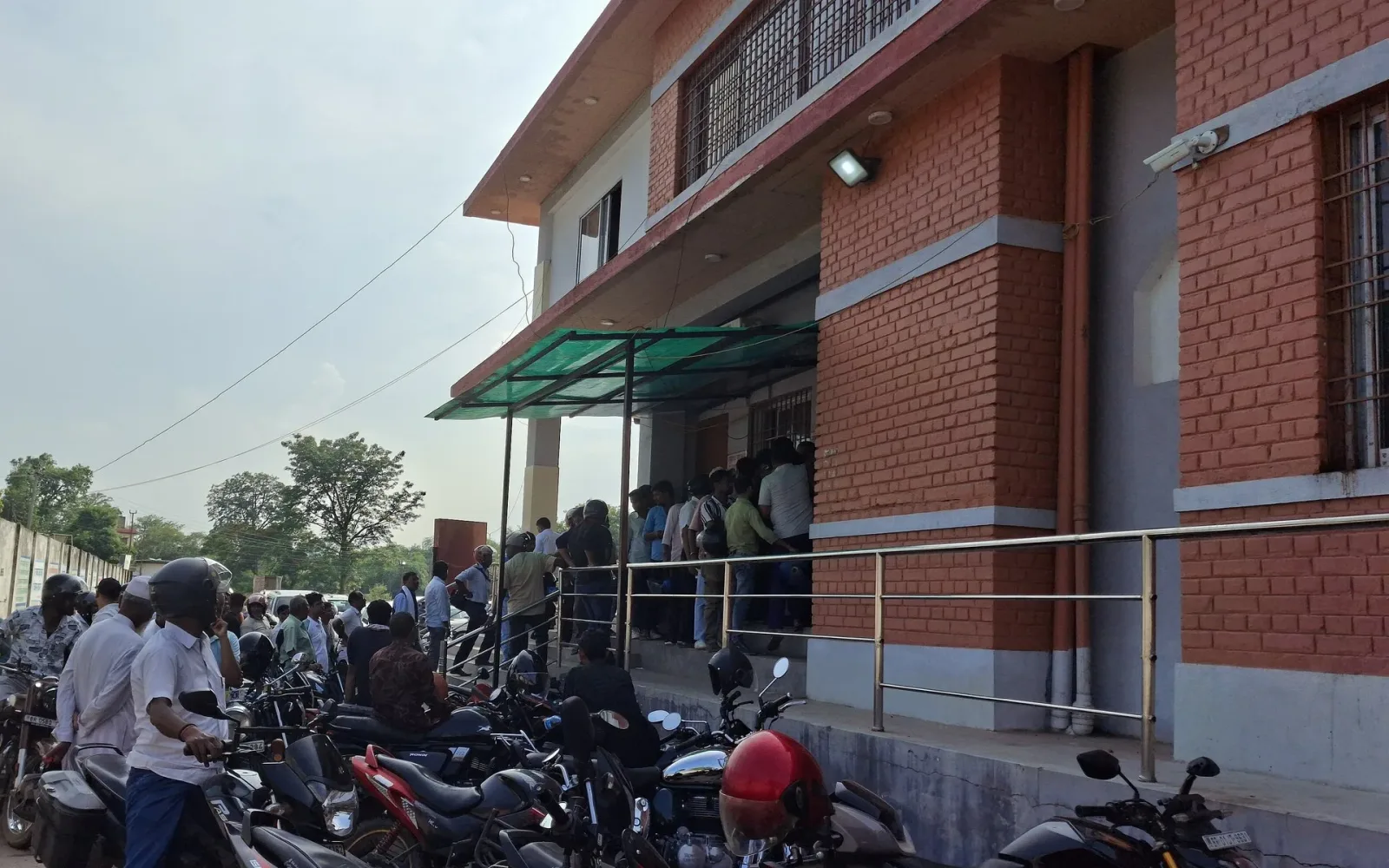

The queue for vehicle entry passes at the Birgunj Customs Office on the Raxaul-Birgunj border, May 2026. Photo: Saddam19, CC BY-SA 4.0, via Wikimedia Commons.

No motor-vehicle agreement - the vehicle needs its own paper
Crossing into Nepal is famously easy for people; it is not automatic for vehicles. The Consulate General of India in Birgunj states the reason plainly: despite heavy cross-border traffic, there is no bilateral Motor Vehicle Agreement between India and Nepal. So while an Indian traveller's entry is a document check (covered in our Nepal visa page), the Indian-registered vehicle - two-wheeler, car, van, jeep - is treated as a temporary import, and temporary imports run through Nepal Customs, called Bhansar. The permit you must carry is the vehicle's pass, variously called the TIV (Temporary Import Vehicle) permit, the Bhansar pass, or for the shortest trips the Day Pass/Challan. It is separate from your personal ID, and driving without a valid one is the single expensive mistake in this corridor.
The Day Pass: same-day, nearest market only, free - and it goes back the same day
If your plan is a day visit to the nearest Nepali municipal area or market across the border, no customs duty applies: you register the vehicle at the border check post and take a Day Pass/Challan. Two conditions come with it, and both are strict: the vehicle must return to India the same day, and the pass must be handed back to Nepal Customs on the way out. A Day Pass is not a cheap overnight workaround - anything beyond the nearest town, or any night halt, moves you into the paid pass regime.
The paid TIV pass: per-day charges, advance registration on the NNSW portal
For travel beyond the nearest town or any overnight stay, the vehicle must be registered for the specific number of days, with per-day charges that vary by vehicle type. Here the two official Indian government pages differ: the Embassy of India Kathmandu quotes NRs 100-500 per day, and the Birgunj Consulate quotes NRs 200-600 per day - treat the exact figure as a border confirmation, not a planning constant. One genuine improvement is recent: the Consulate notes that travellers can register their vehicle particulars online in advance on Nepal's National Single Window portal (nnsw.gov.np/tiv/gen) for the TIV/Bhansar permit, which speeds up processing at the border. Get the pass for the correct number of days at entry itself - the Embassy instructs this directly - and keep the pass or challan available for inspection by police or any authority throughout the stay.
The 30-day annual cap, and how re-entry works
However long your pass runs, the total is capped: an Indian-registered vehicle may stay in Nepal for a maximum of 30 days in a calendar year, and the Embassy is explicit that payment cannot extend this. A pass issued for a specific duration must be exited before expiry; the vehicle may then re-enter on a new pass, subject to the same 30-day annual ceiling. Plan a long Nepal road trip around that arithmetic before you plan the route.
Overstay is the real risk: seizure, confiscation, auction
The enforcement section of the Embassy's page deserves quoting in substance, because travellers underestimate it. Vehicles caught in Nepal without a pass, or with an expired pass, are treated as illegally smuggled; the Embassy says such vehicles are seized, confiscated and later auctioned by Nepal Customs, and although provisions exist for release on heavy fines, they are very rarely used - in most cases the vehicle is seized. If something forces an overstay, the remedy is time-sensitive: approach the nearest Nepalese Customs office for an extension before the existing pass expires (in Kathmandu, the Nepal Customs office at the Tribhuvan International Airport cargo complex handles extensions). Two cautions on that remedy: the request must be made before expiry - after expiry the Embassy describes no available remedy - and while the same page holds the 30-days-a-calendar-year cap even against payment, it does not explain how an extension interacts with that cap; do not assume an extension will be granted or can exceed it - seek Customs guidance before expiry.
Papers and people: two separate checklists
The vehicle side: registration particulars for the TIV registration, the pass or challan itself, and payment for the days declared. The people side: Indians need no visa for Nepal, and the accepted identity documents are covered in our Nepal visa guide - carry the original, not a photocopy. Neither official page reviewed for this article lists a vehicle-document set beyond the pass regime, and no official source we read establishes whether an Indian driving licence is legally valid for driving in Nepal. So carrying the vehicle's registration certificate, your driving licence and the customs pass together is sensible practice, not proof of driving authorisation: verify your driving authorisation with the competent Nepal authority - start with the Nepal Customs office at your crossing - before you drive.
The border checklist
1. Decide your trip type first: same-day nearest-market visit (free Day Pass, return and surrender the same day) or beyond/overnight (paid TIV pass). 2. For anything beyond a day visit, register the vehicle in advance on Nepal's NNSW portal (nnsw.gov.np/tiv/gen) if you can, or at the border check post; declare the correct number of days. 3. Budget per-day charges by vehicle type - the two official Indian pages quote different ranges (Embassy NRs 100-500, Birgunj Consulate NRs 200-600 per day); confirm the exact figure at the border or during online registration. 4. Count your days against the 30-day-per-calendar-year cap; payment does not extend it. 5. Carry the pass, the vehicle's registration certificate and your driving licence - as practice, not proof of driving authorisation, since no official source read establishes the licence's legal validity in Nepal; verify authorisation with the competent Nepal authority before driving, keep the pass ready for inspection and surrender it to Nepal Customs at exit. 6. If an overstay threatens, seek guidance from the nearest Nepal Customs office before the current pass expires - the Embassy mentions requesting an extension but does not explain how it interacts with the 30-day annual cap, so do not assume an extension will be granted or can exceed it; after expiry, seizure is the described outcome.
Last verified: 25 November 2026 against the Embassy of India Kathmandu vehicle-entry page, the Consulate General of India Birgunj vehicle-permit page, and Nepal's National Single Window TIV portal (live page, JavaScript-only - cited for its existence and URL as the Consulate states them).
Questions people ask at the gate
Does my Indian car or bike need a permit to enter Nepal?
Yes. With no bilateral motor-vehicle agreement, Indian-registered vehicles are temporarily imported through Nepal Customs (Bhansar). A same-day visit to the nearest border market uses a free Day Pass; anything further or overnight needs the paid TIV pass.
What does the Nepal vehicle pass cost?
Per-day, by vehicle type. The Embassy of India Kathmandu quotes NRs 100-500 per day and the Birgunj Consulate NRs 200-600 per day - the exact current figure should be confirmed at the border or during advance registration on the NNSW portal.
How long can my vehicle stay in Nepal?
A maximum of 30 days in a calendar year in total, and payment cannot extend this. You may exit before a pass expires and re-enter on a new pass within the same cap.
Can I register the vehicle before reaching the border?
Yes. The Birgunj Consulate notes that vehicle particulars can be registered online in advance on Nepal's National Single Window portal (nnsw.gov.np/tiv/gen) for the TIV/Bhansar permit, making border processing quicker.
What if I overstay my pass?
The Embassy of India Kathmandu says vehicles without a pass or with an expired pass are treated as smuggled, seized, confiscated and auctioned; release on heavy fines exists but is very rarely used. Seek guidance from the nearest Nepal Customs office before expiry - the Embassy mentions requesting an extension but does not explain how it interacts with the 30-days-a-year cap, so do not assume one will be granted or can exceed it.
Does my India-Nepal visa exemption cover the vehicle?
No. The person and the vehicle are separate: Indians enter Nepal visa-free with an accepted ID, but the Indian-registered vehicle always needs its own Bhansar pass, even when the occupants walk through with just their documents.
Next walk starts at a new gate.
Was this helpful?
one tap, no sign-up

A Miranda House graduate and lawyer who traded courtrooms for slow travel. Cheshta travels with the batches we host ourselves, with a soft spot for travelling alongside elders.