



Before buying duty-free, separate the shop transaction from the whole journey. You need to qualify for that store’s service, collect the purchase in the right place, carry it through every remaining checkpoint and meet the destination’s import rules. A departure-store receipt does not answer all four questions. Delhi and Singapore below are labelled service examples, not worldwide shopping rules.
1. Before departure, list every flight and the final destination
Keep the passport, issued itinerary and international boarding pass available. Record connections and any separate domestic leg, because another security check or customs entry can change what you can carry. Ask the store and operating airline about the exact itinerary before choosing liquids or other restricted goods. Official source.
2. At the store, confirm who can buy
Delhi Duty Free’s FAQ says its T3 stores serve international travellers using that airport with a valid international boarding card and passport; domestic-only travellers cannot shop there. Do not treat a domestic boarding pass or the fact that a shop is in an airport as duty-free eligibility. Other airports and online services have their own conditions. Official source.
3. Decide which collection service you are actually using
Delhi Duty Free calls online ordering “Click & Collect”: order online and collect when flying, with in-person collection and the required travel documents. Its separate “Shop & Collect” service lets you buy at Departures while travelling abroad and collect on return. These are different collection plans. Our practical suggestion: confirm the exact flight, departure or return date, collection point and order reference before paying; do not assume either service is home delivery. Official source.
4. Collect with the documents named by that service
For an iShopChangi departure order, its FAQ asks for the order confirmation, digital or printed, passport and boarding pass at the departure-terminal Collection Centre near the GST Refund Counter. That is a Changi example, not Delhi’s collection location. Our practical suggestion: keep the order reference and receipt accessible and confirm any flight or terminal change with the actual retailer. Official source.
5. For liquids, ask about the remaining screening route
Delhi Airport’s transit-duty-free page tells passengers to keep liquids, aerosols and gels in a security tamper-evident bag (STEB) for the onward flight and comply with destination customs allowances. A sealed shopping bag is not an ordinary resealable liquids bag and is not a universal exemption at the next airport. Ask which bag, receipt and delivery arrangements your entire route requires before paying. Official source.
6. A labelled transfer example: Singapore onward to Australia
Singapore Airlines’ international duty-free page says liquids from earlier sectors in containers over 100 ml are not permitted when transiting Singapore to Australia, even in a sealed STEB. It permits larger duty-free liquids purchased at Changi only via gate delivery after Singapore screening, or bought onboard the final flight to Australia. This is that named route’s guidance, not a rule that every sealed purchase can pass every transfer. Official source.
7. Keep customs separate from the duty-free shop label
The destination decides import concessions, declarations and prohibited goods. Singapore Customs, for example, says overseas duty-free purchases still fall under its arrival conditions and says there is no duty-free concession or GST import relief for cigarettes and tobacco. Do not use an Indian departure-store allowance table as the rule for entering another country, or assume a gift is outside customs requirements. Official source.
8. Keep the bag and receipt as instructed, then protect the flight deadline
For routes requiring a sealed tamper-evident bag with the receipt, keep them together and follow the operating airline and checkpoint instructions. Singapore Airlines warns non-compliant purchases may be disposed of at the gate. Before queueing or arranging collection, check your actual boarding and gate deadline. If collection is missed, contact the retailer under the order’s conditions; do not assume a refund or free later collection. Official source.
A short document and decision checklist
Our suggested checklist, combining the named service requirements above with practical preparation: passport and valid international boarding pass for the store; complete itinerary including transfers; order confirmation if pre-ordered; receipt; the retailer’s confirmed bag or gate-delivery plan where needed; and the destination’s customs conditions. Our practical suggestion: if the retailer cannot confirm a liquid purchase will fit the remaining route, compare buying at the last departure point or after arrival rather than assuming the sealed bag settles it. Official source.
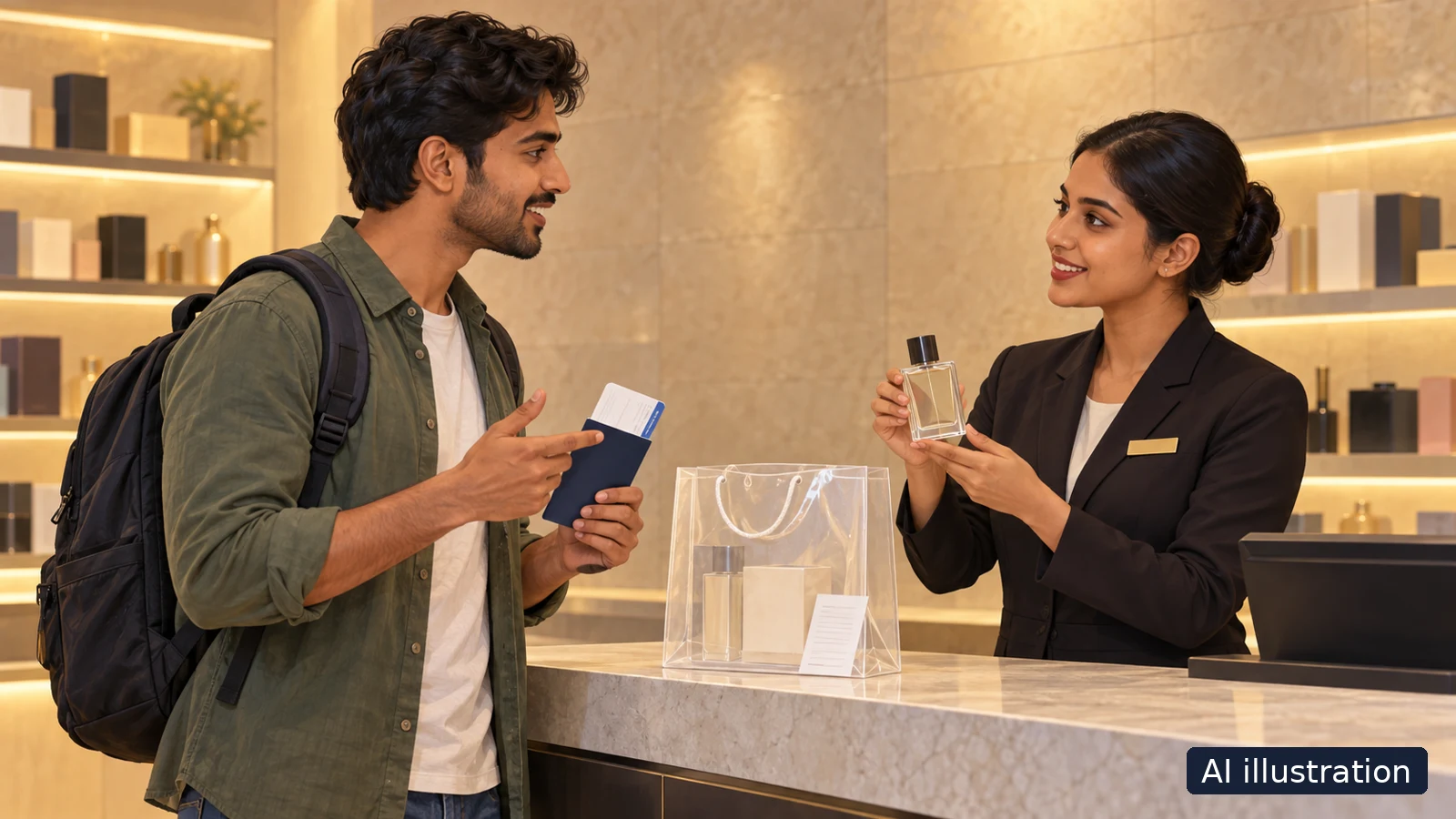
AI illustration: A fictional traveller asks about an unbranded purchase at a generic airport shop. Not Delhi Duty Free, Changi, a real product or proof of security acceptance.
Quick questions
Are Click & Collect and Shop & Collect the same at Delhi Duty Free?
No. Its FAQ describes online Click & Collect for collection when flying; Shop & Collect is a departure-store purchase collected on return. Confirm the actual service and dated order.
Does a sealed duty-free bag guarantee every connecting flight accepts it?
No. Check every remaining checkpoint and airline rule. Singapore Airlines’ Singapore-to-Australia guidance restricts earlier-sector liquids over 100 ml even in a sealed STEB.
Does buying duty-free remove destination customs rules?
No. Import concessions and declarations are separate. Check the destination authority for the goods and traveller, not only the departure retailer.

A Miranda House graduate and lawyer who traded courtrooms for slow travel. Cheshta travels with the batches we host ourselves, with a soft spot for travelling alongside elders.
Planning your next trip?
We'll handle insurance, hotels, airport assistance and the itinerary — the same way we do it for every trip.
Questions on this article
asked by readers, answered by us
Was this helpful?
one tap, no sign-up