




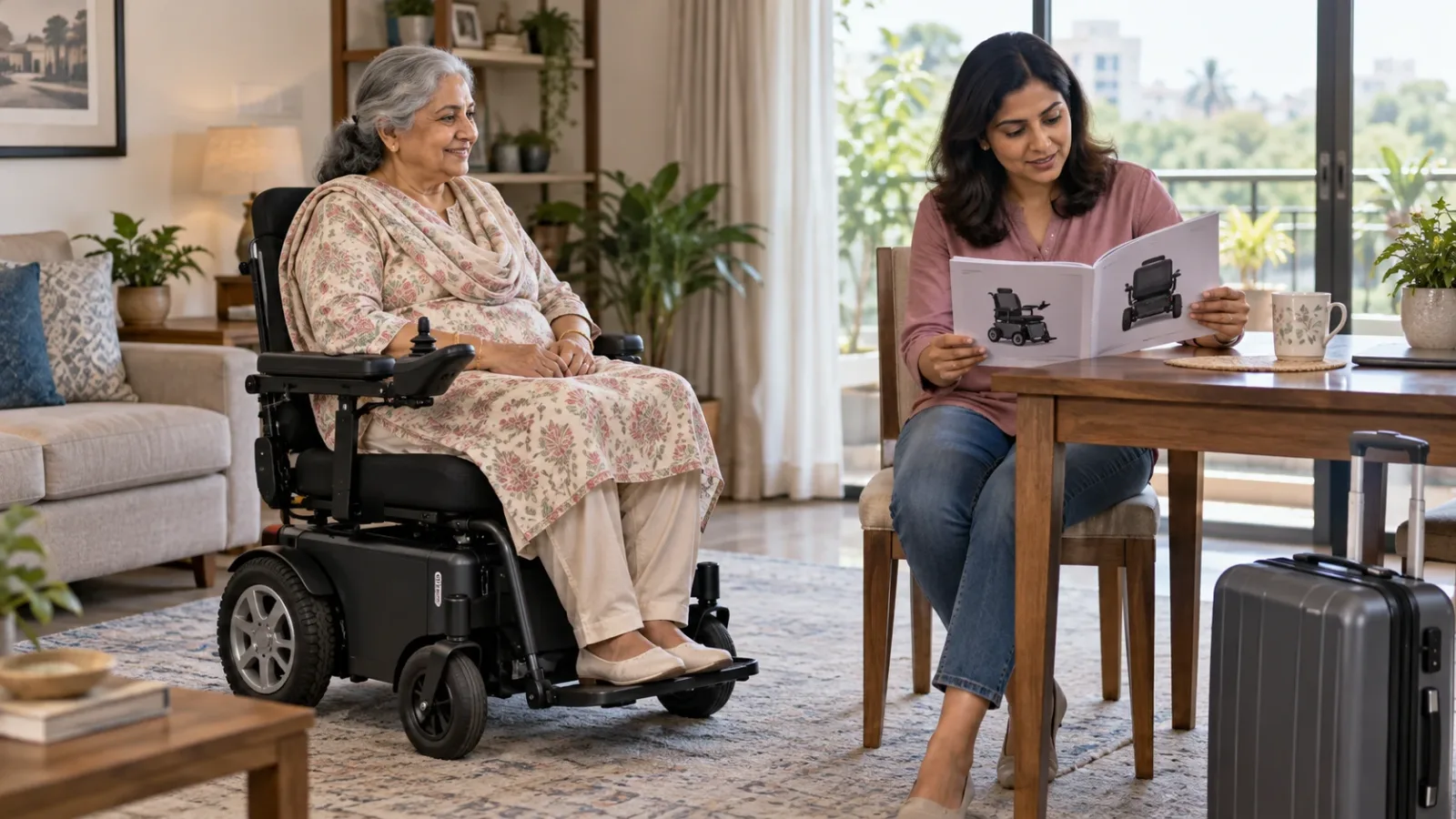
Before flying with a personal electric wheelchair, ask each operating airline how to obtain approval for the actual chair and battery arrangement. Send the manufacturer information, not just “one wheelchair” in a booking note. Booking airport assistance and arranging carriage of your own powered equipment are separate tasks.
Start a device file, not a guessed battery answer
IATA's Battery-Powered Wheelchair and Mobility Aid Guidance Document is revised for the 2026 regulations and carries the date 1 January 2026. Its operator-approval section says airline approval is required and recommends seeking it in advance. Appendix A asks for the maker and model, battery type, total weight, travel-ready dimensions, removable parts and handling instructions.
Use the actual chair's manual, battery label and manufacturer or supplier response. Include the model and the precise battery arrangement installed on this chair, including any replacement batteries. If a label is unclear, ask the maker to identify it. Do not decide battery chemistry or transport suitability from the chair's appearance.
Give the airline a clear battery inventory
- Identify the battery type and how many batteries are installed.
- Provide the maker's rating information for each battery, including Watt-hours for lithium-ion batteries where available.
- State whether a battery remains installed, is designed to be removed for transport, or is a spare.
- Ask the manufacturer for the relevant documentation and instructions; the 2026 IATA checklist specifically asks about UN38.3 compliance for lithium-ion batteries.
IATA's February2023 transport guidance also identifies battery type, lithium-ion Watt-hour rating and removability among the advance information to communicate. Do not apply a loose-battery or power-bank rule to the entire chair without checking the applicable mobility-aid arrangement with the airline. This article does not give a universal battery cap or tell you which battery belongs in which bag.
The chair must fit the actual handling plan
Give the total weight with installed batteries and accessories, plus length, width and height in the configuration presented for travel. Say whether those figures are for an upright chair, a folded chair or a maker-approved configuration with specified parts removed. Avoid sending the compact catalogue dimensions if they do not describe what staff will receive.
The 2026 IATA guidance explains why this matters: the aircraft door and cargo compartment must accommodate the device, including on connections. Ask for the chair and configuration to be checked against every operating flight. An approval for one aircraft or airline is not something to silently extend to another after a schedule change.
Send instructions, not DIY wiring advice
Provide the manufacturer's instructions for preventing accidental activation, isolating electrical circuits, any required battery removal, and engaging or disengaging freewheel mode. Ask who will perform each handling step and what staff need from you at handover. Do not cut wires, bypass a battery-management system or improvise removal based on an internet video.
If you or a helper cannot explain the chair's controls, ask the maker and airline to work through the uncertainty before departure. IATA's Appendix A specifically calls for cooperation with the passenger, representative or manufacturer when the user cannot answer the handling questions. Keep the chair usable for the traveller until the agreed handover; this article is not an instruction to disconnect it at home.
Confirm the outcome, not just receipt of the form
Ask whether the airline has approved the actual device, which flights that answer covers, any outstanding information and the agreed handover and return arrangements. Keep the approval and submitted details accessible to the traveller and helper. A form upload, assistance code or generic “wheelchair requested” message does not itself answer those questions.
If airline pages or replies disagree, show the relevant passages to its specialist team and request a written answer for your equipment and itinerary. Do not pick the most generous rule. Carrier requirements and actual acceptance must be settled with the operator; a general industry guide is not a boarding or carriage guarantee.
TripKeeper's equipment handover check
Our suggested family file keeps the device identity, battery inventory, maker instructions, travel-ready dimensions and airline response together. A parent should not arrive with only a relative's memory of a phone call. After a flight or aircraft change, ask whether the equipment plan needs checking again, and keep a named helper responsible for that follow-through.
This is a powered-equipment information checklist. It is not the same as requesting airport wheelchair assistance, and it does not cover medical clearance, personal care, charges or compensation.
What if the aid is a foldable mobility scooter?
Identify it as the actual powered mobility aid you use and send the scooter’s model, manufacturer manual, battery arrangement, weight and travel-ready dimensions to the operating airline. Folding it does not by itself establish battery safety, aircraft fit, an ordinary-baggage classification or free carriage. Ask the airline to confirm which mobility-equipment process applies, whether it has approved this device on each flight, any charge and the handover and return points. IATA’s guidance dated 1 January 2026 addresses battery-powered wheelchairs and mobility aids; it is not a ticket-specific acceptance or fee waiver. Current scooter acceptance, baggage treatment and charges for your booking are unconfirmed until the airline answers. Do not substitute an airport wheelchair-assistance request for the device approval.
Dated primary sources
Checked 4 November 2026: IATA Battery-Powered Wheelchair and Mobility Aid Guidance, revised for2026, dated1January2026, especially Operator Approval and Appendix A; and IATA Guidance on the Transport of Mobility Aids, February2023. Use these to prepare questions and information, then obtain the actual airline's current response.

A Miranda House graduate and lawyer who traded courtrooms for slow travel. Cheshta travels with the batches we host ourselves, with a soft spot for travelling alongside elders.
Planning your next trip?
We'll handle insurance, hotels, airport assistance and the itinerary — the same way we do it for every trip.
Questions on this article
asked by readers, answered by us
Was this helpful?
one tap, no sign-up