




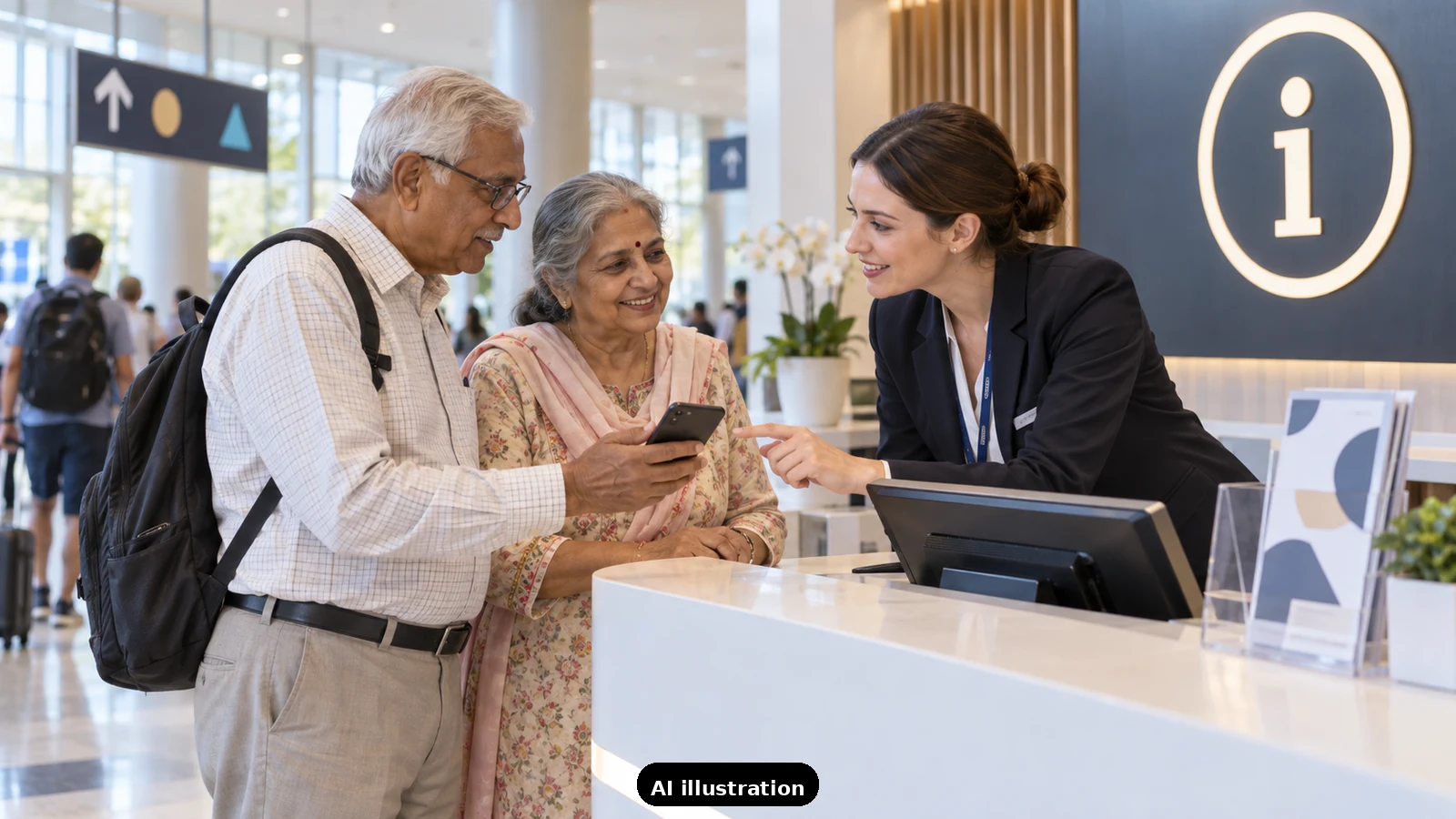
Short answer: you do not need to be there, and your parents do not need English. In an overseas emergency, language help comes from four places, roughly in this order - the travel insurer's assistance company, the nearest Indian embassy or consulate, the MEA's MADAD helpline system, and translation tools you set up on their phones before departure. The children in India coordinate all four; the parents' only job is to hand the phone to the nearest helpful person.
First call: the insurer's assistance line. Every travel policy comes with a 24x7 assistance company whose number is printed on the policy certificate and the assistance card. These companies exist precisely for this situation: many offer multilingual support, can conference in interpreters, and can speak directly to the hospital, clinic or police on the traveller's behalf. In a medical emergency this is the call that matters most, because the assistance company also guarantees payment and coordinates treatment. Call them from India yourself, explain that your parents are Indian seniors who do not speak the local language or fluent English, and ask them to contact your parents through the hotel or the hospital with language support arranged.
Second call: the Indian embassy or consulate. Consular assistance is a right, not a favour: Indian missions abroad assist Indian nationals in distress, and the Ministry of External Affairs asks travellers to treat consular staff as a resource in exactly these situations. In a serious emergency the embassy can help your parents understand what local authorities or hospitals are telling them, point the family to local resources, and step in formally where needed. The MEA publishes emergency numbers for every mission on its website - save the one for your parents' destination before they fly, and note that for longer stays, registering with the local embassy improves access to consular help.
The MEA's MADAD system answers in Indian languages. If your parents or you need the Ministry itself: the MADAD consular services system runs a call centre on 1800-11-3090 (toll-free within India) and +91-11-26885021 from abroad, with helpline@mea.gov.in for written complaints - and its regional language call centres and the Pravasi Bharatiya Sahayata Kendra handle calls in Hindi, English, Tamil, Telugu, Malayalam, Kannada, Marathi, Gujarati, Bengali and Oriya. A parent who cannot explain an emergency in English can explain it in their own language to their own government, which can then coordinate with the mission.
Set up the phone before the flight, not during the crisis. A translation app with the destination language downloaded for offline use turns your parents' phone into an interpreter that works without data or signal: type or speak a sentence, show the screen, let the other person reply. Conversation mode handles two-way exchanges at a pharmacy or police desk, and camera translation reads forms, prescriptions and signboards. Do the setup at home, together: download the offline packs, practise three real sentences (I need a doctor, I am allergic to this medicine, please call my son on this number), and put the app on the home screen.
The paper layer that never runs out of battery. Apps fail; laminated cards do not. Prepare a one-page card in the destination language carrying the essentials: your parents' names, hotel address, medical conditions, allergies, current medications with generic names, the insurer's assistance number, and your number in India with the country code. Hospitals in many countries can also arrange professional interpreters for medical conversations - your parents or the assistance company can simply ask - and hotel concierges and local Indian community associations (gurdwaras, temples, cultural groups) have quietly rescued Indian travellers from language jams for decades.
The family's division of labour. Keep it simple and agreed in advance: in an emergency, your parents call the insurer's assistance line or hand their laminated card to the nearest official; you in India call the assistance company and, if needed, the embassy; everyone messages on the family group so no one works at cross purposes. One coordinator, one channel, no panic.
How we build this in at TripKeeper. For parents travelling without their children, we prepare the destination-language emergency card, save the embassy and assistance numbers in their phones, and set up offline translation before departure, so a language barrier never becomes an emergency of its own. Send us a trip-planning inquiry if that is the kind of backup you want behind your parents.

A Miranda House graduate and lawyer who traded courtrooms for slow travel. Cheshta travels with the batches we host ourselves, with a soft spot for travelling alongside elders.
Planning your next trip?
We'll handle insurance, hotels, airport assistance and the itinerary — the same way we do it for every trip.
Questions on this article
asked by readers, answered by us
Was this helpful?
one tap, no sign-up