



- Where
- Carry-on bag
- Containers
- Original labelled
- Papers
- Rx copies + doctor note
- Quantity
- Trip + buffer days
- Check first
- Destination embassy
The short answer
Prescription medicines travel in your carry-on, in their original labelled containers, with copies of the prescriptions and a little extra for delays. How much you may carry depends on the exact medicine and on your destination and transit countries' rules - many countries allow roughly a 30-day personal supply with a prescription or medical certificate, so check your destination's embassy rules before you fly, especially if anyone in the family uses a controlled or injectable medicine.
Checks to do before you pack
Every country has its own medicine laws, and a medicine that is common in India can be unlicensed or treated as a controlled substance elsewhere. The CDC advises travellers to check with the destination's embassy - and the embassies of any layover countries - that their medicines are permitted. Consequences at the border can include confiscation and, in serious cases, penalties. For medicines containing narcotics or psychotropics, the International Narcotics Control Board keeps a country-by-country regulations index for travellers. If a medicine is not allowed at your destination, ask your doctor about alternatives and a letter describing the condition and treatment plan.
Time the prep: a doctor or travel-health visit 4-6 weeks before departure covers vaccines and destination-specific advice in one go. If anyone's dosing schedule matters across time zones, ask the doctor how to handle it - the CDC notes medicines are taken by time since the last dose, not the local clock.
How to pack them
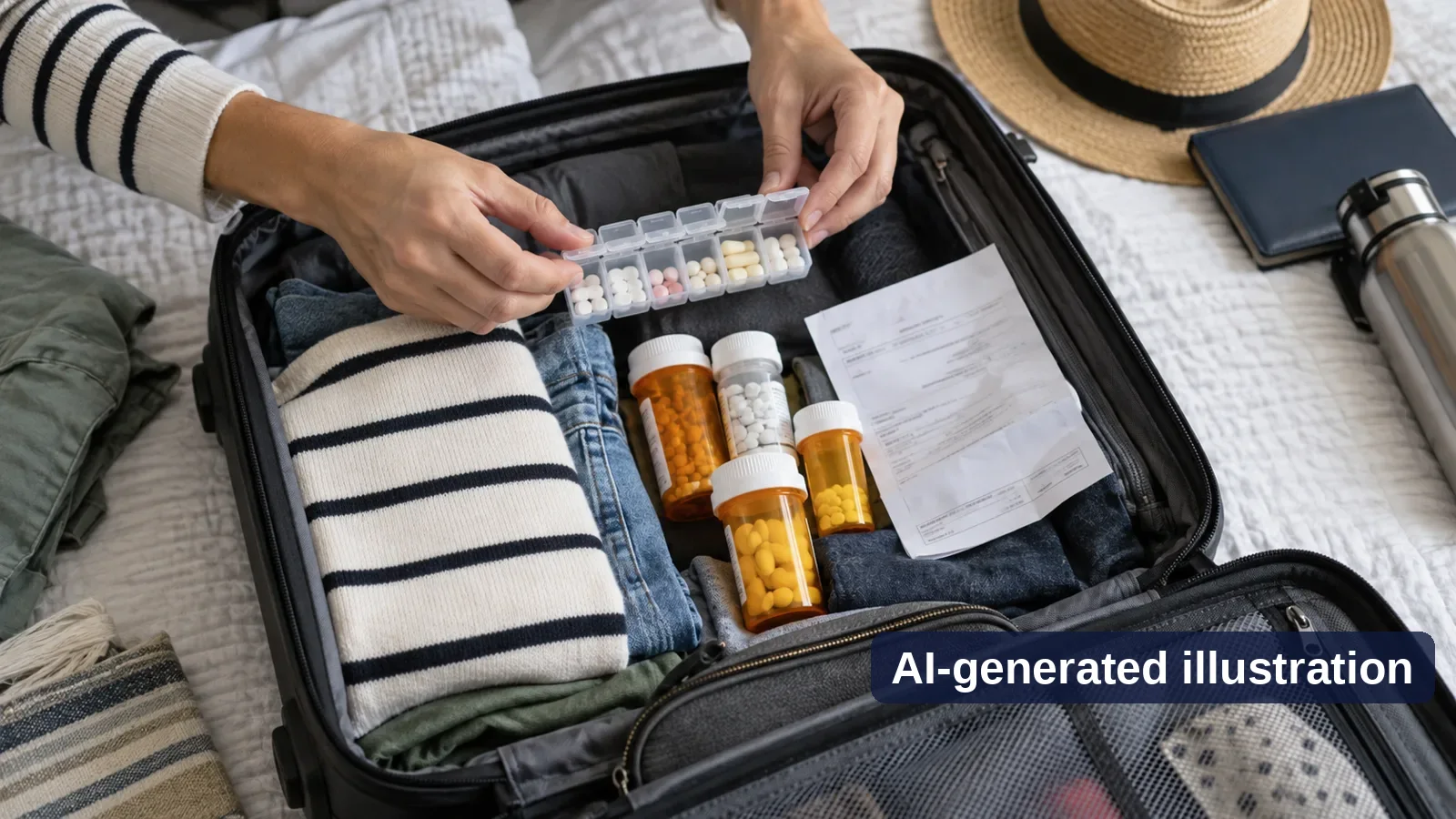
Pack all medicines in a carry-on, not checked luggage - bags get lost or delayed, medicines cannot wait. Keep every medicine in its original, labelled container showing the traveller's full name, the prescriber's name, and the generic and brand names with the exact dosage. Bring copies of all written prescriptions (with generic names) and leave one copy at home with someone you trust. For controlled substances and injectables - the CDC's examples are insulin and EpiPens - ask the prescribing doctor for a note. Take enough for the whole trip plus extra days for delays, and check whether anything needs refrigeration: extreme temperatures can reduce the effectiveness of many medicines.
Packing for a family
Keep each person's medicines in their own name-labelled containers - a shared pill box with mixed tablets is exactly what border checks and emergencies make difficult. Children's medicines follow the same rules: original packaging, prescription copy, the child's name on the label. Add a small health kit of basics you might not easily find at the destination. One practical habit: keep the prescriptions and the doctor's letter together in one pouch at the top of the carry-on, so nothing needs digging out at security or immigration.
Buying medicines abroad
Plan not to. Counterfeit drugs are common in some countries, so the CDC advises using the medicines you brought from home and packing enough for the whole trip plus delays. If an emergency forces a purchase abroad, check official guidance on spotting counterfeits first.
Common questions
Cabin or checked bag for medicines?
Carry-on. The CDC's reason is simple: checked luggage can be lost or delayed, and your medicines cannot.
How much medicine can we carry?
It varies by country and by the exact medicine. Many countries allow about a 30-day personal supply of certain medicines if you carry a prescription or medical certificate, but how much you may actually carry depends on the medicine and on your destination and transit countries' rules - verify with the embassy before you pack. For trips longer than 30 days, ask the prescriber how to arrange enough supply.
A medicine that is ordinary in India - can it be a problem abroad?
Yes. The CDC warns that medicines commonly prescribed or sold over the counter in one country can be unlicensed or controlled in another, with consequences from confiscation to penalties. Check the embassy and, for controlled substances, the INCB country index.
Can we move pills into a weekly organiser?
The CDC recommends keeping medicines in their original, labelled containers with names and dosage visible - so don't rely on an unlabelled organiser alone for the trip.
Sources checked on 25 October 2026: CDC - Traveling Abroad with Medicine (official US travel-health guidance, page last reviewed 18 August 2022; embassy and layover checks, ~30-day supply norms, original labelled containers, prescription copies, carry-on packing, extra supply for delays, doctor's note for controlled/injectable medicines, refrigeration caution, counterfeit-drugs warning), INCB - Travellers: country regulations (official index of per-country rules for carrying medicines containing narcotics/psychotropics). Dosing and regimen questions belong with your doctor, not this article.

A Miranda House graduate and lawyer who traded courtrooms for slow travel. Cheshta travels with the batches we host ourselves, with a soft spot for travelling alongside elders.
Planning your next trip?
We'll handle insurance, hotels, airport assistance and the itinerary — the same way we do it for every trip.