




- Subject
- Great Banyan morphology
- Account
- Botanical Survey of India
- Root origin
- Branches above ground
- Role described
- Upright prop support
- Reviewed
- 17 November 2026
Reviewed: 17 November 2026. Botanical-form explanation, not a health, safety or access assessment.
AI-generated fictional Great Banyan-inspired scene, not an exact root layout, present tree condition, current visitor route or access record.
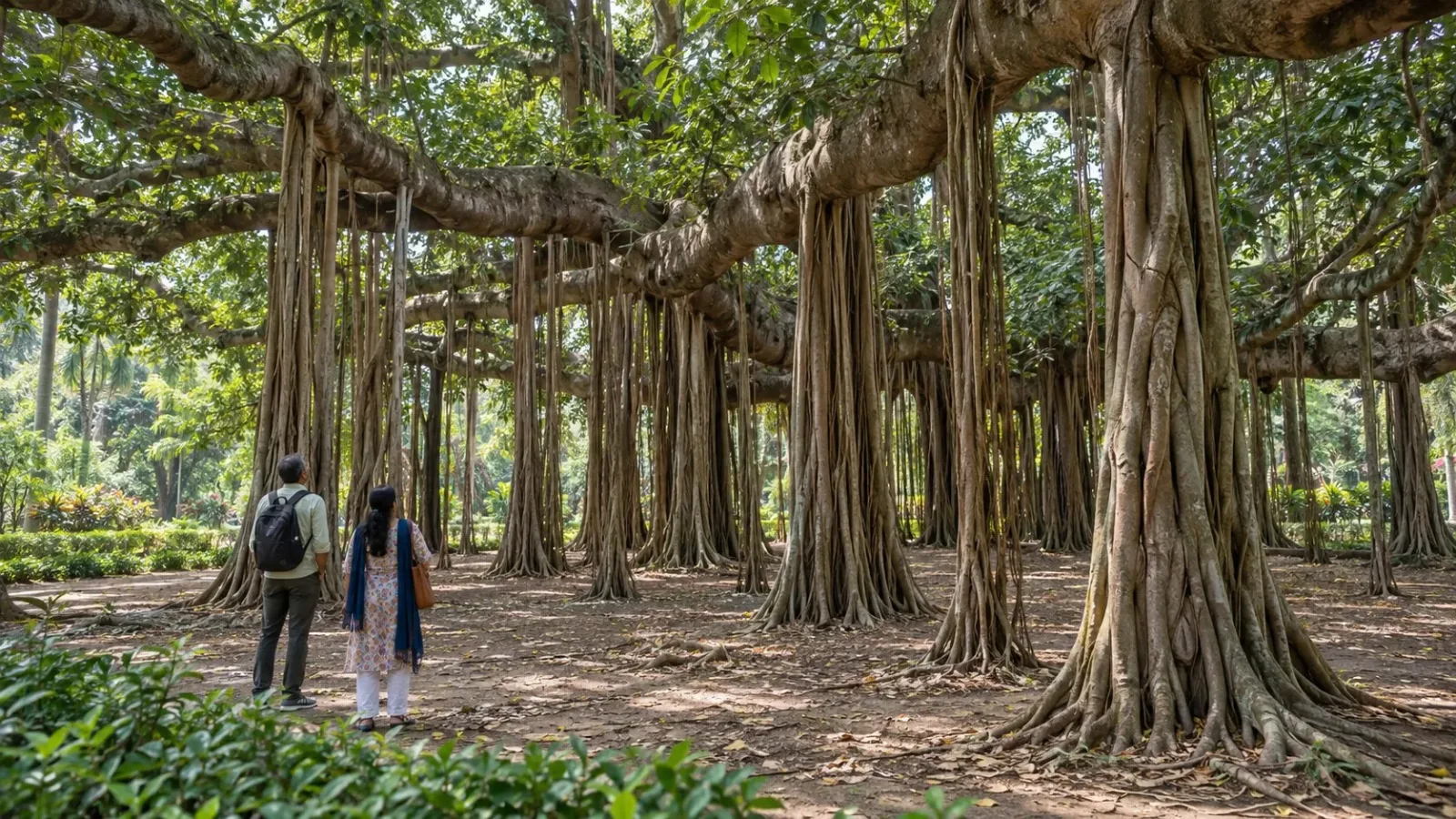
Howrah's Great Banyan can look like a small forest, but the Botanical Survey of India's garden account describes an individual tree whose aerial roots descend from its branches. On reaching the ground, these roots form upright supports beneath the spreading branches. The useful subject is that relationship between canopy, branches and prop roots.
Begin with the branches above
The BSI account describes branches growing horizontally and being supported by pillar-like prop roots. Consider the spreading branches and the supports beneath them together, rather than treat each upright form as an unrelated trunk.
This is a description of the tree's form. It does not map every branch or identify the connection of every upright feature in a photograph. The documented relationship matters more than trying to assign a name to each visible part.
Follow the root relationship in the description
Aerial roots begin above the ground. At the Great Banyan, BSI describes roots dropping from branches and running vertically to the ground, where they become prop roots. Their position and connection explain why the upright supports belong to the tree's branching structure.
The word prop describes their supporting role in this account. It is not an engineering assessment of an individual root or a promise that any particular branch is secure. No handling, loading or testing of the roots is proposed.
Distinguish appearance from a tree count
BSI explicitly compares the tree's appearance to a miniature forest because its descending roots look like many trunks. Keep the comparison and the identity separate: a forest-like impression does not make every trunk-like support a separately identified tree.
This account offers no numerical root inventory, boundary map or method for counting individual plants. It also does not diagnose a tree from a distant image. Its explanation comes from the garden's description, not a resemblance alone.
Keep the explanation qualitative
The canopy-and-root relationship can be understood without a size ranking, age estimate or claim of immortality. This article makes none. It also provides no present health assessment, account of maintenance or tutorial for shaping living roots.
A botanical description is not a current viewing arrangement. No route, access, visibility, facility or service is established here. The purpose is narrower: understand why roots descending from spreading branches can create the appearance of many trunks beneath one banyan canopy.
Frequently asked questions
What are the upright supports described here?
Aerial roots that descend from branches and reach the ground as prop roots.
Why can the tree resemble a small forest?
BSI says the descending roots look like many trunks.
Does this identify every upright form in a photograph?
No. It supplies no photographic inventory or branch map.
Does the explanation establish present health or visitor access?
No. Neither is assessed here.
Does this supply an age or size ranking?
No. No age estimate, size ranking or claim of immortality is supplied.
Does this propose handling or testing roots?
No. No handling, loading, root testing or living-root shaping is proposed.
Official sources and limits
The garden account supports the relationship between spreading branches, descending aerial roots and prop supports. No root tally, boundary map, age, size rank, health, safety, maintenance, shaping method or current viewing arrangement is established.

A Miranda House graduate and lawyer who traded courtrooms for slow travel. Cheshta travels with the batches we host ourselves, with a soft spot for travelling alongside elders.
Planning your next trip?
We'll handle insurance, hotels, airport assistance and the itinerary — the same way we do it for every trip.
Questions on this article
asked by readers, answered by us
Was this helpful?
one tap, no sign-up