



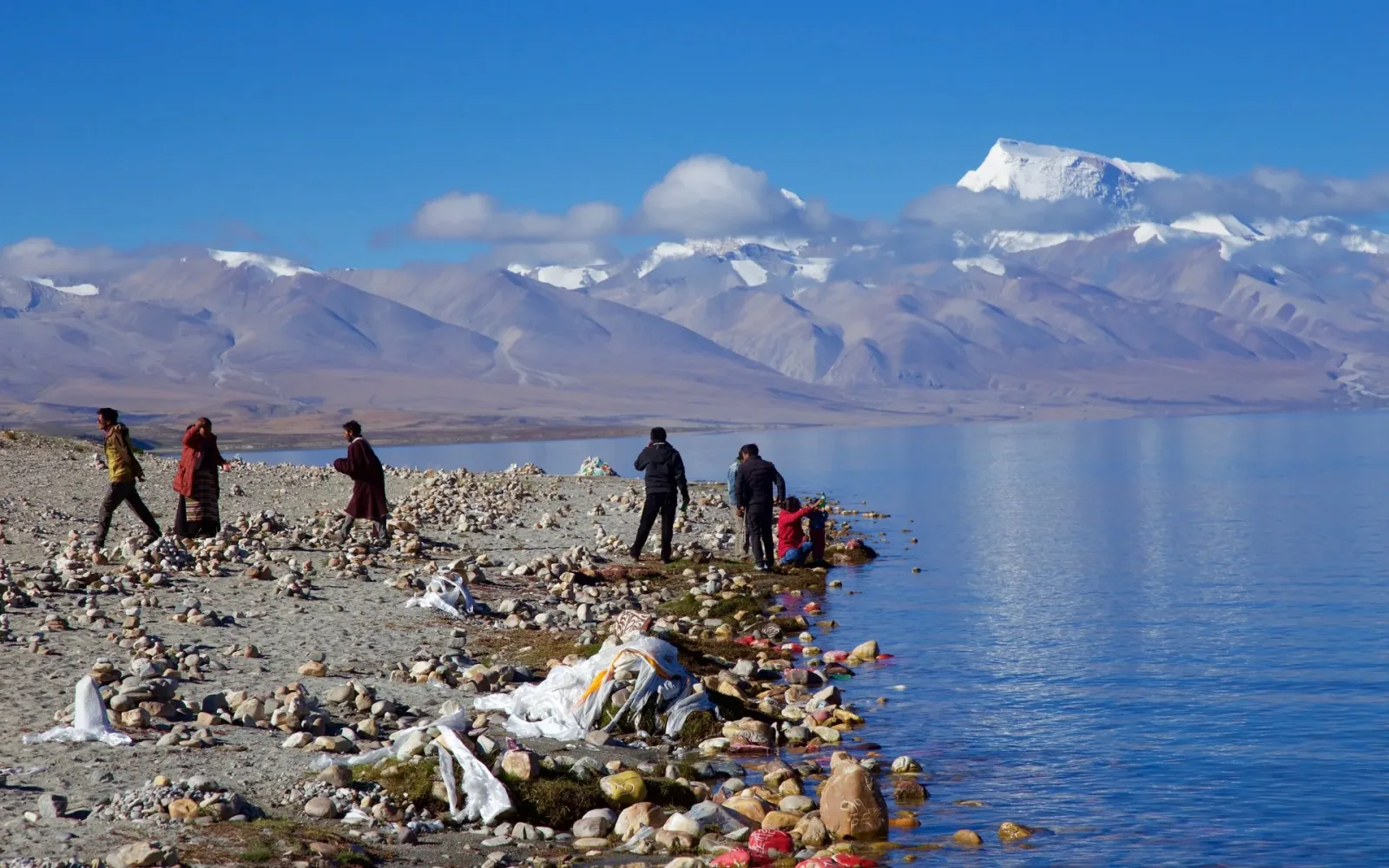

Pilgrims on the shore of Lake Manasarovar, Tibet. Photo: Jmhullot, CC BY-SA 4.0, via Wikimedia Commons.

What the MEA yatra is, and what this article covers
The Ministry of External Affairs organises the Kailash Manasarovar Yatra each year between June and August or September, over two routes: the Lipulekh Pass route through Uttarakhand and the Nathu La Pass route through Sikkim. The portal says it is open to eligible Indian citizens holding valid Indian passports who wish to go for religious purposes, and that the Ministry gives no subsidy or financial assistance. The 2026 cycle was announced on 30 April 2026 and applications closed on 19 May 2026. This article describes that cycle as the portal and the Ministry's release showed it. It does not tell you applications are open now, and it does not promise that the next cycle will use the same costs, dates or conditions: the next cycle is unannounced and its terms are unverified until the MEA publishes them. It also does not cover private Nepal-route tours, which are not the MEA yatra.
The 2026 routes, batches and estimated costs
The Ministry's 30 April 2026 release scheduled ten batches of 50 yatris through Uttarakhand over Lipulekh Pass and ten batches of 50 through Sikkim over Nathu La Pass, with the yatra running June to August 2026, in coordination with the Government of China. The portal's homepage listed Lipulekh as about 22 days with an estimated cost of Rs 2.09 lakh per person, and Nathu La as about 21 days at Rs 3.31 lakh per person. The FAQ adds that the whole yatra takes about 23-25 days depending on the route, because it includes four days in New Delhi for formalities; the advisory says three or four days. Trekking differs sharply: about 200 km on the Lipulekh route against about 35 km on Nathu La, which is motorable. Applicants could rank both routes or choose one, and could pick where to end the return leg: Dharchula or Delhi on Lipulekh, Gangtok or Delhi on Nathu La.
Who could apply in 2026
The eligibility page set these conditions: Indian citizen; an Indian passport valid for at least six months as on 1 September of the cycle year; age 18 to 70 as on 1 January of the cycle year; BMI of 25 or less; and physically fit and medically healthy for the yatra. The page words the two reference dates as "the current year"; for this cycle, with a 19 May 2026 deadline, that meant 1 September 2026 and 1 January 2026, and the next cycle's dates are unannounced. Foreign nationals were not eligible, and the page says OCI card holders are therefore not eligible. It names medical conditions an applicant should not have: high blood pressure, diabetes, asthma, heart disease and epilepsy, among others. People under a legal or executive sanction that bars foreign travel could not apply, and incomplete applications were liable to rejection and left out of the draw. One point softens the BMI line: the official FAQ says doctors "may not be rigid" about BMI and allows them flexibility for a person who is otherwise found fit after comprehensive medical examinations, while still advising applicants to bring it down to 25 or less; the final medical decision rests with the examining doctors.
Applying, the draw and who gets priority
Applications were online only on kmy.gov.in; the release says no letters or faxes were needed. Applicants kept ready a passport-size photo in JPG under 300 KB and the passport photo page plus the last page with family details as a PDF under 500 KB. One user account could submit at most two registrations for two people going together, and both applications had to be completed together before the last date. Applicants also downloaded forms for an undertaking about helicopter evacuation, an indemnity bond and a consent form for cremation on the Chinese side. Selection was a computer-generated, random, gender-balanced draw. Two rules shaped it: applicants going for the first time got priority over those who had been on the MEA yatra in an earlier year, and there was a moratorium on anyone who had already been more than four times, with the Ministry's decision final. Incorrect or false information, or concealed facts, was grounds for disqualification at any stage including during the yatra, and earlier payments are forfeited.
Money: what the portal says about payments and refunds
The Ministry does not charge or receive any payment from yatris; payments for Indian-side services go directly to KMVN (Lipulekh) or STDC (Nathu La). The fee page for the Nathu La route listed a Rs 5,000 confirmation amount plus balance amounts and other items, including DHLI medical tests of Rs 5,500, a stress echo test of Rs 2,500 only if advised, a Chinese visa fee of Rs 1,800 in cash, Rs 4,000 pool money, and Tibet costs in US dollars and RMB that are subject to revision. The confirmation amount is the number to know: the FAQ says it is non-refundable if the yatri is confirmed in any batch, and refundable only if a wait-listed yatri is never confirmed, with such refunds handled after all batches finish through KMVN or STDC. Amounts paid after confirmation, or during the yatra, are non-refundable even if the services go unused. Medical test spending is non-refundable whether or not you go, and ITBP tests are free. A yatri disqualified at any stage on medical or other grounds forfeits the confirmation amount and earlier payments. The fee page text I could read covers the Nathu La route; check the portal's fee page for the other route's table before budgeting.
The medical gates are real
Selected applicants must undergo and qualify medical examinations at the Delhi Heart and Lung Institute and the ITBP Base Hospital in New Delhi, because the yatra trekks up to 19,500 feet. The FAQ is blunt that these tests only determine fitness and do not guarantee protection from altitude illness, that reports from other hospitals are not accepted, and that a person once declared medically unfit is advised not to take part that year and is not considered for a later batch. There is a second check at Gunji (3,220 metres) on the Lipulekh route and at Sherathang (4,115 metres) on the Nathu La route, and only those found fit go further. For a major illness on the way, evacuation by helicopter is at the yatri's own cost and depends on weather. The advisory also states the itinerary is tentative, that the Government of India is not responsible for loss of life, injury or property loss, and that every yatri signs a consent form for cremation on the Chinese side in case of death.
Where the cycle stands, and how to prepare for the next one
The 2026 application window closed on 19 May 2026, and the portal shows registration for 2026 as closed. The next cycle is unannounced. Nothing here is an instruction to apply now. If you want to be ready, the preparation is documentary and physical: keep an ordinary Indian passport with comfortable validity, keep the scans described above ready, get your own health check early (the advisory says a self-check is useful but is not valid for the DHLI and ITBP tests), and watch mea.gov.in and kmy.gov.in for the launch notice. Treat 2026's routes, durations, estimated costs, reference dates and fee lines as last cycle's terms, not as a promise for the next.
Last verified: 25 November 2026 against the KMY portal homepage, the portal's eligibility, how-to-apply, FAQ, fee structure and advisory pages, and the MEA release of 30 April 2026.
Questions people ask at the gate
Are Kailash Manasarovar Yatra applications open now?
No. The 2026 window opened with the MEA's release of 30 April 2026 and closed on 19 May 2026; the portal shows registration for 2026 as closed. The next cycle is unannounced and its terms are unverified until the MEA publishes them on mea.gov.in and kmy.gov.in.
Who could apply in the 2026 cycle?
Indian citizens with an Indian passport valid at least six months as on 1 September 2026, aged 18 to 70 as on 1 January 2026 (the portal says 'of the current year'), BMI of 25 or less and medically fit. OCI holders and foreign nationals were not eligible. The BMI criterion is 25 or less; the official FAQ allows doctors flexibility for a person otherwise medically fit, and the final medical decision rests with the examining doctors.
How were yatris selected?
By a computer-generated, random, gender-balanced draw. First-time applicants had priority over earlier MEA yatris, and anyone who had already been more than four times faced a moratorium. Selected applicants then had to qualify the medical tests in Delhi.
What did the 2026 routes cost?
The portal homepage showed about Rs 2.09 lakh per person estimated for the Lipulekh route (about 22 days) and Rs 3.31 lakh for Nathu La (about 21 days), with no MEA subsidy. The Rs 5,000 confirmation amount is non-refundable once you are confirmed in any batch. These are 2026 figures, not a promise for the next cycle.
What medical tests are required?
Tests at the Delhi Heart and Lung Institute and the ITBP Base Hospital in New Delhi, plus a second check at Gunji on the Lipulekh route or Sherathang on the Nathu La route. Someone declared unfit is not allowed to continue, and DHLI test fees are not refunded whether or not you go.
Do I need a visa or do private tours count?
This article covers the MEA yatra only. The Chinese visa fee appears on the portal's fee page as a cash payment at DHLI for the cycle covered; private Nepal-route tours are a different arrangement that the MEA portal does not govern.
Next walk starts at a new gate.
Was this helpful?
one tap, no sign-up

A Miranda House graduate and lawyer who traded courtrooms for slow travel. Cheshta travels with the batches we host ourselves, with a soft spot for travelling alongside elders.