




- Subject
- Body and border
- Relationship described
- Separately woven, interlocked
- Weaving instructions
- Not supplied
- Durability guarantee
- None
- Reviewed
- 17 November 2026
Reviewed: 17 November 2026. Selective heritage outline, not a ticket or access guarantee.
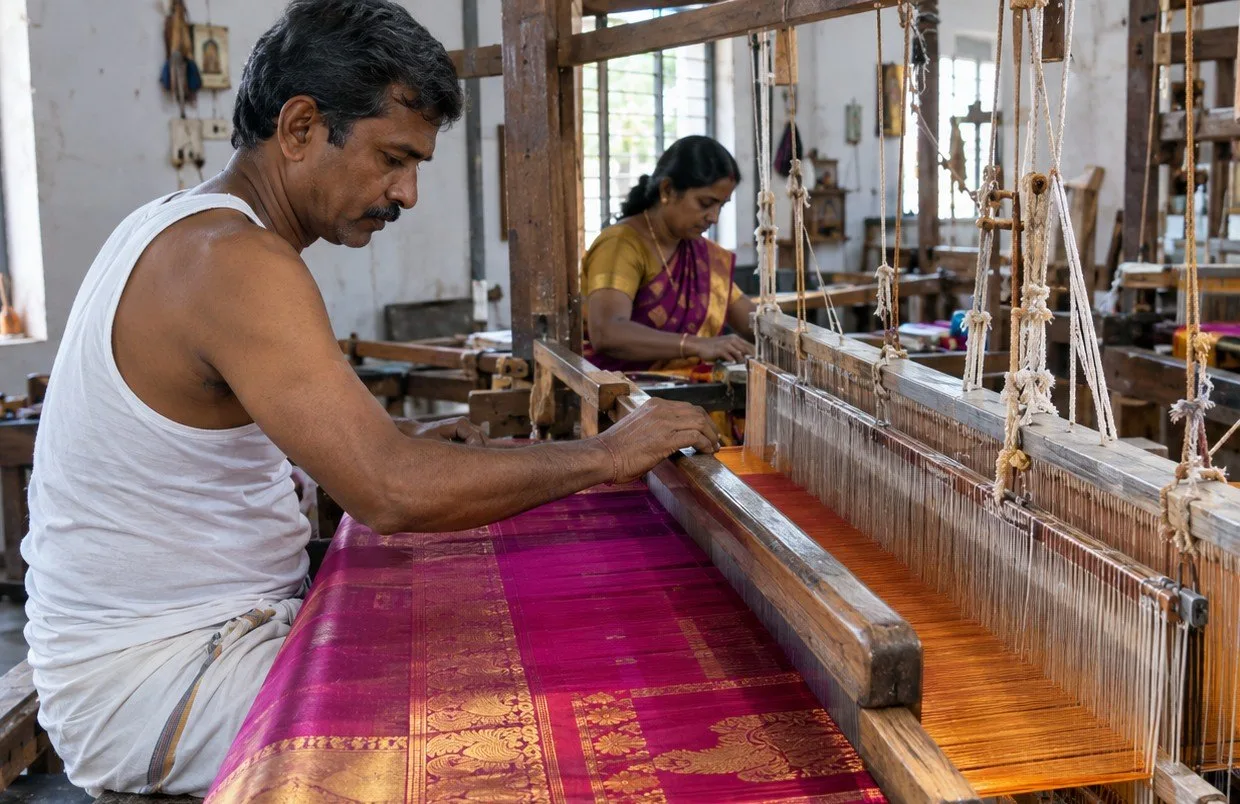
AI-generated fictional weaving scene, not a verified loom setup, interlocking diagram, authentic product, identified artisan or current workshop.
In its account of Kanchipuram silk, the Handloom Export Promotion Council describes the sari's body and border as separately woven and then interlocked. That gives a focused construction question: how are the main field and its edge related in the description? The useful point is the woven join, not simply a contrast of colours.
Separate the body from the border in the description
The council's account identifies a body and a border, then connects them through weaving. Read those as distinct areas in its construction description, rather than treating the border only as a decorative line around the finished cloth.
This article does not classify every kind of sari or explain every section of one. It stays with the body-border relationship described for Kanchipuram. No particular colour combination, motif or finished item is identified.
Understand the interlocking relationship
The council says the body and border are woven separately and then interlocked together. The join therefore belongs to its explanation of how the fabric's areas are connected, not merely how their colours look beside each other.
Keep the account qualitative. It is not a loom lesson or a seam diagram, and it supplies no threading arrangement, shuttle instruction or method for reproducing the join. Nor does this article identify the technique of an object from a photograph.
A general description also does not establish the method used in every item bearing the place name. Understanding the relationship and assessing a particular textile are different tasks.
Keep construction separate from a product judgement
The council's construction account is not used here as an authenticity test. A contrast border, visible line or label does not independently establish an item's maker, materials, origin or method.
No claim is made about the strength of the join or whether a border could detach. The article gives no durability, fibre-purity or performance guarantee. Pulling, stretching, unpicking or otherwise testing a textile is not proposed.
The narrow takeaway is the connection described by the source: separately woven body and border brought together through interlocking. No current workshop, demonstration, class, seller or purchase arrangement is confirmed.
Frequently asked questions
What body-border relationship does the council describe?
Separately woven body and border joined by interlocking.
Is the point only a contrast in colour?
No. The explanation concerns the woven connection between the areas.
Does a visible border authenticate a sari?
No such item-level test is established here.
Does this promise a stronger join or teach how to make one?
No. It supplies neither a performance guarantee nor weaving instructions.
Does this identify an artisan or workshop?
No current artisan, seller, class or workshop is confirmed.
Should a textile be pulled apart to test this relationship?
No. Pulling, stretching or unpicking is not proposed.
Official sources and limits
Official separately-woven body/border and interlocking relationship only. No universal product construction, authenticity, strength, non-detachment, fibre-purity, weaving tutorial or current workshop claim.

A Miranda House graduate and lawyer who traded courtrooms for slow travel. Cheshta travels with the batches we host ourselves, with a soft spot for travelling alongside elders.
Planning your next trip?
We'll handle insurance, hotels, airport assistance and the itinerary — the same way we do it for every trip.
Questions on this article
asked by readers, answered by us
Was this helpful?
one tap, no sign-up