




Reviewed 18 November 2026. A focused fort-and-collection choice using Kangra district and Himachal Tourism descriptions. Check current official visitor information.
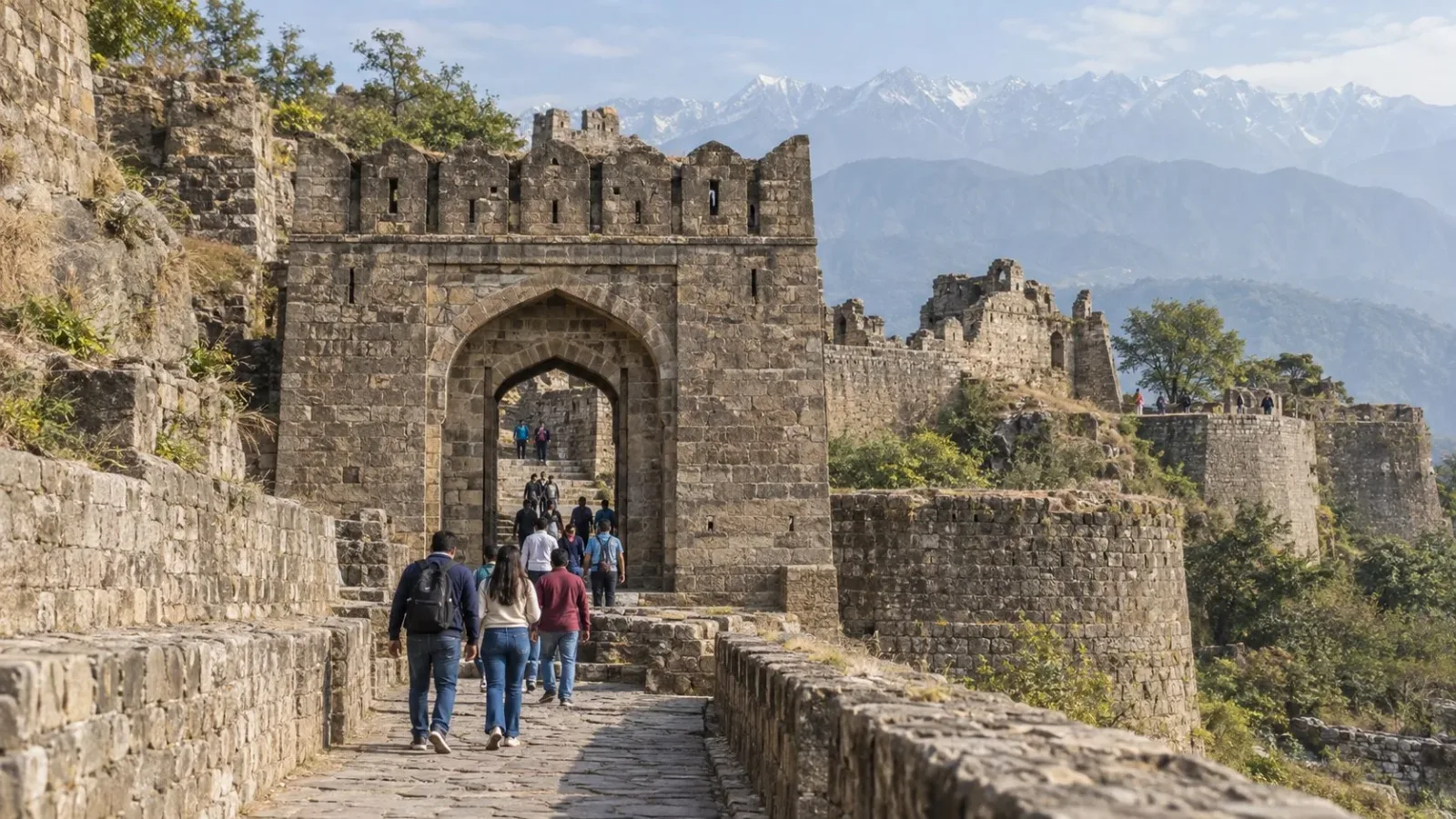
AI illustration: a fictional stone fort scene inspired by Kangra. Not an actual location, person, route inspection or service.
Choose the fort as the main subject
Are the surviving buildings and their setting what interests you, or is a collection the stronger draw? Make that choice before turning a fort visit into several unrelated tasks.
Our suggestion is a focused look at the remains and their historical layers. Check current official visitor information and keep a meal, a break and the return.
Read a layered place, not one complete palace
Kangra district connects the fort with the Katoch dynasty and describes later Mughal, Sikh and British phases. The surviving place is not a single untouched palace from one moment.
Look at an entrance, a wall or a structure as a question: what does the site interpretation actually identify? Do not assign every stone to the ruler whose name you remember first.
Use the hill setting to understand its position
Himachal Tourism describes the fort on high ground, with a river and another stream forming natural protection around it. That relationship between fort and landscape helps explain the importance of its position.
Consider the land around the buildings rather than making one particular photograph the purpose of the outing. This guide does not select a surveyed river map, precise perimeter or promised mountain view.
Let the 1905 earthquake explain historical change
District and state accounts describe extensive damage from the 1905 earthquake. Read the surviving remains with that major change in mind rather than imagining that every missing room can be reconstructed from one glance.
Do not label each damaged surface as earthquake damage without a reliable explanation. A broad account of the event does not identify the cause and date of every visible change.
Name the collection before choosing a museum
Kangra district’s culture page identifies the Maharaja Sansar Chand Museum, adjoining the fort and founded by the former royal family, as a place associated with Kangra paintings.
That gives a named collection to investigate if painting is your stronger interest. It does not make every museum reference the same collection or promise a particular painting on display. Keep a collection choice separate from the fort’s architecture.
Finish without forcing a wider circuit
Choose the building detail or historical question you want to remember. The district and tourism accounts differ on some conquest details; this guide does not select a disputed succession date or an exact ancient foundation year.
Dharamshala, Masroor or another destination can be a separate choice. Check current official visitor information and keep food, rest and the return, rather than adding every name in a regional tourism list.
Sources
Questions people ask at the gate
What is the suggested focus at Kangra Fort?
The surviving structures, hill setting and historical layers.
Which dynasty does the district connect with the fort?
The Katoch dynasty, alongside accounts of later Mughal, Sikh and British phases.
Why mention the 1905 earthquake?
District and state descriptions connect it with extensive damage. It is historical context for the surviving remains.
Does one event explain every damaged surface?
No. A broad historical account does not identify the cause or date of each visible change.
Which painting-related museum does the district name?
The Maharaja Sansar Chand Museum, adjoining the fort and founded by the former royal family.
Must Dharamshala or Masroor be added?
No. Make another destination a separate decision, check current official visitor information and keep food, rest and the return.
Next walk starts at a new gate.
Was this helpful?
one tap, no sign-up

A Miranda House graduate and lawyer who traded courtrooms for slow travel. Cheshta travels with the batches we host ourselves, with a soft spot for travelling alongside elders.