




- Subject
- Rain collection and storage
- Setting
- Monastic cave complex
- Features named
- Cisterns and rainwater harvesting
- Hydraulic route
- Not mapped
- Reviewed
- 17 November 2026
Reviewed: 17 November 2026. Collection-and-storage explanation, not a hydraulic plan or present water report.
AI-generated fictional Kanheri-inspired scene; not an exact cave or cistern layout, identified water structure, historical reconstruction, present water condition or current route/access record.
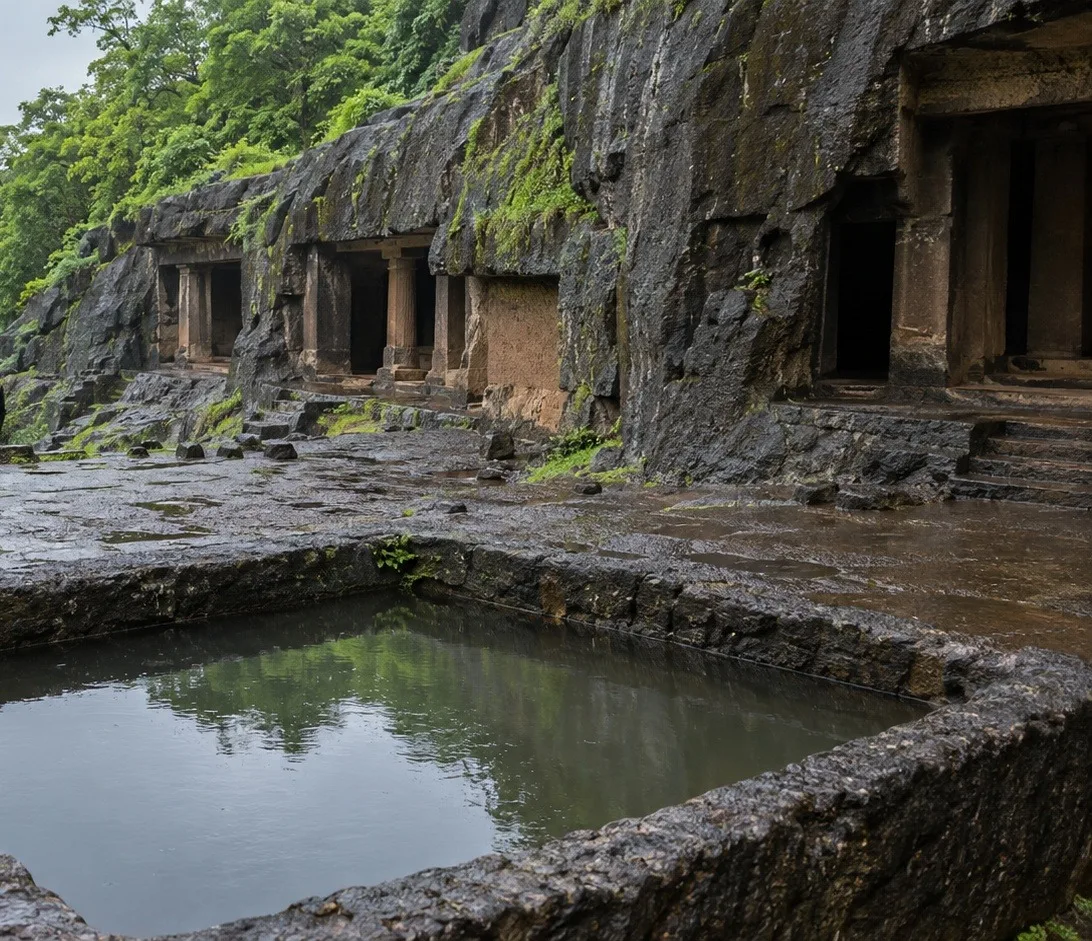
Kanheri's cave setting includes a story about water as well as excavated spaces. The Ministry of Culture's account mentions water cisterns and rainwater harvesting in its discussion of the monastic and pilgrimage centre. Those features give a reason to consider collecting and keeping water alongside the site's other architectural interests.
Keep water in the architectural explanation
The official account places cisterns and rainwater harvesting within its explanation of Kanheri. That makes them part of understanding the setting, rather than an unrelated detail after the sculptures and excavated spaces. Here a cistern means a container for storing water; the account also names the collection of rainwater.
The useful question is how water collection and storage belong in the explanation of a monastic place. This article does not assign a particular daily activity to an individual cave or say that every excavated space had an identical water arrangement.
Distinguish a feature from a complete hydraulic plan
Naming cisterns and rainwater harvesting does not supply a map of how water moved through the site. This account does not trace channels, connect a particular inlet to a particular tank or reconstruct the order in which structures were built.
It also does not identify a basin or opening from a photograph. A feature can be part of a sourced architectural explanation without this article certifying its exact function, material, capacity or relationship to every nearby excavation.
Keep the description qualitative. No engineering-performance claim, construction method or claim of environmental success is needed to understand why collection and storage are worth noticing in the source's account.
Separate the description from present conditions
The Ministry's description is not a report on the water present now. It does not establish current flow, water quality, a working supply or the condition of an individual cistern. This article makes no drinking-water claim.
Nor is a named water structure permission to enter or handle it. No route into a cistern, movement through a channel, demonstration or water activity is proposed. Follow the areas and conservation directions actually permitted, rather than treat an architectural description as a route.
This explanation confirms no present opening, transport, assistance or viewing arrangement. Its limited purpose is to keep rain collection and water storage within the understanding of Kanheri, without turning a descriptive source into an operating plan.
Frequently asked questions
Why discuss water alongside Kanheri's caves?
The Ministry's account includes cisterns and rainwater harvesting in the site's monastic setting.
Does this trace a channel-to-tank system?
No. No hydraulic route or connection between individual structures is established here.
Does it confirm water or a working supply today?
No. A descriptive account is not a current water report.
Is entering a cistern or handling a structure part of the article?
No. No such activity or permission is proposed.
Does this establish drinking-water quality?
No. No drinking-water or current water-quality claim is made.
Does this give a construction or performance assessment?
No. No construction method, capacity, engineering-performance or environmental-success assessment is given.
Official sources and limits
The dated Ministry account supports cisterns and rainwater harvesting in the monastic setting only. Derivative channel details are excluded. No channel-to-tank map, chronology, capacity, performance, current flow, quality, operating supply, facility, route or access entitlement is established.

A Miranda House graduate and lawyer who traded courtrooms for slow travel. Cheshta travels with the batches we host ourselves, with a soft spot for travelling alongside elders.
Planning your next trip?
We'll handle insurance, hotels, airport assistance and the itinerary — the same way we do it for every trip.
Questions on this article
asked by readers, answered by us
Was this helpful?
one tap, no sign-up