




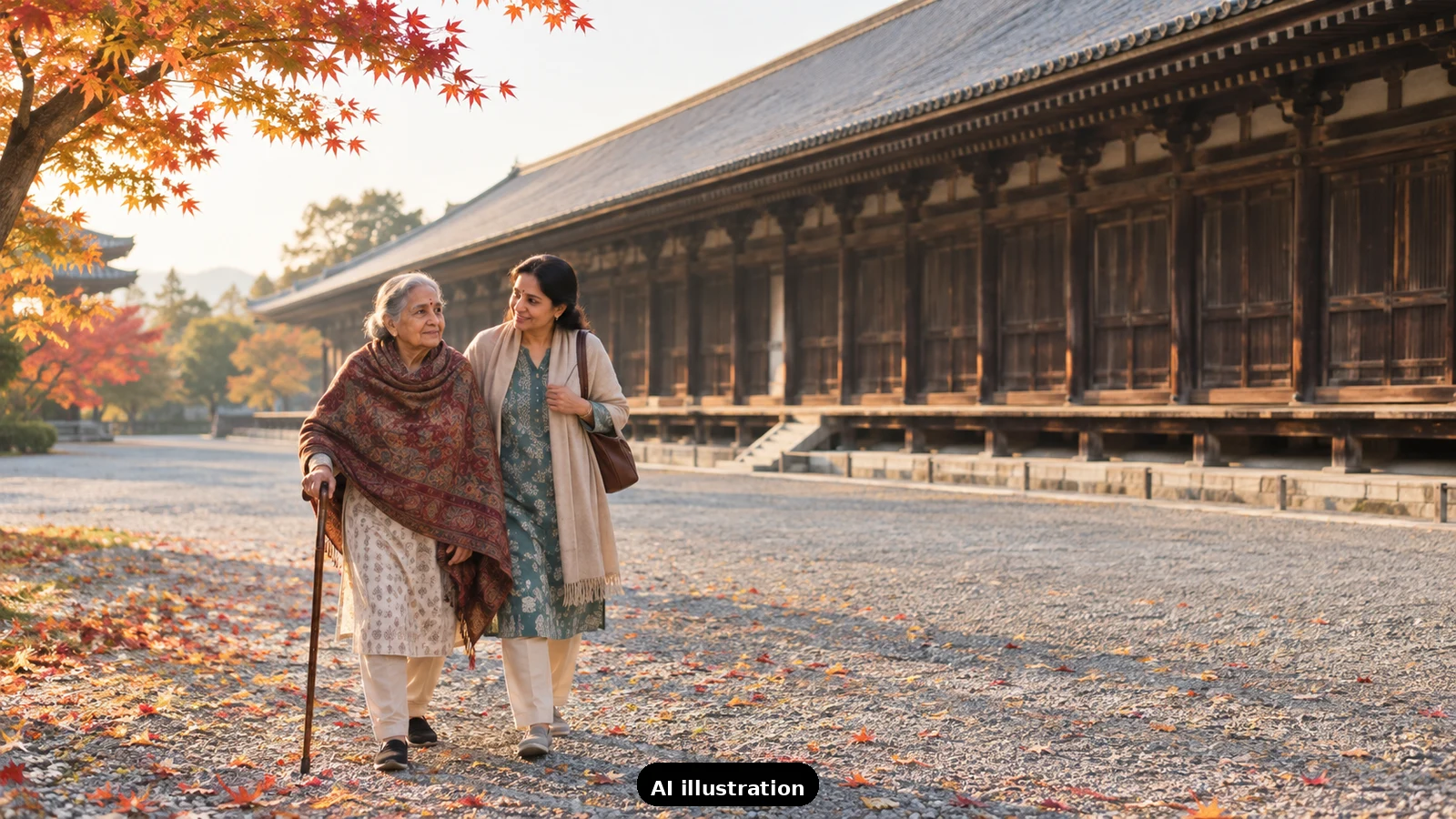
Kyoto has a mixed reputation for mobility, and the honest version is this: the transport is excellent, and the ground is not. Stations are step-free with staff who genuinely help, buses kneel and carry ramps - but the lanes people come to walk are stone, stepped and steep, and many temple halls sit at the top of a wooden flight. The good news is that a genuinely wonderful Kyoto is available at ground level, if you know which sights to pick.
The genuinely easy wins. Sanjusangen-do publishes the fullest provision of any Kyoto sight: ramps on the visiting route, loan wheelchairs at the door, accessible toilets, even accessible parking - and the sight itself, a thousand golden statues in one long hall, is one of the city's best. To-ji's grounds are level gravel around Japan's tallest wooden pagoda. Nijo Castle's outer grounds are flat (though the famous Ninomaru Palace interior is shoes-off with steps and polished floors). The Kyoto Imperial Palace is a level circuit of courtyards with free entry. And Nishiki Market is a flat, covered 390-metre arcade - tight and crowded from midday, so go early.
The mostly-manageable. Kinkaku-ji, the Golden Pavilion, is a level circuit with one short slope near the tea house - most visitors with a cane or a companion-pushed wheelchair manage it. Tenryu-ji's garden in Arashiyama is largely manageable, though the halls have steps. Ginkaku-ji's lower garden works; the famous hill viewpoint is a stepped climb and should be skipped without guilt.
The hard ones, honestly. Kiyomizu-dera is the difficult name on every list: the approach lanes are steep stone, the temple itself is stepped, and there is no easy fix - some families enjoy the view from the lane below and treat the climb as optional. Kodai-ji is steps from the entrance itself. Fushimi Inari's main hall and first torii gates sit on level ground right by the station, so you can absolutely see and photograph the shrine - but the famous mountain path is stairs almost immediately. Kurama and Kibune in the northern mountains are not realistic.
The transport is the good news. Kyoto's subway is step-free at every station, and the standard practice is lovely: tell the staff at the barrier where you are going, and someone will be waiting at your destination platform with a ramp. City buses are low-floor with deployable ramps, though eastern-route buses at peak hours can simply be too full. Kyoto Station is thoroughly step-free with accessible toilets on every level. Wheelchair-accessible taxis exist - ask your hotel to call one rather than hailing. For the smoothest day, a hired car with a driver removes every transfer at once.
Discounts worth carrying the paper for. Many Kyoto venues reduce or waive admission for a disability certificate holder and often one carer - Kiyomizu-dera waives the fee entirely, Sanjusangen-do charges half price, Ginkaku-ji a token hundred yen. Bring the physical certificate, not a photo; staff are used to foreign documents. Where nothing is published, asking at the window usually gets a yes.
Practical notes from the ground. Shoes-off halls mean a raised threshold and a polished floor - carry grip socks. Temple gravel is manageable in a wheelchair with a companion and hard work alone. Accessible hotel rooms are scarce and compact; ask properties for room dimensions and door width in centimetres, which they will provide. Ryokan, with tatami, floor futons and entrance steps, are usually not adapted - a modern hotel near Kyoto Station or downtown is the practical choice.
How TripKeeper plans this. When a family tells us someone in the group has limited mobility, we build the Kyoto days around the flat south-and-centre circuit - Sanjusangen-do, To-ji, Nijo and the Imperial Palace - rather than the stepped eastern hills, arrange vehicles with space and patient drivers, and pick hotels with verified step-free access. Our team handles the hotel checks and on-ground assistance end to end. Send a "Plan your trip" inquiry and tell us what mobility looks like in your family - we will shape the days around it.

A Miranda House graduate and lawyer who traded courtrooms for slow travel. Cheshta travels with the batches we host ourselves, with a soft spot for travelling alongside elders.
Planning your next trip?
We'll handle insurance, hotels, airport assistance and the itinerary — the same way we do it for every trip.
Questions on this article
asked by readers, answered by us
Was this helpful?
one tap, no sign-up