




- LINK
- 2024 staircase report
- TICKET
- confirm product scope
- GATES
- sequence unconfirmed
- ACCESS
- check whole walk
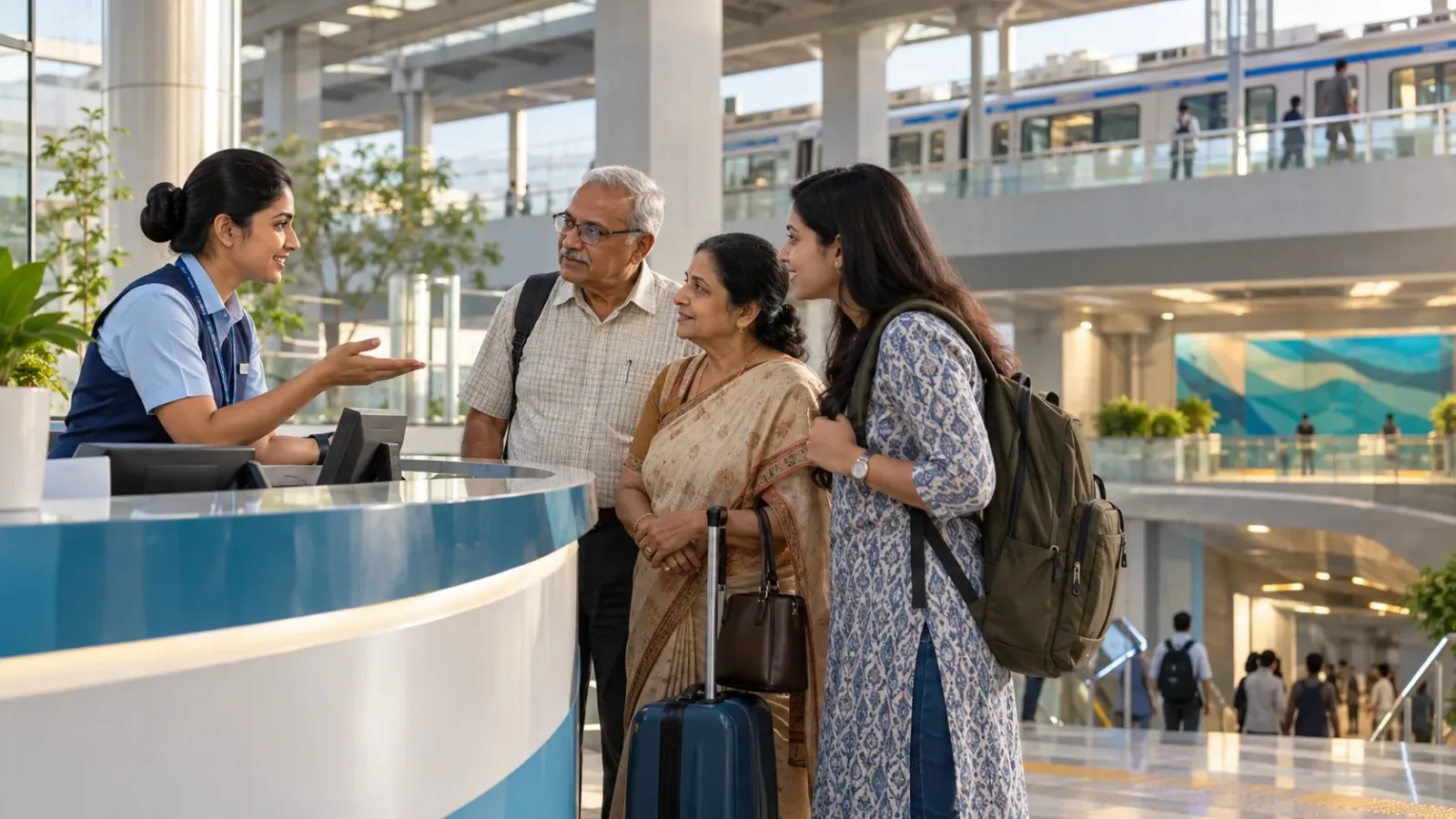
Illustration: a fictional family asks about a line change at a generic metro information desk. This is not the actual Marol Naka layout, a fare-boundary map or a verified walking route.
For a change between Mumbai Metro Line 1 and Aqua Line 3 at Marol Naka, confirm the ticket boundary separately from the physical connection. The sources reviewed here do not establish exactly where today's ticket change happens, whether your specific product covers both parts, or a universal exit-and-re-entry sequence. Do not treat the word "interchange" as proof of one continuous paid area or one through-ticket.
What the dated official release actually says
MMRC's 13 October 2024 multi-modal integration release says a staircase linking the nearest Metro Line 1 exit to the Marol Naka Aqua Line concourse was completed. That is useful dated primary evidence of a historical physical link.
It does not establish a current gate number, the precise fare-gate boundary, free transfer, one-ticket validity or a lift-only route. In particular, a staircase link is not evidence that a parent who cannot use stairs can follow the same connection. No on-ground walking or access test was performed for this article.
Use current station pages without inventing the missing route
The official MMRCL Marol Naka page identifies it as an interchange station and lists station facilities and lifts. The retrieved page is undated. Its general station status and equipment list are not a journey-specific confirmation of a continuous step-free connection from Line 1 to Line 3.
The Line 1 operator's How to Use page places ticketing information and customer care at concourse level. Its FAQ lists different ticket products. MMRCL has a separate Line 3 ticketing page. These retrieved pages are undated and do not settle here the cross-line entitlement of your particular ticket. Separate websites are not, by themselves, proof that exactly two purchases are required.
A line-by-line handover worksheet
This original worksheet records questions, not an official interchange diagram. Fill it for the actual direction of travel. Reverse travel needs its own confirmation rather than a mechanically reversed set of turns.
| Stage | What to confirm |
|---|---|
| First line | Origin, Marol Naka arrival line, intended travel date/time and exact ticket product already held or offered. |
| Ticket coverage | Does that product cover the onward line and final station? If not, which additional ticket is needed and where should it be obtained? |
| Fare boundary | Which ticket must be used at each gate? Where, if anywhere, must you exit a paid area and make a new entry? |
| Physical connection | Current signed route to the other line's concourse, including stairs, lifts, street movement and any temporary closure. |
| Second line | Correct direction and final station; ticket conditions and final total before any new payment. |
| Fallback | What to do if a required lift or connection is unavailable, or the ticket cannot be resolved before travel. |
Suggested question: "We are arriving at Marol Naka on [Line 1/Line 3] and continuing on [other line] to [station]. This is our ticket product. Does it cover the next part? If not, where do we obtain the next ticket, and which exit/entry gates and walking route apply? We need [lift/access requirement]. Please confirm the full route and price before we pay."
Ask before committing to a gate or another purchase
Use the issuing channel for what the ticket covers and station customer care for the current physical route and gate handling. Keep the first ticket record available until staff have explained what is needed for that journey. Do not discard it because the station name appears on both lines.
If the onward ticket is not clearly covered, ask rather than repeatedly scanning or following someone through a gate. If another purchase is needed, confirm the displayed final total, intended station pair and terms first. This article does not promise a refund for an earlier ticket or an incorrect purchase.
One app, one payment or one contactless card does not by itself answer whether one fare or one QR covers both parts. Read the actual product scope. Do not transfer a smart-card condition to a QR ticket or assume a historical integration announcement changed every ticket product.
With parents, check both the walk and the handover
Describe the actual mobility need, luggage and any inability to use stairs. Ask for the route all the way from the arriving platform to the departing platform, not only whether each station has a lift. An equipment list does not establish that the two accessible paths join at the point you need.
Do not use a generic map distance or the station page's proximity listing as a measured platform-to-platform walk. Include finding the route, ticket questions, any screening and waiting. No fixed transfer duration, last-service connection or guaranteed lift availability is established here. If the route cannot be confirmed as manageable, compare a different journey rather than leaving parents at an unresolved barrier.
For a wider Mumbai airport-to-railway journey, the CSMT transfer comparison and Mumbai Central handover guide address the additional first and last stages. They do not replace this interchange check.
Reviewed 6 November 2026. Dated 2024 evidence establishes the reported staircase link only. Current cross-line ticket coverage, exact ticket-change point, gate sequence and accessible walking route remain unconfirmed here. Public pages were reviewed; no ticket purchase, gate test or station visit was made.

A Miranda House graduate and lawyer who traded courtrooms for slow travel. Cheshta travels with the batches we host ourselves, with a soft spot for travelling alongside elders.
Planning your next trip?
We'll handle insurance, hotels, airport assistance and the itinerary — the same way we do it for every trip.
Questions on this article
asked by readers, answered by us
Was this helpful?
one tap, no sign-up