



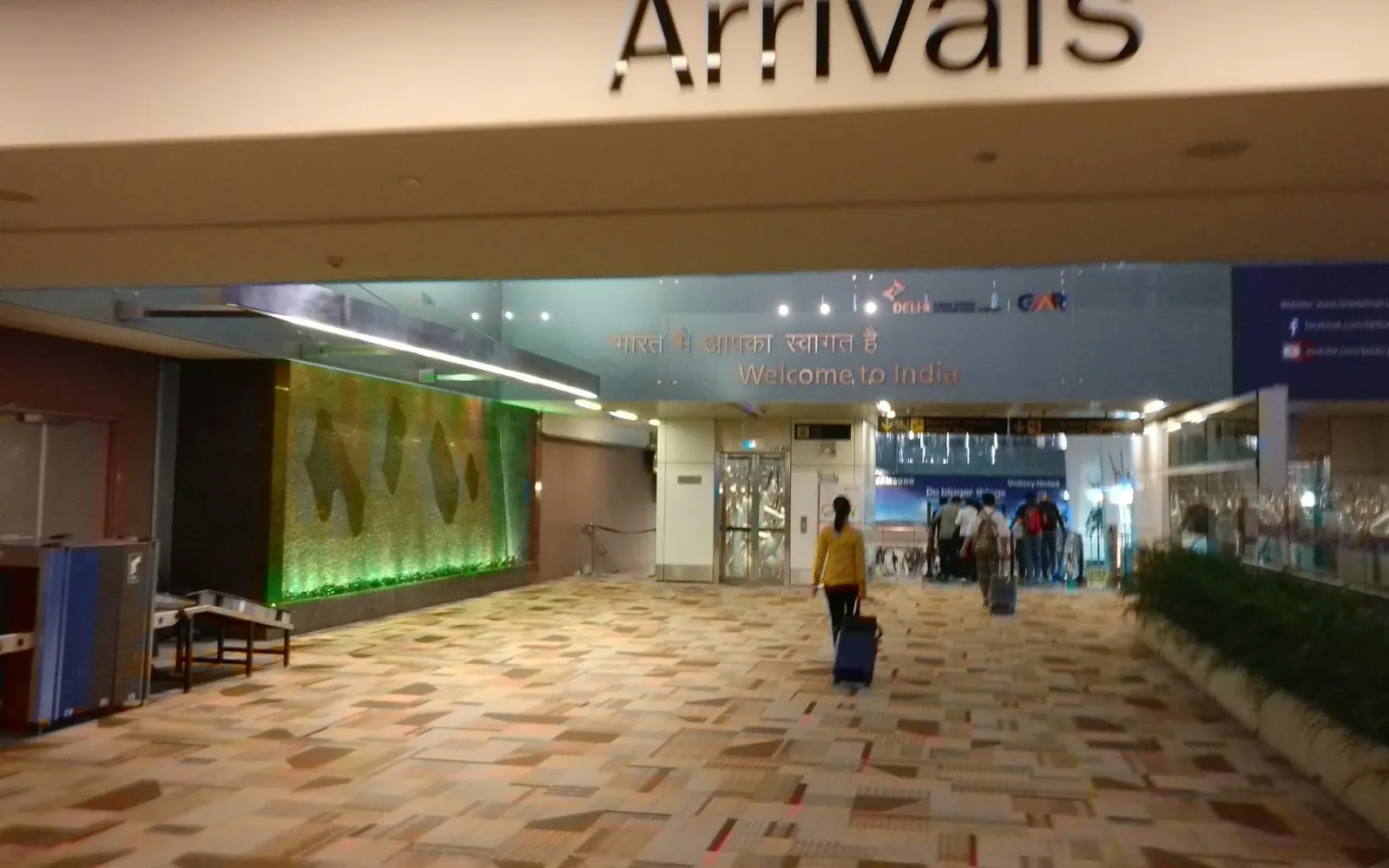

The International Arrivals area at Terminal 3 of Indira Gandhi International Airport, New Delhi. Photo: Bharatahs, CC BY-SA 4.0, via Wikimedia Commons.

The OCI card is a lifelong visa - the passport stays primary
The Overseas Citizen of India card is, in the Ministry of External Affairs' own framing, a multiple-entry lifelong visa for visiting India for any purpose. Two clarifications matter at the border. First, the cardholder remains a foreign national holding a foreign passport, not a citizen of India. Second, the passport is the primary travel document: the MEA states plainly that staying in India without a valid passport is illegal even for an OCI cardholder, so a valid passport is a permanent condition of the stay, not just of the entry day. A small set of activities sits outside the lifelong visa's "any purpose": research, missionary or tabligh work, mountaineering, journalistic activities, internship or employment in foreign diplomatic missions or foreign government organisations in India, and visits to notified protected, restricted or prohibited areas all require prior special permission or a special permit, sought online at ociservices.gov.in.
The e-Arrival card: required for OCI cardholders since 1 October 2025
From 1 October 2025, India requires every foreign national entering the country - and consular notices name OCI cardholders explicitly - to complete the electronic Arrival Card prior to entry. The MEA's OCI FAQ answers the question directly: yes, all foreign nationals are required to fill the e-Arrival Card. Two things the card is not, both worth stating because they are confused constantly: it is not a visa - Indian Visa Online describes it as arrival information only - so it changes nothing about the OCI card's role as the visa; and it is free of cost, so any site charging for it is not the official service.
The 72-hour window and the three official channels
The Bureau of Immigration states the operational rule: submit the e-Arrival card online within 72 hours before your arrival in India. Three official channels exist, all free: the Bureau of Immigration's own site (boi.gov.in), the Indian Visa Online portal (indianvisaonline.gov.in/earrival), and the official Indian Visa Su-Swagatam mobile app for Android and iOS. The form asks for personal details, arrival details and an address in India. Filing it in the days before departure - not in the arrivals hall - is what the system is built for.
What happened to the paper disembarkation card
At launch in October 2025, the physical disembarkation card was kept as a transitional option for up to six months or until further notice, as the Consulate General of India in Sao Paulo's public notice recorded at the time. That transition window has passed, and the MEA's current FAQ treats the e-Arrival card as required for all foreign nationals. Treat the paper card as a closed chapter: submit the e-Arrival card online before every trip.
New passport? The upload track and the reissue track
OCI cardholders renew foreign passports far more often than the booklet, and the Ministry of Home Affairs' OCI brochure splits the follow-up into two tracks by age. The upload track: each time a new passport is issued up to 20 years of age, and once after completing 50 years of age, the cardholder may upload a copy of the new passport and a latest photo on the online system under OCI Miscellaneous Services, within three months of receiving the new passport, on a gratis basis. The reissue track: the OCI card itself must be re-issued once, when a new passport is issued after completing 20 years of age, to capture the cardholder's facial features on attaining adulthood - an online application under OCI Miscellaneous Services with a fee of US $25 or the equivalent in local currency.
No 'U' sticker, no FRRO registration - and two forms others file for you
Two legacy frictions are gone. The 'U' (Universal) visa sticker on the foreign passport was dispensed with from 29 January 2015, and immigration authorities have been advised not to insist on it - the OCI booklet simply travels with the passport. And OCI cardholders are exempt from registration with the FRRO or FRO for any length of stay in India; only those normally resident in India must intimate the jurisdictional FRRO by email whenever their permanent residential address or occupation changes. One newer layer is filed by others rather than by you: under the Immigration Act, 2025, universities and schools report enrolled foreign students - OCI cardholders included - in Form II, and keepers of accommodation transmit a Form III for every foreign guest within twenty-four hours of arrival. Expect hotels and institutions to ask for particulars; that reporting is routine.
The entry checklist
1. Travel with a valid foreign passport and the OCI booklet - the passport is the primary document, and staying without a valid one is illegal even for OCI cardholders. 2. Within 72 hours before arrival, submit the e-Arrival card free of cost on boi.gov.in, indianvisaonline.gov.in/earrival or the Su-Swagatam app; it records arrival information, not a visa. 3. New passport since the OCI was issued? Upload it online within three months for a passport issued up to age 20, or for your first update after turning 50 (gratis); get the card re-issued once if the new passport was issued after completing 20 years of age (US $25). 4. No 'U' sticker is needed (dispensed with in 2015), and no FRRO registration applies for any length of stay; if normally resident in India, email the jurisdictional FRRO about address or occupation changes. 5. Research, missionary/tabligh, mountaineering, journalism, diplomatic-mission internships or employment, and protected-area visits need prior special permission via ociservices.gov.in.
Last verified: 25 November 2026 against the MEA's FAQ on the OCI scheme, the Bureau of Immigration's e-Arrival notice, the Indian Visa Online e-Arrival portal, the Consulate General of India Istanbul notice (7 October 2025), the Consulate General of India Sao Paulo public notice (6 October 2025, cited for the dated paper-card transition), and the MHA OCI brochure (published 22 July 2021, for the passport upload and reissue tracks).
Questions people ask at the gate
Do OCI cardholders need a visa to enter India?
The OCI card is itself a multiple-entry lifelong visa for visiting India for any purpose; carry it with a valid foreign passport. Some activities still need prior special permission or a special permit: research, missionary or tabligh work, mountaineering, journalism, internships or employment in foreign diplomatic missions, and visits to protected, restricted or prohibited areas - apply at ociservices.gov.in.
Do OCI cardholders have to fill the e-Arrival card?
Yes. The MEA's FAQ states all foreign nationals are required to fill the e-Arrival Card, and consular notices name OCI cardholders explicitly. Submit it online within 72 hours before your arrival in India; it is free of cost.
Is the e-Arrival card a visa, or does it replace the OCI card?
Neither. Indian Visa Online describes the e-Arrival card as arrival information, not a visa. Your OCI card remains your visa for India; the e-Arrival card is an additional pre-arrival declaration that every foreign national files.
I renewed my passport - do I need a new OCI card?
Two tracks. Upload a copy of the new passport and a latest photo online (gratis, within three months of receipt) each time a new passport is issued up to age 20, and once after turning 50. The card itself is physically re-issued only once, when a new passport is issued after completing 20 years of age, to capture adult facial features - US $25 via OCI Miscellaneous Services.
Can I fill a paper arrival card at the airport instead?
When the e-Arrival card launched in October 2025, consular notices kept the physical disembarkation card as a transitional option for up to six months. That window has passed, and the MEA's current FAQ treats the e-Arrival card as required for all foreign nationals - submit it online before you travel.
Do OCI cardholders have to register with the FRRO after arrival?
No. OCI cardholders are exempt from FRRO/FRO registration for any length of stay in India. If you are normally resident in India, intimate the jurisdictional FRRO by email whenever your permanent residential address or occupation changes.
Next walk starts at a new gate.
Was this helpful?
one tap, no sign-up

A Miranda House graduate and lawyer who traded courtrooms for slow travel. Cheshta travels with the batches we host ourselves, with a soft spot for travelling alongside elders.