




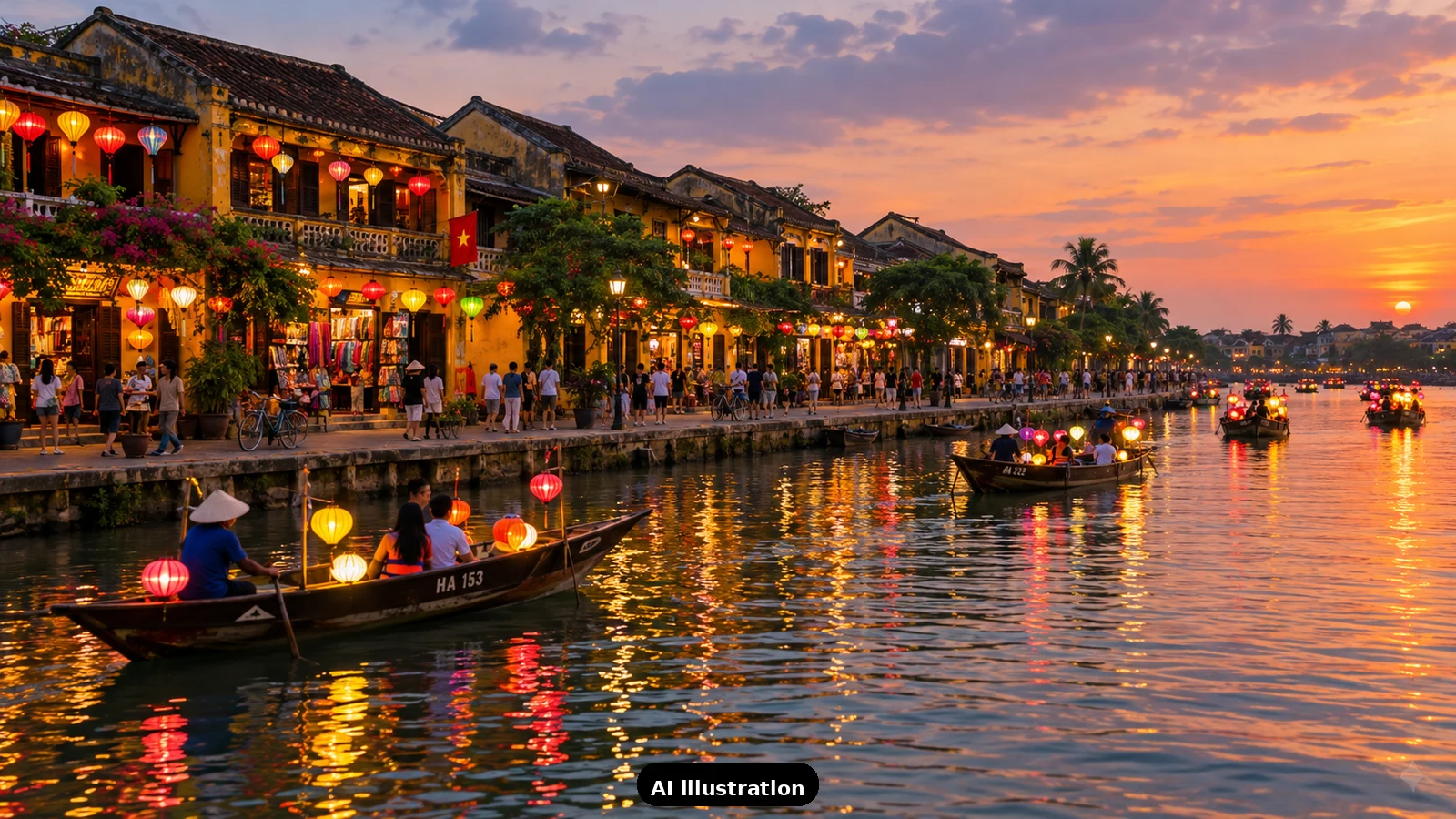
Short answer: both work beautifully for Indian families, and they are different enough that the right choice depends on your family's mood. Siem Reap is a history holiday - two or three big temple days around Angkor, based in one hotel. Hoi An is a slow holiday - a flat, lantern-lit old town by a river, a beach ten minutes away, and days that ask almost nothing of anyone's knees. If your family wants wonder, pick Siem Reap. If they want rest with a little culture, pick Hoi An.
Getting there from India. Neither has a direct flight from India, so both are one-stop journeys of roughly 9 to 13 hours door to door. For Siem Reap, you fly into the new Siem Reap-Angkor airport via Bangkok, Singapore or Kuala Lumpur. For Hoi An, you fly to Da Nang (the airport is about 45 minutes from the old town) - either via a direct India flight to Hanoi or Ho Chi Minh City plus a short domestic hop, or via Singapore or Bangkok. Flight costs are similar on most dates; check both before deciding, since sale fares often decide this argument on their own.
Visas and entry costs. Cambodia offers Indians an e-visa at 30 USD (single entry, about three business days to process) or a visa on arrival. Vietnam's e-visa costs 25 USD for single entry and is valid for up to 90 days - generous if you are combining stops. On the ground, both are kind to Indian budgets, with Siem Reap usually a little cheaper for hotels and meals. The big-ticket entries: Angkor's temple pass is 37 USD for one day or 62 USD for three days, while Hoi An's old town ticket is about 120,000 VND (roughly 5 USD) - a fraction of the cost.
What the days feel like. Siem Reap days start early and are structured: car to the park, temples in the cool hours, hotel break at midday, one more stop in the evening light. It is car-based and very senior-manageable when paced well, but the temple terrain, heat and steps mean it is still an active holiday. Hoi An days have no structure at all unless you want one: a flat old town you cross on foot or by cycle, coffee by the river, a tailor fitting, a beach afternoon at An Bang, and lantern-lit evenings that need no planning. Multi-generation families often find Hoi An the easier week.
Food for Indian families. Both towns are used to Indian visitors. Hoi An's old town has several Indian restaurants within walking distance, plus plenty of rice, noodle and fresh-vegetable local dishes that work for vegetarians. Siem Reap clusters its Indian restaurants around the old market area, and hotel breakfasts handle the rest. Jain and pure-veg travellers can manage in both, with a little more planning needed on temple days when lunch is near the park.
So which one? Choose Siem Reap if Angkor is a bucket-list dream, if a single-base 4-5 day trip suits you, and if the family is happy with two or three active mornings. Choose Hoi An if the trip mixes grandparents and kids, if you want beach time alongside culture, or if shopping and tailoring are part of the fun. With nine days or more, combine them - a one-stop connection through Bangkok or Singapore links the two easily, and the contrast (temples first, rest after) is exactly the right order.
How TripKeeper does both. Our founder-hosted Siem Reap batches pace the temples for Indian families, with the visa, hotels and airport assistance handled by the team. Our Vietnam trips include Hoi An with the same handholding - ask for the Vietnam itinerary through a trip-planning inquiry, and tell us if you want the two-country combination priced as one trip.

A Miranda House graduate and lawyer who traded courtrooms for slow travel. Cheshta travels with the batches we host ourselves, with a soft spot for travelling alongside elders.
Planning your next trip?
We'll handle insurance, hotels, airport assistance and the itinerary — the same way we do it for every trip.
Questions on this article
asked by readers, answered by us
Was this helpful?
one tap, no sign-up
