




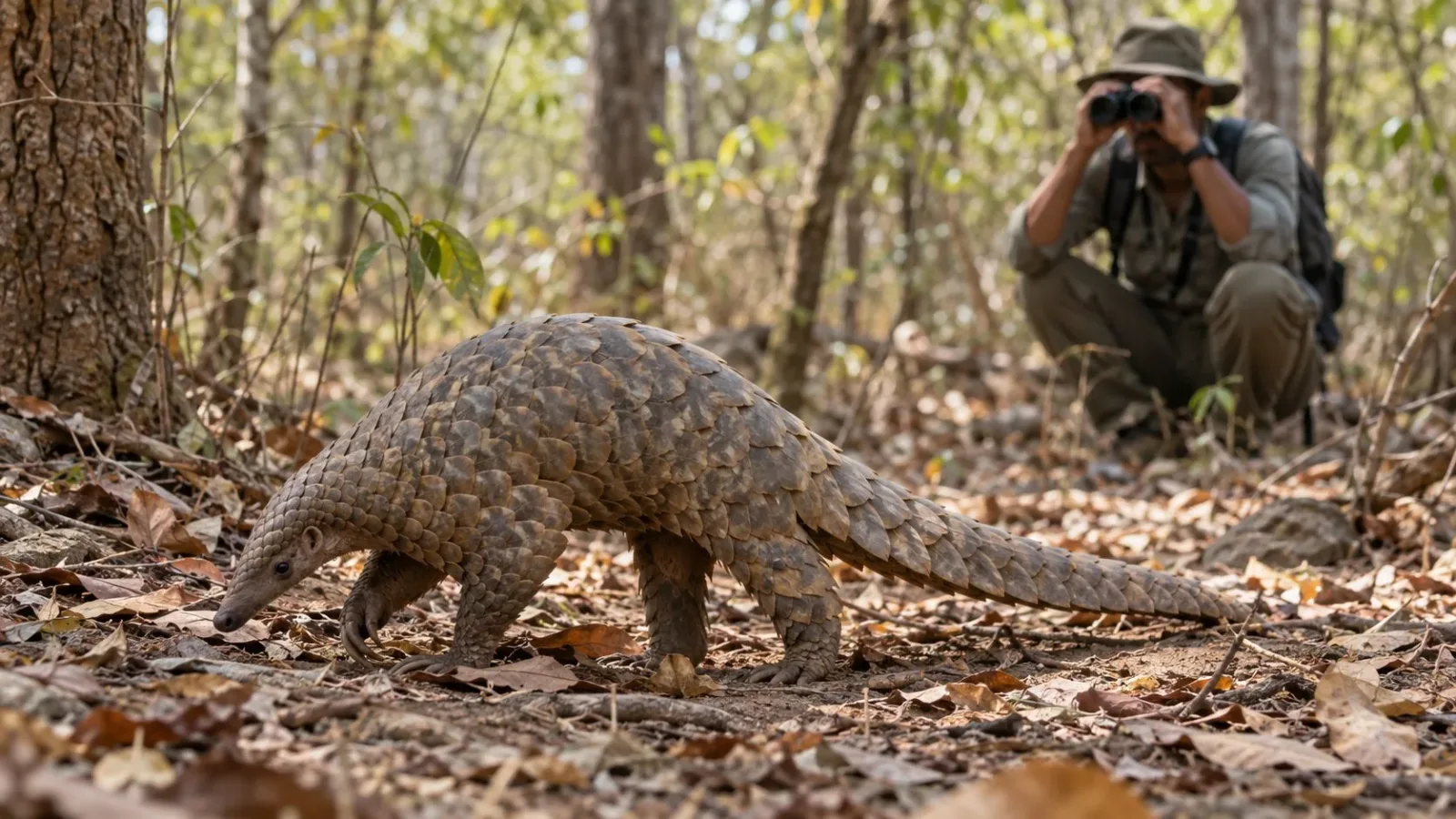
- Animal discussed
- Indian pangolin
- Classification
- Mammal
- Scale material
- Keratin
- Loose-scale identity
- Not established
- Reviewed
- 17 November 2026
Reviewed: 17 November 2026. Anatomy explanation, not a specimen-identification or encounter guide.
AI-generated fictional Indian-pangolin-inspired scene, not a specimen-identification key, current animal/display record, health assessment, safe distance or permitted encounter.
Scales do not make the Indian pangolin a reptile. Nandankanan Zoological Park's educational account describes pangolins as mammals with hard keratinous scales and names the Indian pangolin among them. Read the covering and the mammal classification together, rather than let a scaly appearance replace the source's classification.
Keep mammal and scales together
The account identifies keratin as the material of pangolin scales and compares it with the material in our fingernails. Here that comparison explains the named material; it does not make a scale interchangeable with a fingernail or establish the properties of a particular specimen.
The useful relationship is simple: a mammal can have the scale covering described in this account. This article does not use appearance alone to classify an unknown animal or give a general classification of all scaled animals.
Read the covering with its stated limit
Nandankanan's description distinguishes the scale-covered body from the underside, where it notes sparse hairs. Preserve that distinction rather than turn the scaly appearance into a claim that every surface has the same covering.
This is a description of body covering, not a test of protective strength or an assessment of an individual's skin, scales or health. No claim about what a particular movement means follows from it.
Separate anatomy from specimen identification
A general description does not identify a loose scale as belonging to an Indian pangolin. Singapore's Animal and Veterinary Service notes the difficulty of identifying pangolin species from the appearance of individual scales. That limitation is a reason not to treat this short explanation as a specimen-identification method.
No handling, collecting, examination or diagnostic procedure is proposed. No current animal, display, viewing route, admission or accompanied visit is verified. Keep the scope anatomical: the source describes a mammal with a scale covering, not a current encounter or an individual specimen.
Frequently asked questions
Does having scales make the Indian pangolin a reptile here?
No. Nandankanan's account describes pangolins as mammals with keratinous scales.
What material does the account name for the scales?
Keratin, with a comparison to our fingernails.
Does the account describe the same covering over every surface?
No. It distinguishes the underside with sparse hairs from the scale-covered body.
Can this identify a loose scale as Indian pangolin?
No. This article provides no specimen-identification method; individual-scale appearance does not readily establish species.
Does this test how protective an individual scale is?
No. No protective-strength test or specimen-property assessment is supplied.
Does it recommend handling or collecting a scale?
No. No handling, collection, examination or diagnostic procedure is proposed.
Official sources and limits
The official educational account supports the scaled-mammal description and underside distinction. AVS supplies only the single-scale identification limitation. No protective-strength test, health/behaviour diagnosis, trade/conservation discussion or current access is established.

A Miranda House graduate and lawyer who traded courtrooms for slow travel. Cheshta travels with the batches we host ourselves, with a soft spot for travelling alongside elders.
Planning your next trip?
We'll handle insurance, hotels, airport assistance and the itinerary — the same way we do it for every trip.
Questions on this article
asked by readers, answered by us
Was this helpful?
one tap, no sign-up