




Reviewed 18 November 2026. A focused sculpture guide using Bhopal Division, Vidisha district and Madhya Pradesh Tourism descriptions. Check current official visitor information.
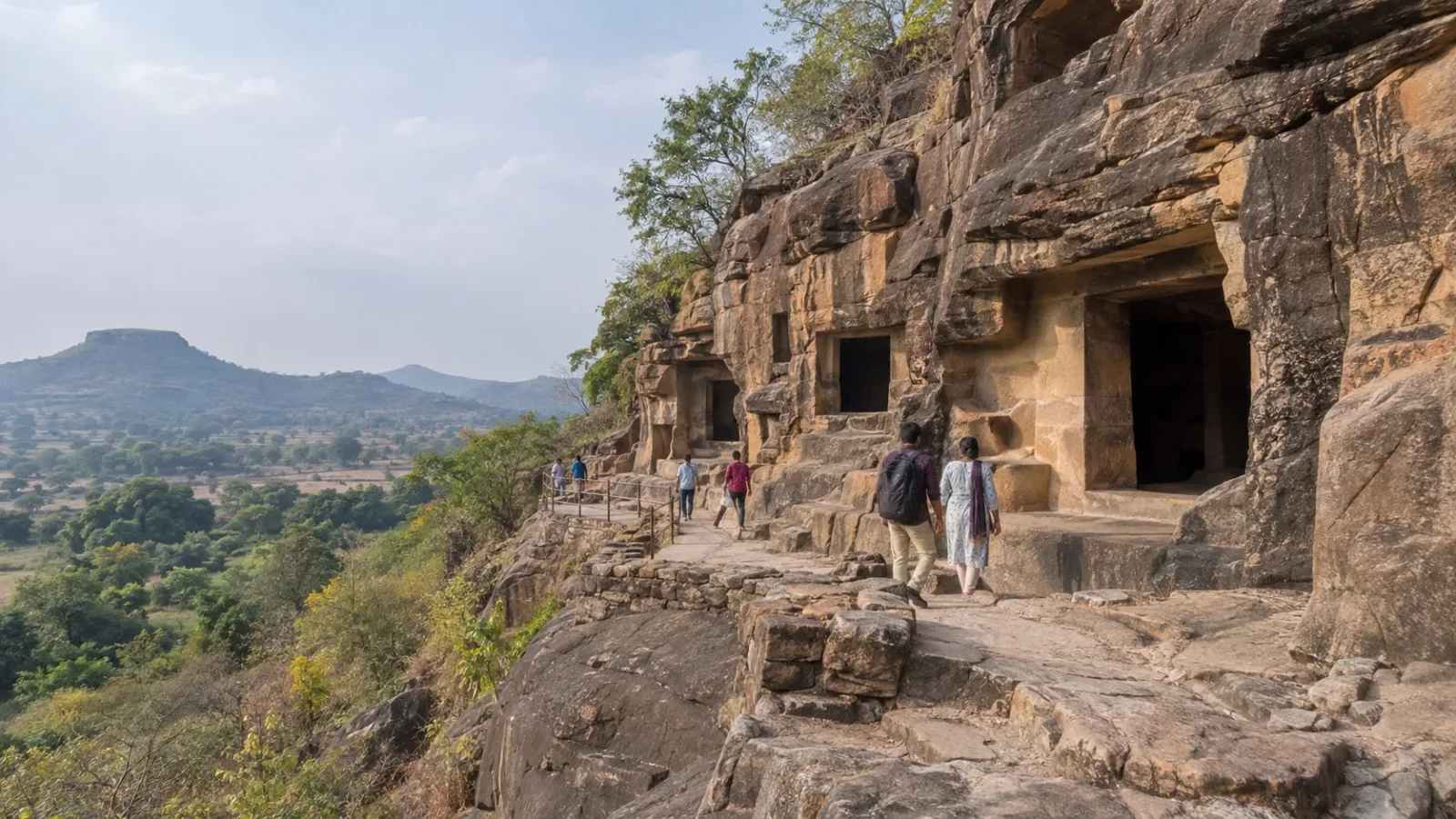
AI illustration: a fictional rock-cut cave scene inspired by Udayagiri near Vidisha. Not an actual location, person, route inspection or service.
Start with the full place name
Choose Udayagiri Caves near Vidisha in Madhya Pradesh. Keep the state and nearby city with the name so a namesake does not become the destination by mistake.
Our recommendation is a focused sculpture visit, with Cave 5’s Varaha relief as its main subject. Check current official visitor information and keep food, a break and the return.
At Cave 5, begin with the main figure
Bhopal Division identifies Cave 5 with a large Varaha representation of Vishnu: a human-bodied figure with a boar’s head. It describes his left foot on the coils of the naga king.
Begin with the main figure, then consider its relationship with the surrounding scene. You do not have to identify every small figure to give the sculpture careful attention.
Read the rescue as the religious subject
Madhya Pradesh Tourism describes Varaha rescuing the Earth goddess from the deep ocean. This explains the scene’s religious subject, not an archaeological report of a literal event.
Keep description and interpretation distinct. Ask for reliable explanation of the elements rather than assigning a certain identity to every figure from a quick glance.
Use Gupta-period context without one exact year
Vidisha district describes rock-cut sculpture, early Hindu iconography and Gupta-period inscriptions. State tourism describes caves cut into a sandstone hill in the fourth and fifth centuries and connects inscriptional evidence with Chandragupta II.
These accounts support a historical-art focus rather than a natural-cavern outing. They do not make every visible mark, later addition or repair the work of one person in a single year.
Let inscriptions be a separate looking subject
The district names Gupta inscriptions and Shankha Lipi, or shell-script, inscriptions. Their presence adds another subject besides the figures carved into the rock.
A published mention is not a full translation. If inscriptions are your main interest, seek a reliable reading rather than treating a decorative-looking mark as something you can confidently decipher.
Do not turn the cave count into a target
State tourism describes a group of twenty caves. That number gives a sense of the site’s scale, not a requirement to collect twenty stops. One carefully understood scene can be the purpose of a visit.
Sanchi, Bhopal or another heritage destination can be a separate choice. Check current official visitor information and keep the group’s interest, food, rest and the return in the plan.
Sources
Questions people ask at the gate
Which Udayagiri is this?
Udayagiri Caves near Vidisha in Madhya Pradesh. Keep the state and city with the place name.
What is the main suggested sculpture?
The Varaha relief at Cave 5.
How does Bhopal Division describe Varaha here?
As Vishnu with a human body and a boar’s head, with his left foot on the coils of the naga king.
What subject does state tourism identify?
Varaha rescuing the Earth goddess from the deep ocean, a religious subject represented in the carving.
What context does the district supply?
Gupta-period rock-cut sculpture, early Hindu iconography and inscriptions, including a mention of Shankha Lipi.
Must every cave and another destination be included?
No. Choose a focused subject, check current official visitor information and keep food, rest and the return.
Next walk starts at a new gate.
Was this helpful?
one tap, no sign-up

A Miranda House graduate and lawyer who traded courtrooms for slow travel. Cheshta travels with the batches we host ourselves, with a soft spot for travelling alongside elders.