




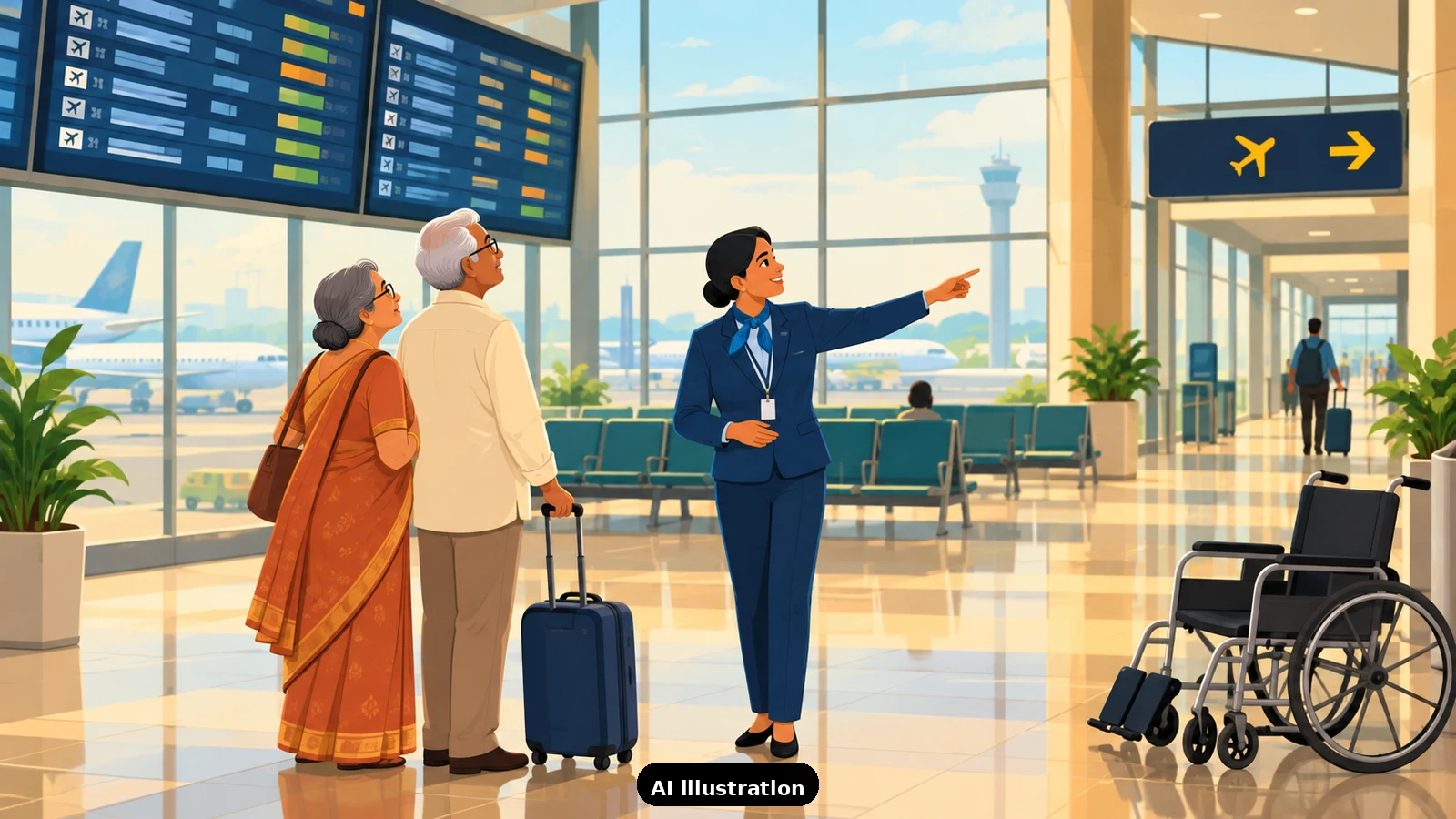
Short answer: nothing bad happens - gate changes are an everyday operational event, and the system is built to move passengers, including elderly and wheelchair users, to the new gate. The key is to do one thing the moment you see or hear the change: tell the staff at the current gate that your parent is there and needs assistance reaching the new one. From that point, moving them is the staff's job, not your parent's.
How you find out about a gate change. Three channels, in the order they usually arrive: the flight information display screens (the big boards everywhere in the terminal), the airline's own app or SMS, and the audio announcements. Elderly travellers often miss the announcements - terminals are noisy and Hindi/English rotate - so the practical habit is to check the nearest display screen every twenty minutes or so, and to keep the airline app installed on the phone with notifications on. IndiGo, Air India and the others push gate and delay updates through their apps, which is why it helps when the booking carries the passenger's own mobile number, or yours.
What to do at the old gate, step by step. First, confirm the new gate on the display screen - announcements can be misheard, the screen cannot. Then walk up to the staff at the current gate podium (there is almost always someone there even before boarding starts) and say the passenger is elderly or has booked wheelchair assistance. The gate team coordinates with the airline's ground handler and the airport's assistance desk; for a pre-booked wheelchair passenger, the assistant who brought them is responsible for delivering them to the aircraft door - that responsibility does not end because the gate moved. If no staff is at the podium yet, any airport information desk or the nearest airline counter can radio it in.
If the new gate is far - and at Indian airports it often is. Delhi T3 and Mumbai T2 are long walks end to end. This is where pre-booked wheelchair assistance pays for itself: the attendant simply wheels the passenger to the new gate. Airports also run buggy services on the long piers - Mumbai's T2 has automated buggies, and terminal staff can call one. For a walkable but slow senior, ask the gate staff whether a buggy is available before setting off; fifteen minutes of anxious walking becomes a three-minute ride. And if the gate change comes with a delay, the staff can seat the passenger in a quieter spot near the new gate instead of having them hover.
What families at home can do. Track the flight on the airline app or the airport's live departures page - you will often see the new gate before your parent does. One phone call - 'Papa, gate badal gaya, screen par dekho, aur wahan jo staff hain unhe bata do wheelchair chahiye' - solves most of the stress. If your parent is travelling alone and you are worried, note that assistance booked in advance (IndiGo and Air India ask for 48 hours' notice for wheelchair requests) means a named staff member is already assigned; they do not leave the passenger stranded at the wrong gate.
The one situation to avoid. The elderly passenger setting off alone toward the new gate without telling anyone. If they leave, the assistance chain loses track of them and the new gate staff do not know to look for them. The rule to drum in: gate changes are fine, moving without telling the staff is not. Tell the podium, then move with help.
Where TripKeeper fits in. When we send senior parents off on a flight, we brief both them and the family on the airport day - screens, announcements, what to say at the gate, and how assistance works end to end. If you would like that kind of handholding planned into a trip, send us a trip-planning inquiry.

A Miranda House graduate and lawyer who traded courtrooms for slow travel. Cheshta travels with the batches we host ourselves, with a soft spot for travelling alongside elders.
Planning your next trip?
We'll handle insurance, hotels, airport assistance and the itinerary — the same way we do it for every trip.
Questions on this article
asked by readers, answered by us
Was this helpful?
one tap, no sign-up