




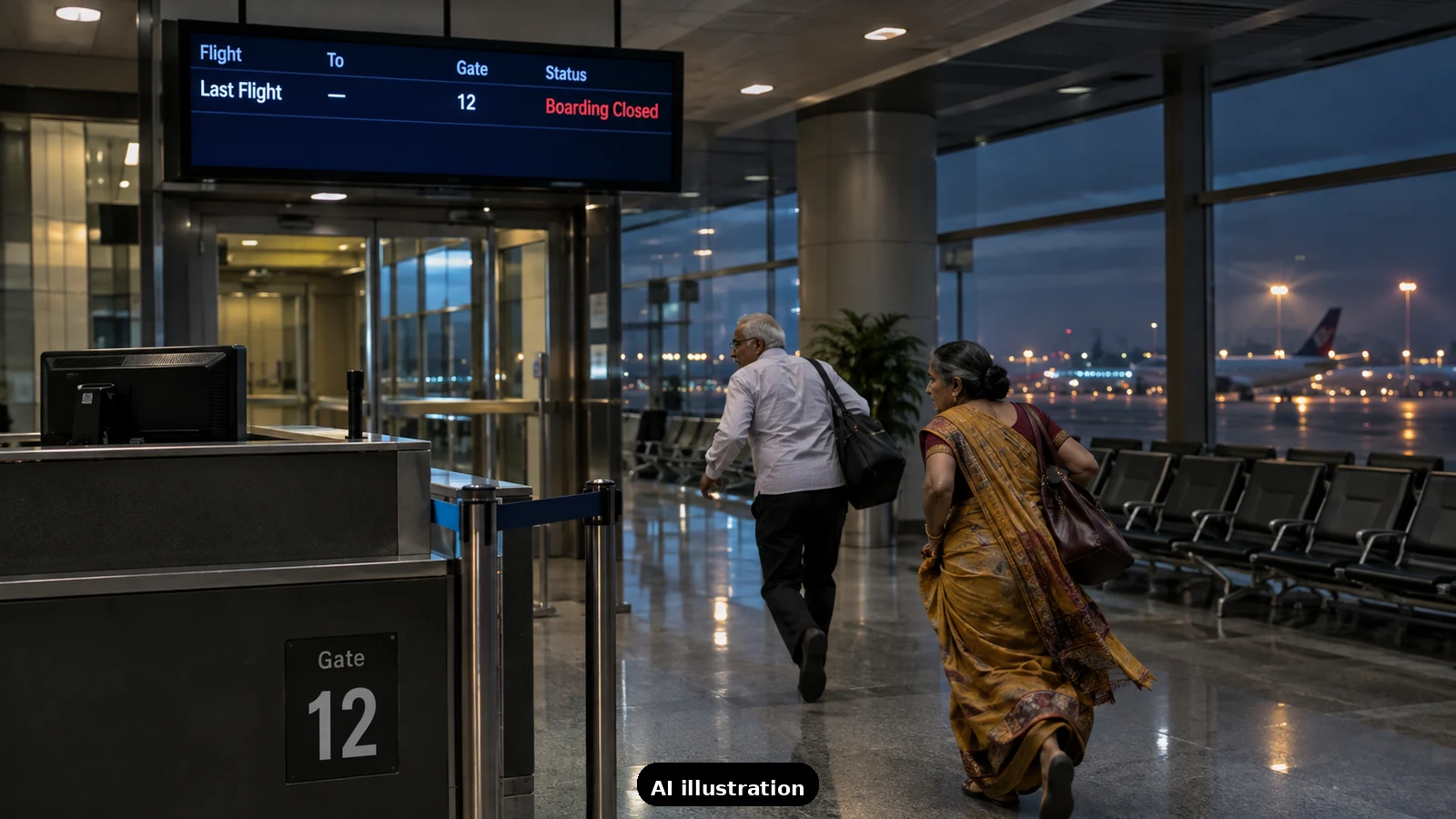
Short answer: the passenger goes directly to the gate staff or the nearest airline counter and says clearly, 'I am booked on this flight - please help me board.' Do not wander off looking for announcements, and do not leave the security area. If the aircraft door is still open, airlines can and do board late passengers at their discretion. If the flight has departed, the same airline desk handles rebooking - and in India, most carriers will move the passenger to the next available flight, usually for a fee or fare difference, sometimes waived for seniors in genuine distress.
Know the clock you are actually up against. Airlines do not close gates at departure time - they close them well before. IndiGo, for instance, closes boarding gates 25 minutes before departure at all airports, and check-in counters 60 minutes before domestic departures (75 for international). Air India and others publish similar cut-offs. So a parent who leaves the gate area 'for two minutes' with 30 minutes to departure is already inside the danger zone. The first family rule: once boarding calls begin, nobody leaves the gate area - toilets get visited before boarding time starts.
If the passenger is at the airport but away from the gate. The steps, in order. One: return to the gate immediately - gate changes and final calls happen, but the gate remains the place where the passenger record is. Two: tell any uniformed airline staff - 'elderly passenger, flight 6E-XXX, gate closed' - staff can call the gate or the ramp and sometimes hold the door. Three: if the flight has gone, go to the airline's transfer or customer service desk in the terminal; they handle missed-boarding rebooking all day. Four: keep the boarding pass and ID in hand - every desk asks for them first.
What the airline will do. A passenger who misses boarding through their own delay is usually treated as a 'gate no-show'. Airlines typically rebook them on the next flight with availability - budget carriers charge a rebooking or no-show fee plus any fare difference, while full-service carriers are often more flexible, especially with elderly passengers. Air India, for example, offers self-service reaccommodation options for disrupted passengers. The practical point for families: this is a solvable problem that costs time and sometimes money - it is not a stranded-forever situation.
The family coordination checklist - this is where it is prevented. Before travel day: check the parent in online and keep their boarding pass photo on your phone. Agree on the gate rule - once at the gate, stay at the gate; washroom visits happen before the boarding window. Keep the parent's phone charged and reachable, and save the airline's customer care number in it. If the flight is missed, the family calls the airline desk in parallel while the parent walks to the counter - two channels are faster than one. And if medication schedules or connections are at stake, tell the staff plainly - they escalate elderly medical cases faster.
How TripKeeper plans for this. We build generous airport buffers into every senior itinerary, brief parents on the gate routine before departure, and stay reachable through the travel day so a missed boarding becomes a phone call, not a crisis. If you would like your family's next trip run this way, send us a trip-planning inquiry.

A Miranda House graduate and lawyer who traded courtrooms for slow travel. Cheshta travels with the batches we host ourselves, with a soft spot for travelling alongside elders.
Planning your next trip?
We'll handle insurance, hotels, airport assistance and the itinerary — the same way we do it for every trip.
Questions on this article
asked by readers, answered by us
Was this helpful?
one tap, no sign-up