




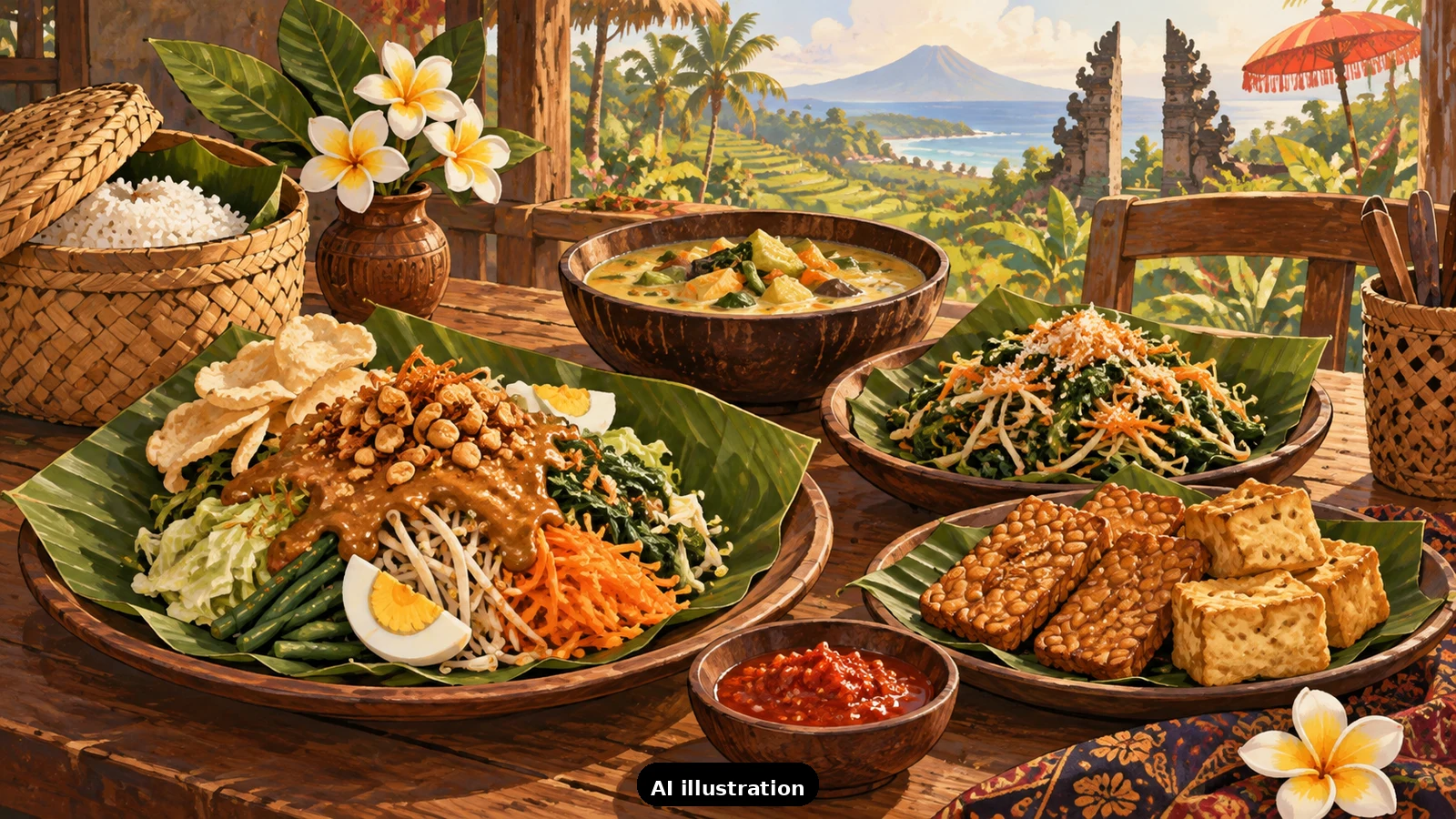
Bali is quietly one of Asia's best islands for vegetarian eating. The catch: "vegetable dish" and "vegetarian preparation" are not the same thing in Indonesian kitchens. This guide maps the safe dishes, the one ingredient that catches everyone out, and the exact phrases that fix it.
The short version
Balinese and Indonesian home cooking leans heavily on rice, tempeh, tofu, coconut and vegetables. At a warung (local eatery), a full vegetarian nasi campur costs roughly 30,000 to 50,000 IDR, and a plate of rice with tempeh, tofu, urap and greens comes in around 35,000 IDR. The risk is not finding food, it is hidden shrimp paste (terasi), fish sauce and chicken stock in dishes that look fully plant-based. Learn two phrases and you will eat brilliantly for very little money.
Safe dishes to look for
- Gado-gado (25,000 to 40,000 IDR): blanched vegetables, tofu, tempeh and egg under peanut sauce. Ask about egg and about terasi in the sauce.
- Urap / sayur urab (20,000 to 35,000 IDR): steamed vegetables tossed with spiced grated coconut. Often fully vegan.
- Nasi campur sayur (30,000 to 50,000 IDR): the point-and-choose mixed rice plate, the most flexible vegetarian option on the island. You see exactly what goes on your plate.
- Tempeh goreng or tempeh bacem (20,000 to 45,000 IDR): fried or sweet-braised tempeh, a protein staple.
- Tahu goreng (20,000 to 40,000 IDR): fried tofu, sometimes with a soy-chili dip.
- Cap cay (25,000 to 40,000 IDR): stir-fried mixed vegetables; ask about oyster sauce.
- Sayur lodeh (25,000 to 40,000 IDR): vegetables in coconut milk; ask about chicken stock.
- Pecel (25,000 to 40,000 IDR): greens with peanut sauce, similar to gado-gado.
- Pisang goreng (10,000 to 20,000 IDR): fried banana, the default dessert.
The terasi trap (and the other two)
Terasi is fermented shrimp paste, and it appears in most sambals and in many vegetable dishes that read as plant-based on a menu. Fish sauce and chicken stock are the other two quiet ingredients. A dish described as "vegetable" tells you what is in it, not how it was cooked.
Phrases that work everywhere
These are understood at the smallest warung, and asking is completely normal. Nobody will be offended.
- Saya vegetarian / saya vegan - I am vegetarian / vegan
- Tanpa terasi - without shrimp paste
- Tanpa daging - without meat
- Tanpa telur - without egg
- Tanpa kaldu ayam - without chicken stock
- Ada yang tanpa terasi? - is there anything without shrimp paste?
Two honest caveats
- At a busy warung with pre-cooked dishes, "without terasi" sometimes means "the dish that already has none", not a modified version. Point and ask rather than assume.
- Cross-contamination is not managed at the warung tier. If your requirement is medical (an allergy, for example), the cafe tier handles it more reliably. Note that gado-gado and pecel use peanut sauce, so peanut allergy needs care too.
Where to base yourself
Ubud is comfortably the best: deepest range at both warung and wellness-cafe tiers, staff who know the questions, and a large plant-based community. Canggu is strong at the cafe tier with good warungs. Seminyak has good cafes at higher prices. Sanur is workable with the phrases. Uluwatu and the Bukit are the thinnest, and rural areas (Sidemen, Munduk, Amed) need the phrases learned properly before you go.
Warung vs cafe prices (2026)
A warung breakfast runs 20,000 to 35,000 IDR and a lunch main 30,000 to 50,000 IDR. The plant-based cafe tier runs 90,000 to 180,000 IDR a main. Both are legitimate; the cafes are often excellent and use imported ingredients. The practical middle many travelers land on is warungs for breakfast and lunch, cafes when you actively want one. Eating mostly at warungs costs around 3 million IDR a month; eating mostly at cafes, 7 to 9 million.
If you want Indian food
Ubud and Seminyak both have long-running Indian restaurants (Spice Mantraa and Queen's of India are the established names), with mains around Rs 700 to 1,400 per person equivalent. Useful on longer stays or for Jain-specific needs, which warungs cannot reliably meet.
Bottom line
Vegetarian Bali is not about finding special restaurants. It is about the warung across the street, the words "tanpa terasi", and knowing that gado-gado, urap and nasi campur sayur are your three best friends. Eat local, ask once, and you will spend very little and eat very well.

A Miranda House graduate and lawyer who traded courtrooms for slow travel. Cheshta travels with the batches we host ourselves, with a soft spot for travelling alongside elders.
Planning your next trip?
We'll handle insurance, hotels, airport assistance and the itinerary — the same way we do it for every trip.
Questions on this article
asked by readers, answered by us
Was this helpful?
one tap, no sign-up