




Reviewed 18 November 2026. A focused tomb-and-garden guide using ASI and official tourism descriptions. Check current official visitor information.
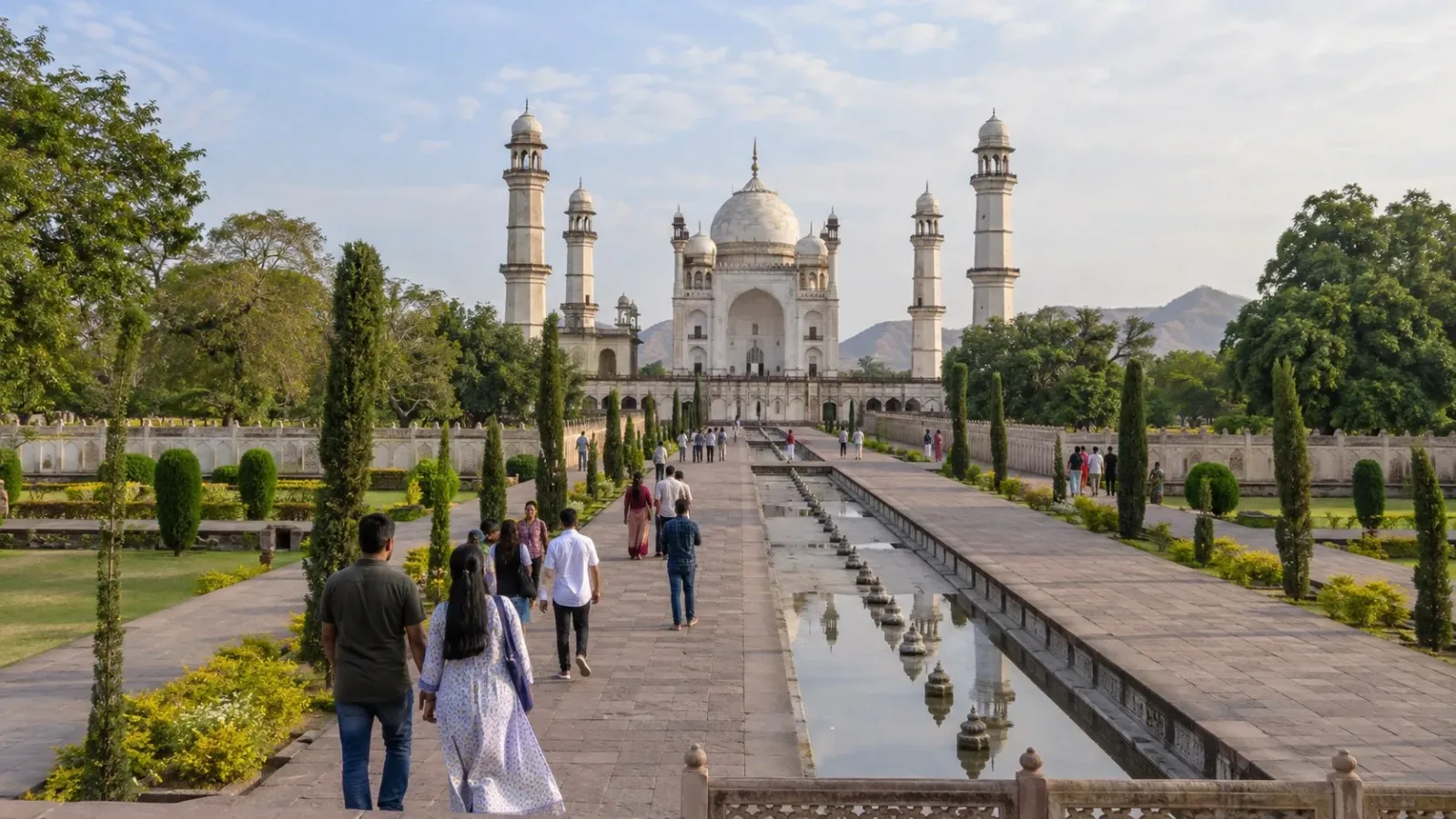
AI illustration: a fictional tomb-and-garden scene inspired by Bibi Ka Maqbara. Not an actual location, person, route inspection or service.
Begin with the tomb and its setting
What holds your attention: the main building alone, or its relationship with the garden? ASI describes the mausoleum on a high platform with four corner minarets, within an enclosed site.
Our suggestion is a focused tomb-and-garden visit, not a test of how many nearby sights can be added. Check current official visitor information and keep a meal, a break and the return.
Read the charbagh as an arrangement
The ASI circle’s Hindi account explicitly identifies the charbagh pattern. Consider the garden’s order alongside the central building rather than using the garden only as the foreground of a photograph.
Choose one broad view, then look at the relationship between the building and the surrounding enclosure. This is a looking exercise, not a requirement to measure the grounds or complete a circuit.
Notice the raised platform and corner minarets
ASI describes the building at the centre of a raised platform, with a minaret at each of its four corners. Notice how that arrangement frames the mausoleum.
Compare the horizontal platform with the vertical minarets and the main building between them. You can spend time on those relationships without turning every architectural element into a checklist.
Choose a detail and name the makers carefully
The ASI circle account records worked brass doors and marble screens among the monument’s details. Use its descriptions as a starting point rather than identifying every surface from its colour.
ASI also reports that an inscription names Ata-ulla as architect and Hanspat Rai as engineer. The named roles offer a more precise conversation about making the monument than an invented story about every decorative choice.
Remember the person, not only the nickname
The official district and state tourism pages identify this as the burial place of Rabia-ud-Durrani, Aurangzeb’s wife. ASI also gives her name as Dilras Banu Begum.
The tourism pages explain the Mini Taj of the Deccan nickname through resemblance to the Taj at Agra. Let that help identify the place without making comparison the whole visit. We do not select a precise construction year here.
Finish with the subject you chose
Think back to the garden’s order, the platform and minarets, and the detail that stayed with you. A tomb-and-garden visit can have its own purpose without another major sight attached.
Another cave, market or monument can be a separate decision. Check current official visitor information and keep food, rest and the return in the plan.
Sources
Questions people ask at the gate
What is the suggested focus?
The tomb’s relationship with its garden, then a few architectural details.
Whose tomb is Bibi Ka Maqbara?
The district and state tourism pages identify Rabia-ud-Durrani, Aurangzeb’s wife. ASI also names her Dilras Banu Begum.
Does an official source name the charbagh pattern?
Yes. The ASI circle’s Hindi account explicitly names the charbagh arrangement.
What arrangement does ASI describe?
A mausoleum in the centre of a high platform, with four minarets at its corners.
Who are the makers named by ASI?
ASI reports an inscription naming Ata-ulla as architect and Hanspat Rai as engineer.
Must this be only a Taj Mahal comparison?
No. Give the tomb and garden their own attention, check current official visitor information and keep food, rest and the return.
Next walk starts at a new gate.
Was this helpful?
one tap, no sign-up

A Miranda House graduate and lawyer who traded courtrooms for slow travel. Cheshta travels with the batches we host ourselves, with a soft spot for travelling alongside elders.