




The Trip Keeper The Trip Keeper
three doors, pick the one that fits your family How do you want to travel?
Cheshta Agarwal, founder and host of The Trip Keeper, smiling on a green country road
Hosted by Cheshta

Founder-Hosted Group Tour

the trips where Cheshta travels with you

Our own exclusive group trips. Cheshta is on the trip, from the first flight to the last dinner.

  • Cheshta travels with the group
  • One clear price, inclusions listed
  • Meet your travel family
Next up: Vietnam, 17 DecView →
See founder trips →
A fixed-departure batch on tour

fixed dates, fixed flights

Join a batch of fellow travellers on set dates. Limited seats, flights included, with options. Our team doesn't travel on these.

  • Fixed dates and flights
  • Limited seats per batch
  • Flight options available
See departures →
A private family trip

Private Tour

your dates

just your family, nobody else

Trips planned around your family, your pace and your dates. Milestone birthdays and anniversaries.

  • Travel on your own dates
  • Route shaped around you
Ask for a quote →
← Journal ☏
Trip Planning 3 min read

Can a Family Put All Their Phones in One Security Tray at an Indian Airport?

Yes, in practice - phones can share a tray if they lie flat without overlapping. The 'separately' rule targets laptops and tablets, which need their own tray, and it really means 'out of your bag,' not 'one device per tray.' Here is how a family of four clears the belt without a re-scan.

share WhatsApp Facebook X
Text size
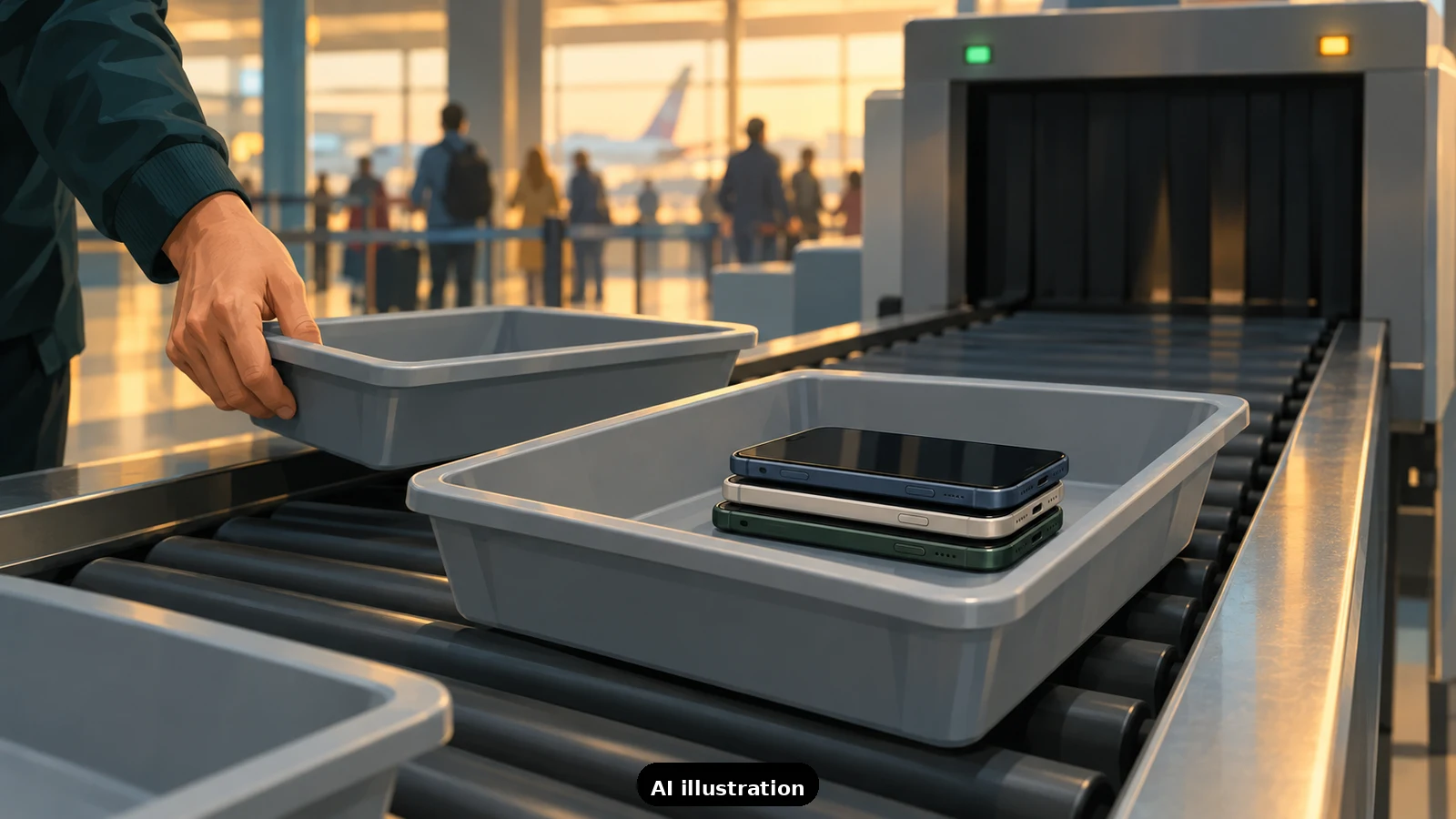
Family phones and a wallet lying flat in an airport security tray on the conveyor
Send to Mummy-Papa Opens WhatsApp with a short summary — pick who to send it to.

Short answer: yes - a family can put multiple phones in one security tray, as long as they lie flat side by side without stacking. Airport guidance (Delhi Airport's security page states it plainly) is that electronics - phones, laptops, smartwatches, tablets - must be placed in trays for screening, and the word that confuses people is 'separately': it means out of your bag and into the tray, not one device per tray. What does need its own tray is the big stuff: laptops and tablets go flat and alone, because anything layered under or over them clouds the X-ray image and earns the bag a second look.

The rule behind the trays. Screening standards come from the Bureau of Civil Aviation Security (BCAS), and the checkpoint is run by CISF at most airports. The officer staring at the X-ray screen needs a clean, readable image: overlapping electronics look like a single dense slab, and a dense slab is what gets a tray pulled aside for a manual check. A tray with three phones laid flat reads clearly. The same three phones stacked like a sandwich may come back for a re-scan - which is slower than just using a second tray.

The family system that works at the belt. Grab two or three trays the moment you reach the conveyor - trays are free and nobody counts them. Tray one: all the family's phones, watches, wallets, keys and coins, laid flat. Tray two: the laptop or tablet, alone and flat. Tray three: the liquids pouch (each container 100 ml or less, together in a clear resealable bag) plus jackets and belts. Delhi Airport even asks for chargers, earphones and glasses to sit inside a tray or a case rather than loose, so they do not jam the rollers. Then, the habit that saves families every time: agree before the belt who collects which tray on the other side.

Small things that trigger extra checks. Stacked phones, a phone hiding under a jacket in the same tray, power banks left inside bags (they must fly in cabin baggage and show clearly on the X-ray), and umbrellas or selfie sticks that officers often pull for a separate look. And one India-specific habit to keep: photography is not permitted at the checkpoint, so the family phone goes in the tray, not in someone's hand filming the queue.

When the lane says otherwise, follow the lane. A few Indian airports now run newer scanners at select lanes that can image a bag without unpacking laptops - where that equipment is installed, the signage at that lane says so. Otherwise, the default everywhere is: big electronics out, flat, alone; small electronics out, flat, shared trays fine. When in doubt, watch what the officer at the belt is telling the queue ahead of you - that instruction always wins over any general rule, including this article.

How TripKeeper families clear security calmly. Before a family trip we walk parents through the airport day - what comes out of the bag, which tray takes what, and what the kids carry - so the security line is two quiet minutes, not a scramble. If you would like that kind of preparation, send us a trip-planning inquiry.

Send to Mummy-Papa Opens WhatsApp with a short summary — pick who to send it to.
Cheshta Agarwal
Founder · Travel Creator · Lawyer

A Miranda House graduate and lawyer who traded courtrooms for slow travel. Cheshta travels with the batches we host ourselves, with a soft spot for travelling alongside elders.

or let us do all of it

Planning your next trip?

We'll handle insurance, hotels, airport assistance and the itinerary — the same way we do it for every trip.

Questions on this article

asked by readers, answered by us

Can we put two or three phones in the same security tray?

Yes, in practice - phones can share a tray when they lie flat side by side without overlapping. Airport guidance says electronics must be placed in trays for screening, and 'separately' means out of your bag, not one device per tray. Stacked phones can cloud the X-ray image and earn a re-scan, so lay them flat or take a second tray.

Do laptops and phones follow the same tray rule?

No. Laptops and tablets come out of the bag and go flat in their own tray - anything layered over or under them makes the X-ray unreadable and triggers a manual check. Phones, watches, wallets and keys are small electronics that can share a tray as long as nothing overlaps.

Can phones stay in my pocket or bag through Indian airport security?

No - phones must come out of pockets and bags and go into a tray. Airport security pages list phones, smartwatches and fitness trackers among the electronics to place in trays, and pocket clutter like coins, keys and belts goes in too. At the checkpoint, keep the phone in the tray, not in your hand: photography is not permitted there.

What should a family do with chargers, earphones and power banks?

Delhi Airport asks that small items like chargers, earphones and glasses be secured inside a tray or a protective case so they do not move or jam the rollers. Power banks must travel in cabin baggage only, and keeping them visible in the tray gives the X-ray operator a clean image and avoids a bag search.

What liquids can go through, and do they need their own tray?

Liquids, aerosols and gels are limited to containers of 100 ml or less, packed together in a clear resealable bag, which goes in a tray separately from your bag. Oversized containers are not allowed through, so finish or bin that big water bottle before the belt.

What if the officer at my lane gives different instructions?

Follow the lane. A few airports run newer scanners at select lanes that do not require unpacking laptops, and the signage there says so. At every other lane the default holds: big electronics out, flat and alone; small items flat in shared trays. The officer's instruction at the belt always overrides any general rule.

Was this helpful?

one tap, no sign-up

Read next

← Journal See our trips