




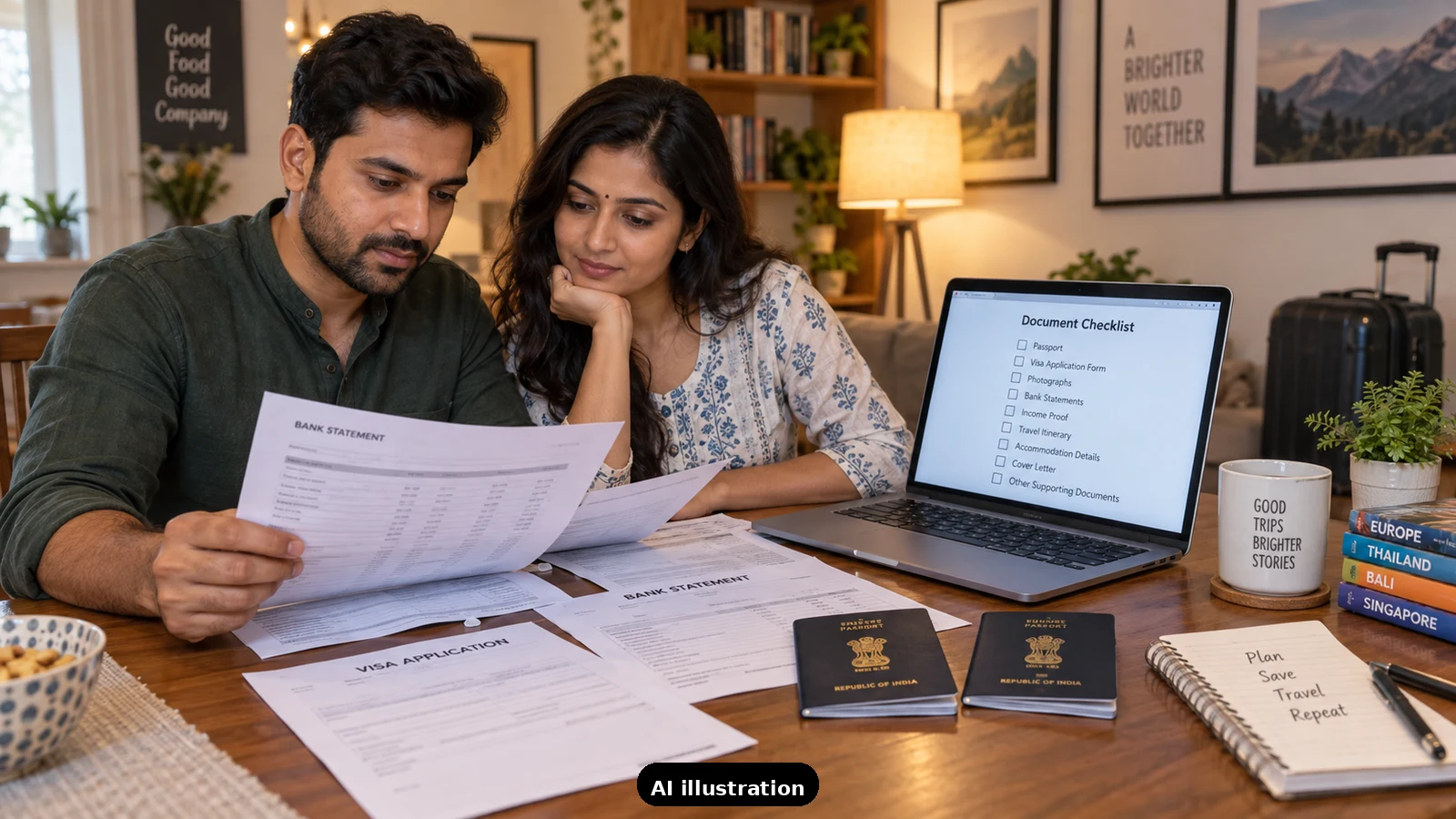
Short answer: yes, and it is normal. Schengen consulates see couples' applications built on shared money every day - joint accounts, one earning spouse, pooled savings. What they do not accept is ambiguity: each of you submits a separate application with a complete document set, and the finances inside each file must be traceable to that applicant. The same bank statement can appear in both files, as long as each file explains why it belongs there.
First, understand that there are always two files. A husband and wife never submit one joint Schengen application. You fill two forms, pay two fees, book two appointments (usually together), and each file is assessed on its own. So the question is never "can we use one statement" - it is "how does the same money show up correctly in two separate files."
Case one: a joint account with both names. This is the simplest shape. Each spouse includes a copy of the same joint-account statements - typically the last three months, bank-stamped, as the German checklist used by VFS in India specifies. Both names on the account header do the explaining: the funds are demonstrably available to each applicant. Some couples add a one-line cover note pointing out the joint account and cross-referencing the spouse's application; it is not mandatory, but it makes the officer's job easier.
Case two: the account is in one spouse's name only. Then the other spouse applies on the sponsor track, which the German missions' checklist spells out plainly. The sponsored spouse's file carries: a sponsor letter from the earning spouse with their passport copy, the sponsor's bank statements for the last three months stamped by the bank, and - since the sponsor is a spouse - the marriage certificate. The sponsoring spouse's own file carries the same statements as their personal proof of funds. Same money, two files, each internally consistent.
The marriage certificate is the load-bearing document. When one spouse's money supports the other's application, the relationship proof is what makes it legitimate. Carry the marriage certificate in the sponsored file; some missions want it apostilled or translated, so check your specific consulate's checklist early rather than at the counter. If you changed your surname after marriage and the passport and certificate disagree, line up the name trail across documents before filing.
What to avoid. One, the non-earning spouse submitting no financial documents at all and hoping the partner's file covers it - it does not; every file needs its own financial trail, even if that trail points to the spouse. Two, a sudden large deposit in the shared account right before applying - officers read statements for stability, not just balance. Three, mismatched stories: if one file says self-funded and the other says sponsored, that inconsistency is worse than either arrangement alone.
Apply together, cross-reference openly. Booking appointments on the same day, mentioning each other's application in cover letters, and keeping travel dates, hotels and itineraries identical across both files reads as what it is - a couple travelling together with shared finances. Consulates do not frown at that. They frown at files that hide the connection.
How we handle this at TripKeeper. For couples we build both applications as a pair - the statements, sponsor letter and marriage certificate arranged so each file stands on its own and matches the other. If you would like your Schengen file prepared that way, send us a trip-planning inquiry.

A Miranda House graduate and lawyer who traded courtrooms for slow travel. Cheshta travels with the batches we host ourselves, with a soft spot for travelling alongside elders.
Planning your next trip?
We'll handle insurance, hotels, airport assistance and the itinerary — the same way we do it for every trip.
Questions on this article
asked by readers, answered by us
Was this helpful?
one tap, no sign-up