




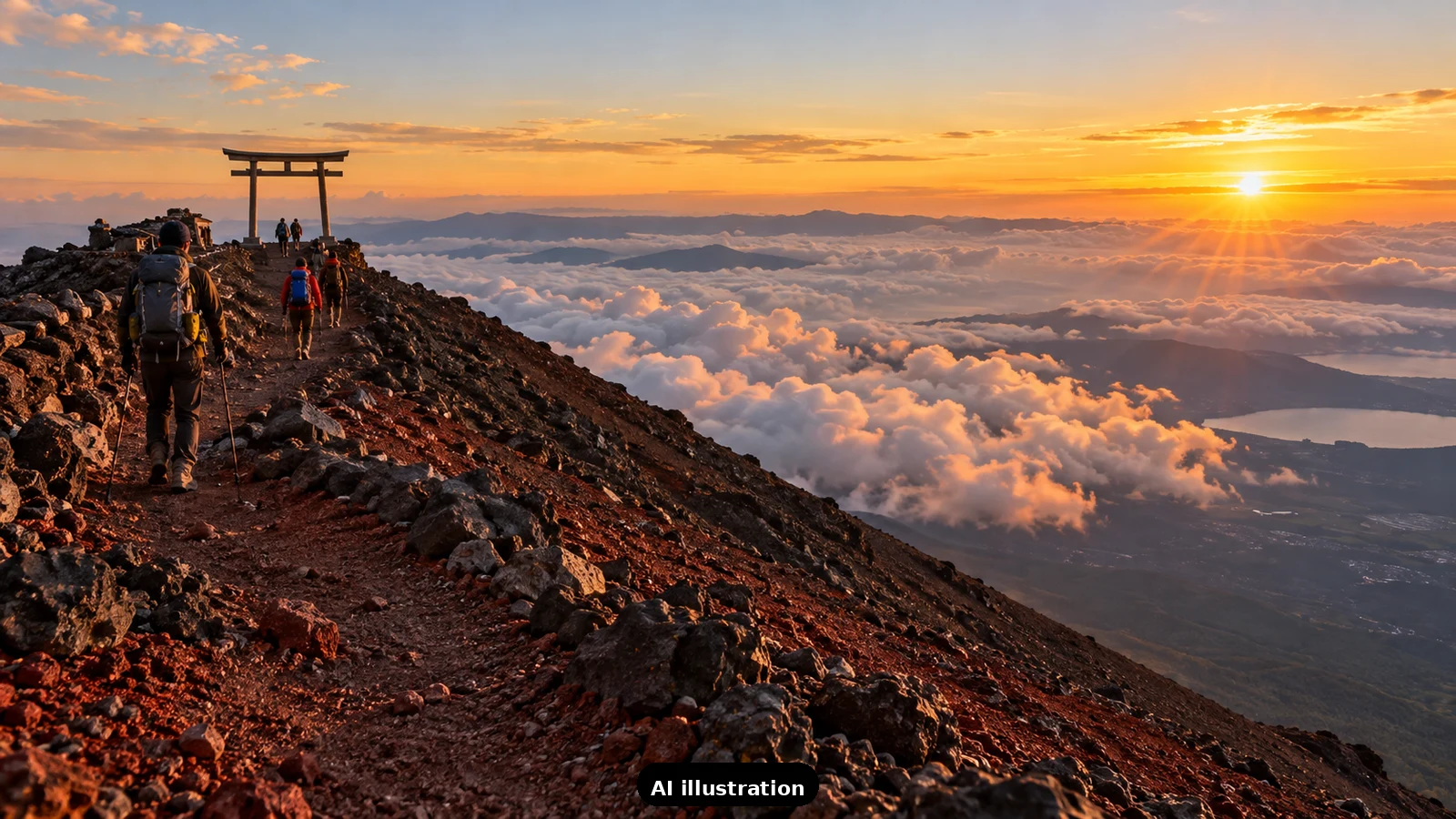
Climbing Mount Fuji used to mean turning up at a trailhead with a headlamp. Not anymore. Both prefectures that share the mountain - Yamanashi and Shizuoka - now run regulated seasons with fees, entry gates, apps and hut-stay requirements, and the details have changed every recent year. Here is the current state of the rules, the four routes, and what to re-verify for 2027 before you book anything around the climb.
Read this first: 2027 rules are not published yet. Each year's regulations are announced in spring (typically April-May) ahead of the season, which runs from early July to early September. What follows are the rules as confirmed for the most recent season - the 2027 season will look similar, but fees, caps and procedures can change, so treat this as the working baseline and confirm on the official climbing site (fujisan-climb.jp) and the prefecture pages once the 2027 announcement lands. Any article giving you 2027 fees before spring 2027 is guessing.
The rules as they stand. Across all four trails, climbers now pay a hiking fee of 4,000 yen per person, charged once. Entry to the mountain between 2 PM and 3 AM requires an overnight reservation at a mountain hut - the days of starting at midnight to 'bullet climb' to the sunrise are over by ordinance, for safety reasons. The Yoshida Trail (Yamanashi side) runs a gate system with a daily climber cap and an advance online reservation system; on the Shizuoka side (Fujinomiya, Subashiri and Gotemba trails), entry procedures run through the official 'FUJI NAVI' app, which includes mandatory pre-learning on rules and etiquette with a short confirmation test, climber registration, fee payment and a QR entry pass - on-site registration is available as a fallback, and completers get a wristband. The 2 PM - 3 AM hut-stay rule applies on both sides.
The season and its edge cases. In recent years the Yoshida and Subashiri trails have opened July 1 and the Fujinomiya and Gotemba trails July 10, all closing September 10 - with the caveat that opening can be delayed by late snow. Outside the season the huts, toilets and patrols are shut and the mountain is genuinely dangerous; climbing out of season is for experienced alpinists with proper registration, not for visitors. For 2027, plan on the same early-July to early-September window and confirm exact opening dates in spring.
The four routes, briefly. Yoshida (from Fuji Subaru Line 5th Station, Kawaguchiko side) is the popular one: easiest access from Tokyo, the most huts, the biggest crowds, and the sunrise viewed over the clouds from the east. Fujinomiya (Shizuoka) starts highest and is shortest but steep - the fit-hiker route. Subashiri merges into Yoshida above the 8th station and has a pleasant forested lower section. Gotemba is the longest and quietest, a serious endurance day with almost no huts low down. First-timers with normal fitness should take Yoshida up with a hut booking; the descent returns by a separate bulldozed track.
Mountain huts: book the moment yours opens. The hut stay is now effectively mandatory for the classic overnight climb - arrive afternoon, sleep a few hours in a communal bunk, summit for sunrise, descend. Huts are spartan and booked out weeks ahead on weekends and through the Obon period in mid-August. Reservations open in spring when each hut's system goes live; expect roughly 9,000-12,000 yen per person with dinner and breakfast in recent seasons (huts set their own prices - verify at booking). Bring earplugs, warm layers for a sub-zero summit dawn even in August, cash for the summit stamps and water, and crampons only if snow lingers early in the season.
Should you climb, or just look? Be honest with yourself: the climb is a long, cold, crowded trudge up volcanic gravel at altitude - many travelers are happier viewing Fuji from Kawaguchiko or Hakone. But for those who want it, the sunrise from Japan's roof is real, and the regulated system has made the experience safer and more orderly. If altitude worries you (symptoms start around 3,000 m), the two-day rhythm with a hut night is exactly the right mitigation.
How TripKeeper handles Fuji climbs. Our team builds Fuji climbs into itineraries only inside the official season, with hut reservations secured when systems open in spring, the prefecture app or gate registration done before travel, and a weather-buffer day around the climb where the route allows. Founder-hosted batches include the climb as a guided, regulated segment; independent travelers get the same booking calendar, rule updates when the 2027 regulations publish, and on-trip support through the trip-planning inquiry.

A Miranda House graduate and lawyer who traded courtrooms for slow travel. Cheshta travels with the batches we host ourselves, with a soft spot for travelling alongside elders.
Planning your next trip?
We'll handle insurance, hotels, airport assistance and the itinerary — the same way we do it for every trip.
Questions on this article
asked by readers, answered by us
Was this helpful?
one tap, no sign-up
