




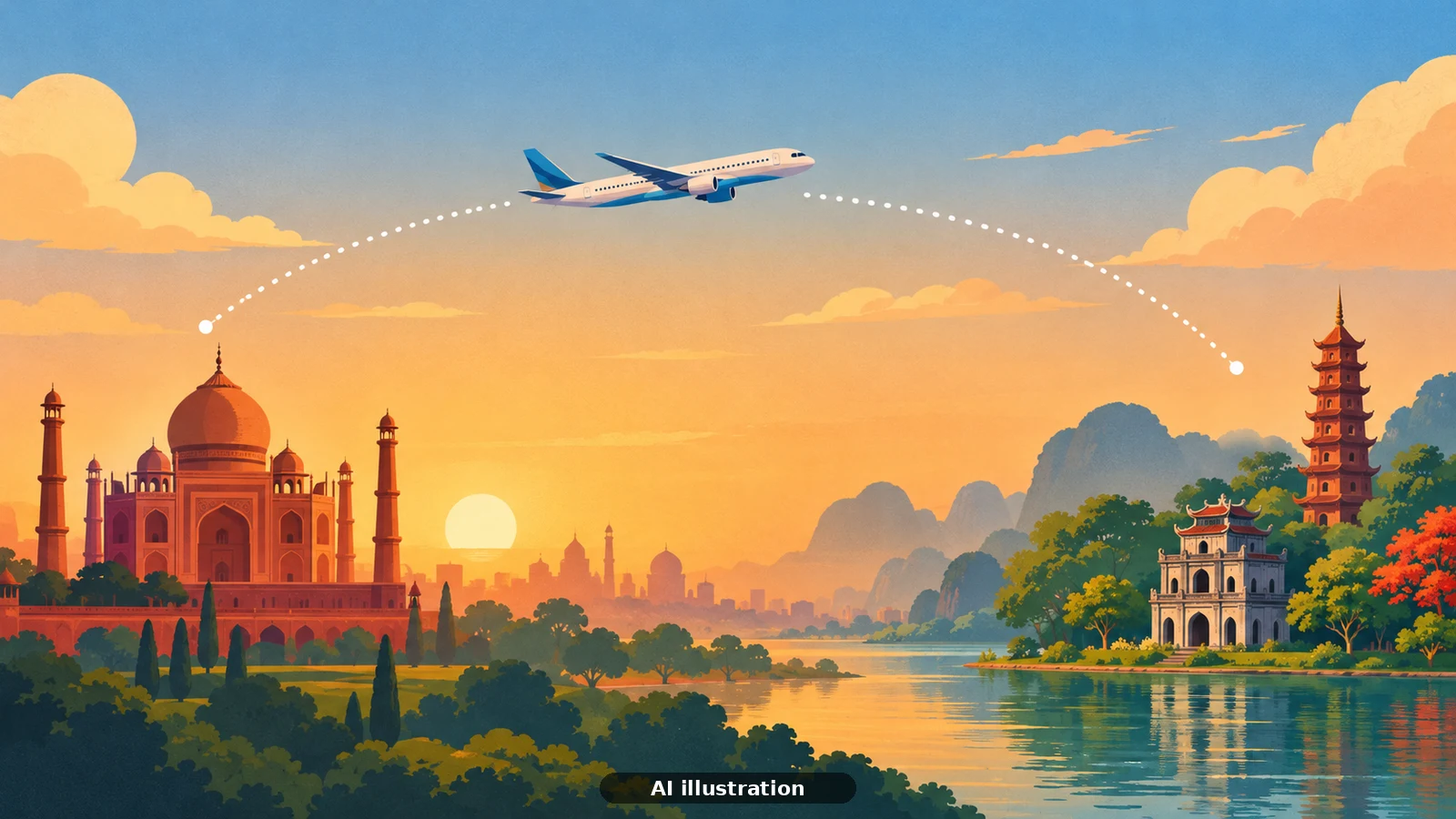
The premise: Hanoi is closer to Delhi than most Indians assume - about 3,000 km, the same air distance as Delhi to Bali is not. Until recently every itinerary meant a layover in Bangkok, Singapore or Kuala Lumpur. That changed on 20 December 2025, when IndiGo opened a daily nonstop and the route filled out. Here is the current picture, checked against sources updated 11 October 2025 to 25 October 2026.
The nonstop: the option that now wins
Four airlines fly Delhi (DEL) to Hanoi (HAN) nonstop - IndiGo, Vietnam Airlines, Air India and VietJet Air - roughly 19 flights a week, scheduled at 4 hours to 4 hours 35 minutes over 1,865 miles (timetable confirmed 25 October 2026). IndiGo's daily service, launched 20 December 2025, runs 6E 1633 out of Delhi at 07:25, landing 13:00 local, with the return 6E 1634 leaving Hanoi at 18:00 and reaching Delhi 21:25 - timings that leave a full first and last evening in the city. One-way fares start around Rs 13,000-13,500 on the meta-search calendars for 2026 dates, less in sales. For almost every traveller, this is the answer: book whichever nonstop matches your dates and budget, and stop reading.
One-stop options: when they still make sense
Two cases. Price: in peak weeks (late December, Tet), nonstop fares climb and a one-stop via Bangkok, Kolkata or Kuala Lumpur can undercut by Rs 3,000-6,000 per person - worth it if the layover stays under four hours. IndiGo also flies Kolkata-Hanoi, so a Delhi-Kolkata-Hanoi same-ticket connection exists within one airline. Coverage: if the nonstop timings do not fit (the morning banks are early), evening one-stops via Bangkok on Thai, AirAsia or Vietnam Airlines fill the gaps. Past about five hours of layover the saving stops being worth the day - count door-to-door hours, not the fare difference alone.
Train and road: the honest verdict
There is no India-Vietnam railway, and there is no sensible road route. The overland lines on the map fail at borders, not distance. The India-Myanmar crossing at Moreh-Tamu exists, but continuing across Myanmar to Thailand and on to Vietnam means multiple border permits, regions with travel advisories, and a week of buses - it is an expedition, not a transfer, and overland operators who ran it have largely suspended it. The China option (Nepal into Tibet, or Yunnan down to the Lao Cai-Hekou crossing into Vietnam) stacks a Chinese visa, a separate Vietnam entry, and three to five days of trains and buses. If you want an overland flavour inside Vietnam, the classic Hanoi-Lao Cai overnight train to Sapa delivers it in one night - from Hanoi, after you have flown in.
Booking friction: what actually decides the fare
Visa first. Indians need a Vietnam e-visa, applied for online - approval is not instant, so apply before fare-hunting in peak season, and match the name on the application to the passport exactly. Bags. VietJet's headline fares are carry-on only; adding 20-25 kg of checked baggage narrows most of the gap to the full-service nonstops. Airport. Hanoi arrivals land at Noi Bai (HAN), about 27 km and 40-60 minutes from the Old Quarter - factor the transfer time when you compare an early-morning nonstop against a midnight one-stop. Timing the buy. For the November-April season, fares on this route have behaved like other new IndiGo international routes: book 6-10 weeks out, and recheck after the launch-period sales end.
Bottom line
Fly nonstop. Four airlines, about 19 flights a week, four and a half hours, from roughly Rs 13,000 one way - IndiGo's daily 07:25 departure being the handiest. Use a one-stop via Bangkok or Kolkata only when it saves real money with a short layover, and treat train-and-road combinations as adventure travel, not as a way to get to Hanoi.

A Miranda House graduate and lawyer who traded courtrooms for slow travel. Cheshta travels with the batches we host ourselves, with a soft spot for travelling alongside elders.
Planning your next trip?
We'll handle insurance, hotels, airport assistance and the itinerary — the same way we do it for every trip.
Questions on this article
asked by readers, answered by us
Was this helpful?
one tap, no sign-up