




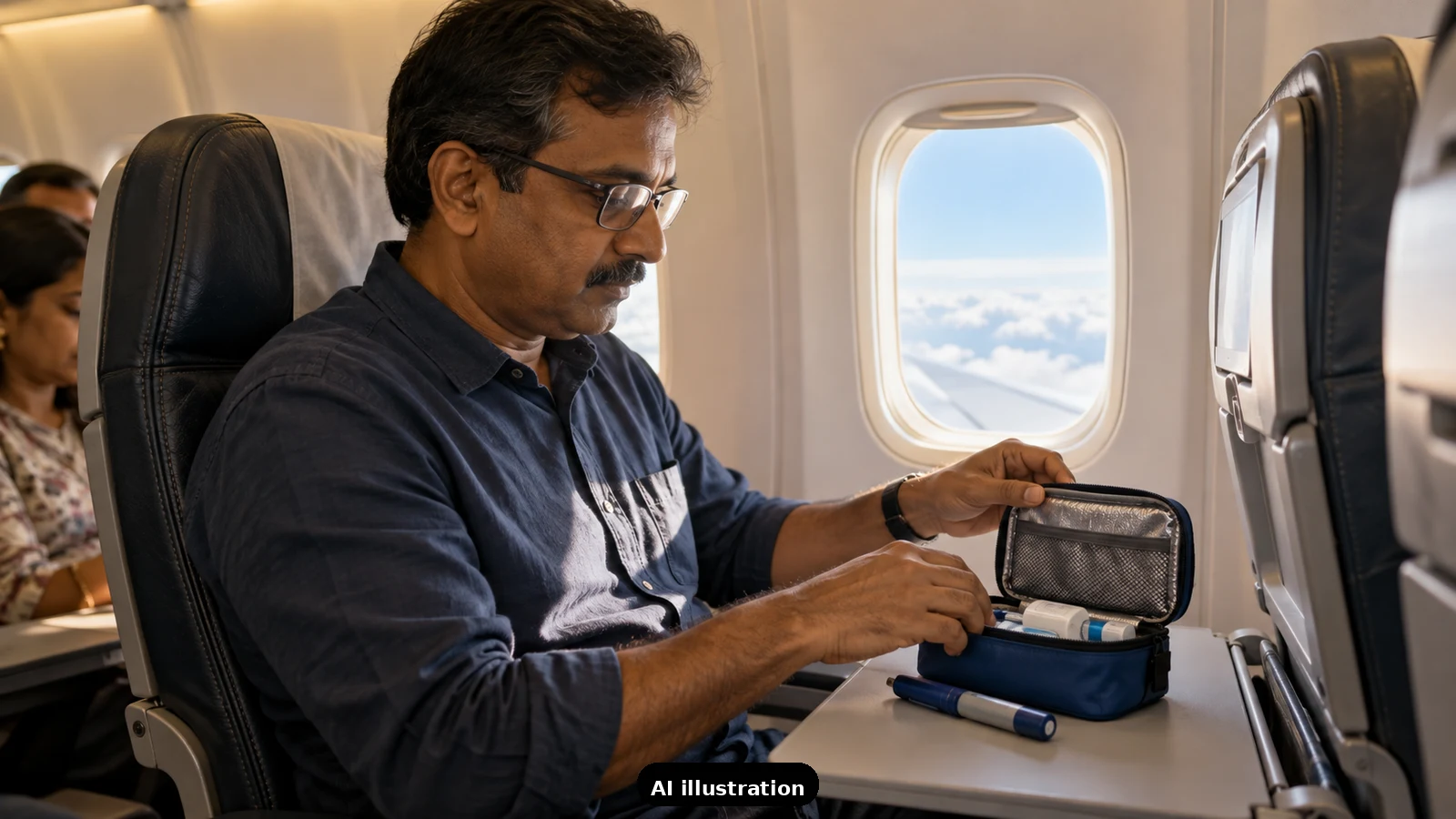
Injectable medicines like insulin, some arthritis biologics and growth hormone share one weakness: heat and freezing both destroy them. The good news is that a long flight is one of the easier legs to manage - the cabin is temperature-controlled, and the right pouch does the rest. What ruins medicine is usually the checked bag, the car dashboard, or direct contact with ice.
First decision: cabin, always. Never pack injectable medicine in checked baggage. The cargo hold can drop below freezing on long sectors and can also overheat on the tarmac, and a lost bag is a medical emergency. The medicine, the cooling kit, the prescription and the doctor's letter all travel in your cabin bag, and ideally the supply is split between two bags in case one goes missing.
Know what temperature you actually need. Unopened insulin stock needs 2-8 degrees Celsius - fridge temperature. But a pen or vial currently in use is stable at room temperature, below about 25-30 degrees, for up to 4 weeks depending on the brand (check your manufacturer's leaflet). For many travellers this means the pen in your pocket needs no cooling at all; only the backup supply does.
Option one: the evaporative cooling wallet. The workhorse for long journeys. Wallets like Frio contain crystals that activate after a soak in water and keep contents cool through evaporation for a minimum of 45 hours - no fridge, no ice, no electricity, and nothing that counts as a liquid at security. It holds safe cool temperatures rather than fridge-cold ones, which is exactly what in-use medicine needs. Activate it before you leave home.
Option two: insulated pouch plus gel ice pack. Better when you must carry unopened stock at fridge temperature. Freeze the pack solid before you leave. TSA and most security regimes allow frozen gel packs through the checkpoint as long as they are frozen solid at screening, and medically necessary gel packs are permitted in reasonable quantities even when partially melted - declare them with your medicine. The critical rule, from Diabetes UK's travel guidance: never let the medicine touch the frozen pack directly, because frozen insulin is ruined insulin. Wrap the pack in cloth and keep a layer between it and the pens.
Option three: nothing. If your whole supply is in-use pens and the journey - door to hotel fridge - is under the room-temperature window, you can skip cooling entirely. This is common on straightforward long-hauls: 15-18 hours is well inside the 4-week room-temperature limit.
On board. Keep the pouch with you or under the seat, not in an overhead bin near the hot reading lights. If you use ice from the crew as a top-up, put it in a separate bag beside the pouch - never put pens directly on ice. Avoid leaving the kit on the seat in direct sunlight from the window.
On arrival. Move the backup supply to the hotel room fridge as soon as you check in. If there is no fridge, a re-soaked evaporative wallet keeps going - just reactivate it with water every couple of days as directed. In hot climates, watch for the warning signs Diabetes UK lists: clear insulin turning cloudy, or any brownish discolouration, means the dose is damaged and should not be used.
Paperwork that smooths the path. Carry the prescription and a doctor's letter naming the medicine, the need for needles and the cooling requirement, and keep everything in original labelled packaging. It turns every security conversation into a 30-second one.
How TripKeeper supports this. When a traveller in the family flies with temperature-sensitive medicine, we plan the cold chain alongside the itinerary - layover lengths, fridge access at hotels, what to declare where. Send us a trip-planning inquiry and we will build it into your trip.

A Miranda House graduate and lawyer who traded courtrooms for slow travel. Cheshta travels with the batches we host ourselves, with a soft spot for travelling alongside elders.
Planning your next trip?
We'll handle insurance, hotels, airport assistance and the itinerary — the same way we do it for every trip.
Questions on this article
asked by readers, answered by us
Was this helpful?
one tap, no sign-up