




- Place
- Masroor rock-cut temples
- Focus
- Main shrine and surrounding grid
- Shrine / image key
- Not supplied
- Walking circuit
- Not established
- Reviewed
- 17 November 2026
Reviewed: 17 November 2026. Selective heritage outline, not a ticket or access guarantee.
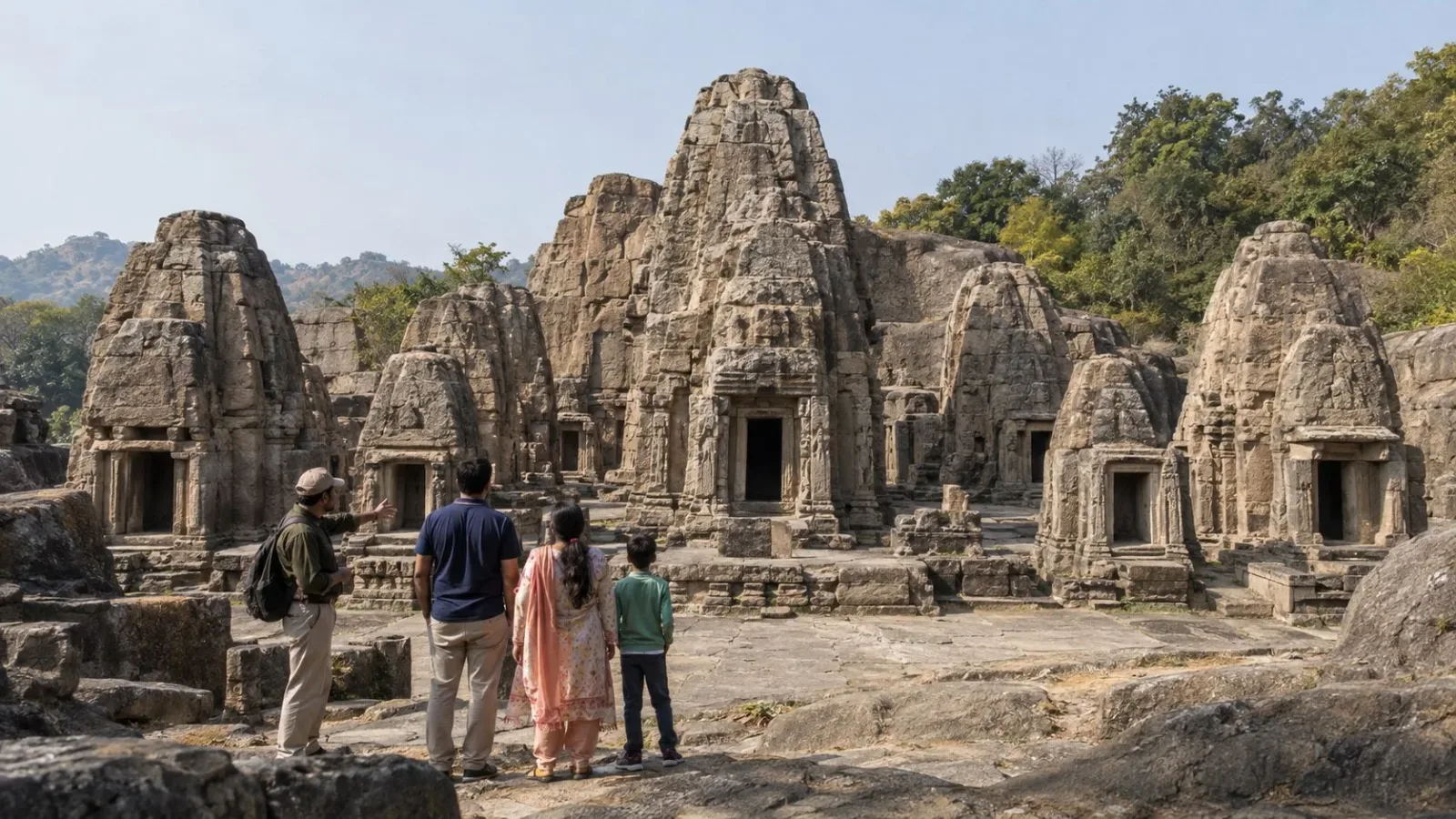
AI-generated fictional Masroor-inspired scene, not a surveyed square grid, shrine-by-shrine or iconographic key, construction sequence or current view/access record.
Masroor's rock-cut temple group has a specific organising idea in the Kangra district description: a square grid, with the main temple surrounded by smaller temples. That relationship is the focus here. It explains the group through its arrangement rather than through a list of shrines to complete.
Begin with the main-and-surrounding relationship
The district describes the complex as symmetrically arranged on a square grid. It also describes square plans for the principal sanctum and other spaces. The useful distinction is between the organisation of the group and the plan of an individual part. They are related descriptions, not interchangeable labels.
The main temple and its surrounding smaller shrines give the grid a readable hierarchy. Keep that relationship in mind without assuming that every remaining feature can be named from a general description. This is not a detailed surveyed plan or a shrine-by-shrine key.
Separate construction from organisation
The same district account describes temples carved from monolithic rock. That tells you about the rock-cut architectural form. The square grid tells you about the way the parts are arranged. Saying 'rock-cut' alone does not explain the main temple's relationship to the surrounding shrines.
These ideas can be considered together without inventing a construction sequence. The sources used here do not supply a practical account of the tools, labour or exact order of carving. No demonstration of how the complex was made is proposed.
Do not make geometry answer every question
A square-grid description is not an identification of every image or a complete account of religious meaning. This article uses the explicit main-and-surrounding relationship, not an inferred symbolic rule for each shrine. It does not assign deities, narratives or ritual functions to individual positions.
It also leaves theories about orientation, celestial alignment, unfinished intentions and causes of damage aside. Those questions need their own evidence. The spatial relationship remains useful without turning the plan into an explanation of everything at the site.
Keep the plan separate from a visitor route
An architectural plan describes the relationship of parts. It is not a walking instruction, a promise that every shrine can be entered or confirmation that the full grid is visible from a particular position.
This account makes no current access, surface, facility or viewing claim. It does not prescribe a circuit or require completion of every part. Its purpose is narrower: to distinguish the main shrine, surrounding shrines and the square-grid organisation described by the district.
Frequently asked questions
What is the organising idea?
The district describes a square grid with the main temple surrounded by smaller temples.
Does rock-cut explain the layout?
It describes the construction form; the grid describes the arrangement.
Does this identify every shrine or image?
No. It is not an iconographic map or a surveyed plan.
Is the grid a confirmed walking circuit?
No. No route or access arrangement is established here.
Does geometry identify each deity or ritual?
No. The article assigns no deity, narrative or ritual function to individual positions.
Does this establish a carving demonstration?
No. No exact tools, labour sequence or visitor demonstration is established.
Official sources and limits
The district description supports the limited main-and-surrounding shrine relationship and square-grid discussion, not a surveyed plan, iconography, carving sequence, complete view or current access arrangement.

A Miranda House graduate and lawyer who traded courtrooms for slow travel. Cheshta travels with the batches we host ourselves, with a soft spot for travelling alongside elders.
Planning your next trip?
We'll handle insurance, hotels, airport assistance and the itinerary — the same way we do it for every trip.
Questions on this article
asked by readers, answered by us
Was this helpful?
one tap, no sign-up