




- Place
- Teli ka Mandir
- Focus
- Roof and ornament
- Upper form
- Dravidian-style in official descriptions
- Decoration
- Northern stylistic vocabulary
- Reviewed
- 17 November 2026
Reviewed: 17 November 2026. Selective heritage outline, not a ticket or access guarantee.
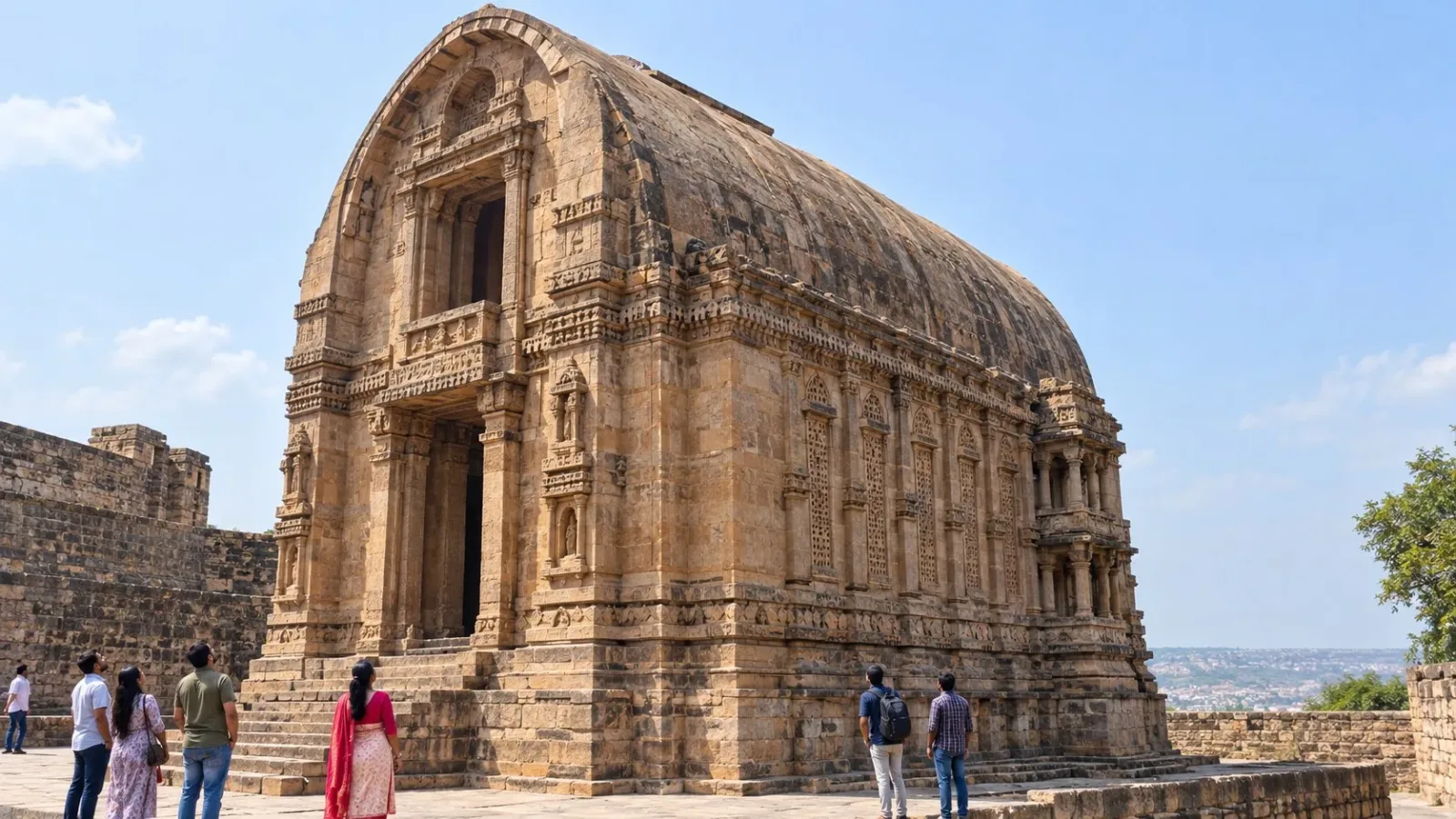
AI-generated fictional Teli ka Mandir-inspired scene, not a measured reconstruction, motif catalogue, structural section or current viewing/access record.
At Teli ka Mandir, the roof and the ornament are useful clues to read separately. Madhya Pradesh Tourism describes a Dravidian-style roof and embellishment associated with northern India. The national tourism account makes a similar distinction between the upper form and Nagara decorative details.
The point is not to label the whole building after noticing a single feature. It is to understand how the official descriptions attach different style terms to different aspects of the architecture.
Begin with what the roof description says
The state account identifies the arched roof as a special feature and calls its style Dravidian. The national account describes a Dravidian-style shikhara. Their wording differs, but the useful shared point is that the upper architectural form receives a specific stylistic description.
This article follows that limited relationship. It does not present a measured section, reconstruct the roof's structural system or claim that one shape is a universal test for identifying every temple in a region.
Read ornament as a separate clue
Madhya Pradesh Tourism describes the embellishment as Indo-Aryan and says the decoration resembles that of northern India. The national description uses Nagara for the northern decorative details. These are source terms for the treatment of the building, not a reason to ignore its roof form.
Keep the distinction simple: form above and decorative vocabulary need not be described in identical terms. This account does not assign every carving to a region, identify a complete set of figures or use a single motif to classify the entire temple.
Do not turn style into a biography
A stylistic comparison does not by itself identify the makers' origins, their movements or the exact sequence of construction. Nor does it establish who paid for the building, why it was named or how its religious associations changed.
Those are separate historical questions. They are left outside this account rather than answered through the appearance of a roof or a decorative detail. No naming legend or patronage story is needed to understand the specific roof-and-ornament relationship described by the official sources.
Keep this a building-specific interpretation
The useful question is how these descriptions work together at Teli ka Mandir. It is not a general north-versus-south checklist or a rule that every building must fit one category. Reading the terms at the scale of the feature keeps the interpretation precise.
This is not a current visitor guide. No viewing position, close inspection, access arrangement, physical condition or facility is verified here. The architectural description should not become a promise about what can be seen or done on a particular visit.
Frequently asked questions
What is the main distinction?
Official accounts distinguish the upper form from northern decorative details.
Is the arched-roof description directly sourced?
Yes. Madhya Pradesh Tourism explicitly describes it.
Can one motif classify the whole building?
That is not the method used here; the focus is on separate architectural clues.
Does style establish who built it or why it was named?
No. Those historical questions are not settled by this comparison.
Does the comparison reconstruct the roof structure?
No. It describes source terms for the upper form, not a measured structural system.
Is this a current viewing guide?
No. Viewing positions, close inspection and access are not verified here.
Official sources and limits
Official descriptions support the feature-level roof/ornament comparison, not a universal architectural test, maker biography, naming story, structural reconstruction or current visitor arrangement.

A Miranda House graduate and lawyer who traded courtrooms for slow travel. Cheshta travels with the batches we host ourselves, with a soft spot for travelling alongside elders.
Planning your next trip?
We'll handle insurance, hotels, airport assistance and the itinerary — the same way we do it for every trip.
Questions on this article
asked by readers, answered by us
Was this helpful?
one tap, no sign-up