




The Trip Keeper The Trip Keeper
three doors, pick the one that fits your family How do you want to travel?
Cheshta Agarwal, founder and host of The Trip Keeper, smiling on a green country road
Hosted by Cheshta

Founder-Hosted Group Tour

the trips where Cheshta travels with you

Our own exclusive group trips. Cheshta is on the trip, from the first flight to the last dinner.

  • Cheshta travels with the group
  • One clear price, inclusions listed
  • Meet your travel family
Next up: Vietnam, 17 DecView →
See founder trips →
A fixed-departure batch on tour

fixed dates, fixed flights

Join a batch of fellow travellers on set dates. Limited seats, flights included, with options. Our team doesn't travel on these.

  • Fixed dates and flights
  • Limited seats per batch
  • Flight options available
See departures →
A private family trip

Private Tour

your dates

just your family, nobody else

Trips planned around your family, your pace and your dates. Milestone birthdays and anniversaries.

  • Travel on your own dates
  • Route shaped around you
Ask for a quote →
← Journal ☏
Trip Planning 3 min read

What Should Elderly Travellers Do If the Station Escalator Is Not Working?

Stop - do not let anyone push on up the stairs. A broken escalator at an Indian station almost always has a working alternative: the lift, a ramp, a station wheelchair, or staff help. Who to ask, what to say, and how to climb stairs safely if there is truly no other way.

share WhatsApp Facebook X
Text size
What Should Elderly Travellers Do If the Station Escalator Is Not Working?
Send to Mummy-Papa Opens WhatsApp with a short summary — pick who to send it to.

Short answer: do not force the stairs. When an escalator is barricaded or dead, the first move is to stop and look for the lift - most stations that have an escalator also have a lift, often on the same foot overbridge. If there is no lift or it is also down, any uniformed railway staff can arrange help: a wheelchair, a staff member or porter to carry bags and steady the climb, or the ramp route where one exists. The only bad option is an elderly parent struggling up a staircase because nobody asked for help.

First: look for the lift and the ramp. Escalators and lifts are usually installed as a pair at major stations, and where there is no lift, many stations have a ramp - sometimes at the end of the platform rather than the middle. Follow the accessibility signage, and remember the lift may serve a different overbridge than the broken escalator. A two-minute look or one question at the enquiry counter saves a dangerous climb.

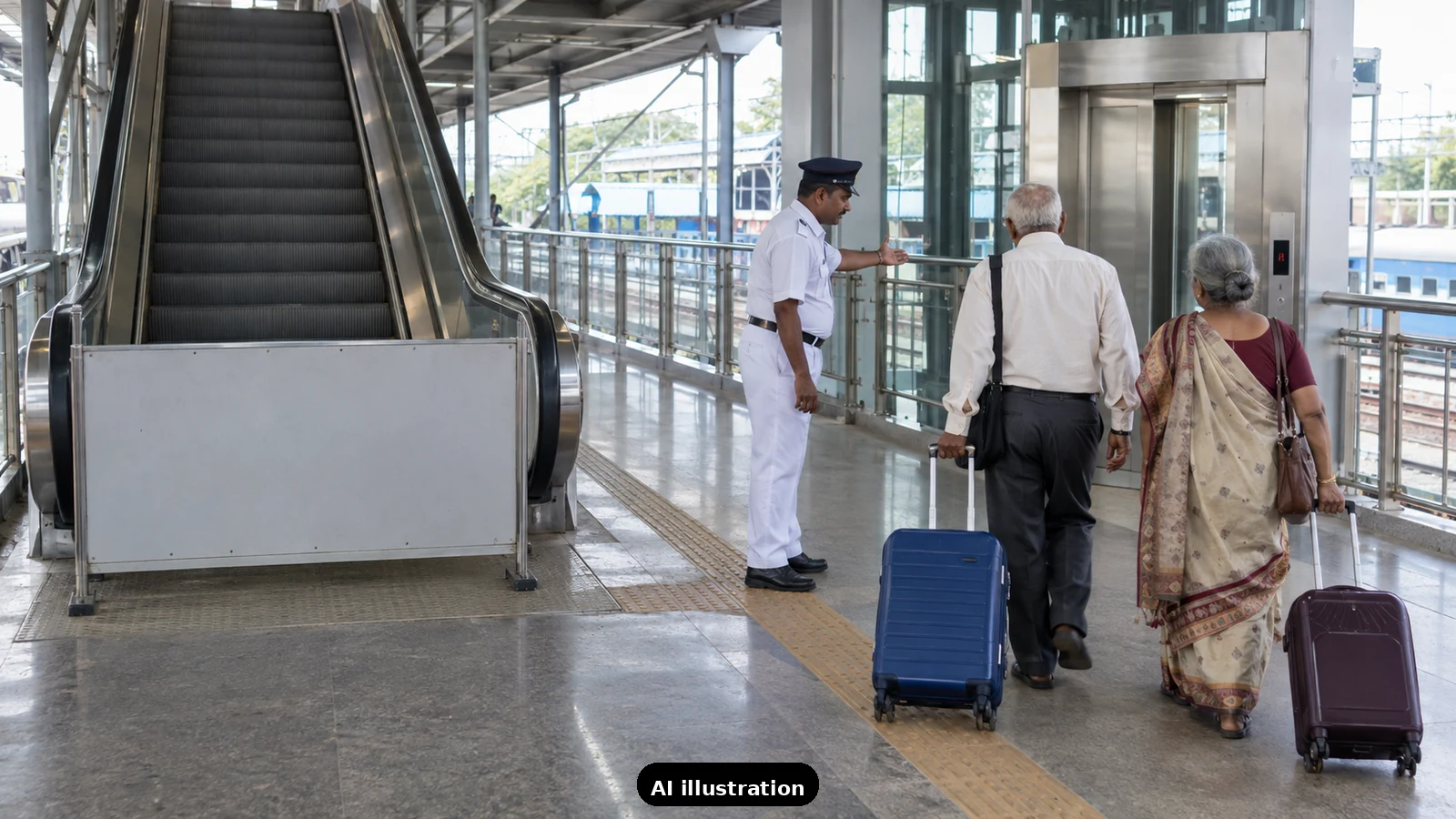
Second: ask - stations are staffed for exactly this. Approach anyone in railway uniform, the enquiry counter, or the RPF post and say clearly: 'Senior citizen hai, escalator band hai - wheelchair ya madad mil sakti hai?' Station staff handle this daily: they can call a wheelchair (free at many stations), assign a porter for the luggage so both your hands are free for your parent, and walk you to the step-free route. If no one is visible, call RailMadad on 139 from the platform - it connects you to the station's help system and your request is logged, which gets faster attention.

Third: let the parent wait seated while you sort it out. The safest arrangement: settle the elderly traveller on a platform bench with the bags, away from the crowd flow, while one person scouts the lift or fetches staff. No hurrying because the train is due - an extra ten minutes on the platform beats a fall on concrete stairs. If the train genuinely cannot be caught comfortably, speak to the TTE or station staff about the next train rather than risking the climb.

If stairs are truly the only way. Sometimes, at smaller stations, they are. Then do it safely: one person ahead carrying nothing, offering an arm; the parent holds the railing on the other side and climbs at their own pace with a rest on the landing; a porter or the second person manages all luggage - the parent carries nothing. Landings exist for resting; use every one. Never let a crowd push the pace.

And before the next journey: verify, don't hope. A two-minute call to RailMadad (139) a day before travel confirms whether your station's lift and escalator are working - and lets you pre-book a wheelchair through IRCTC's e-wheelchair service at nominated stations. Choosing to board from a better-equipped nearby station is often the smarter plan entirely.

How TripKeeper handles station access. When we plan train journeys for elderly travellers, we confirm step-free routes at every station and arrange wheelchairs and porters in advance - so a broken escalator is a detour we planned for, not a crisis. If you would like your parents' journey planned that way, send us a trip-planning inquiry.

Send to Mummy-Papa Opens WhatsApp with a short summary — pick who to send it to.
Cheshta Agarwal
Founder · Travel Creator · Lawyer

A Miranda House graduate and lawyer who traded courtrooms for slow travel. Cheshta travels with the batches we host ourselves, with a soft spot for travelling alongside elders.

or let us do all of it

Planning your next trip?

We'll handle insurance, hotels, airport assistance and the itinerary — the same way we do it for every trip.

Questions on this article

asked by readers, answered by us

What should I do if the escalator at my railway station is not working?

Don't force the stairs. Look for the lift - stations with escalators usually have one, often on the same overbridge - or a ramp, sometimes at the platform end. If neither works, ask any uniformed staff or the enquiry counter for a wheelchair or help, or call RailMadad on 139 from the platform.

Whom do I contact at the station when the escalator is broken and my parent cannot climb stairs?

Any uniformed railway staff, the enquiry counter, or the RPF post - say clearly that a senior citizen needs a wheelchair or assistance. If no staff is visible, call RailMadad on 139; the request is logged and routed to the station's help system.

Are wheelchairs available at Indian railway stations if the escalator fails?

Yes - many stations provide wheelchairs free through staff assistance, and at nominated stations you can pre-book through IRCTC's e-wheelchair service. Ask at the enquiry counter or any uniformed staff member; they will call one to your platform.

Is it safe for an elderly person to climb the foot overbridge stairs if there is no lift or escalator?

Only carefully, and only if there is genuinely no alternative: one person ahead offering an arm, the parent holding the railing, climbing at their own pace with a rest on every landing, and someone else carrying all the luggage. If a comfortable climb is not possible, waiting for help or even taking a later train is safer than a fall.

Can I get a porter to help my elderly parent at the station?

Yes - licensed porters are available at most stations and carry the luggage so your hands are free to support your parent on stairs or ramps. Agree the rate before starting. For hands-on mobility help, ask station staff for a wheelchair rather than relying on a porter alone.

How can I avoid this situation before travelling with elderly parents?

Call RailMadad (139) a day or two before travel to confirm your station's lift and escalator are working, and pre-book a wheelchair via IRCTC's e-wheelchair service at nominated stations. If the station has no step-free access, boarding from a better-equipped nearby station is often the smarter plan.

Was this helpful?

one tap, no sign-up

Read next

← Journal See our trips