




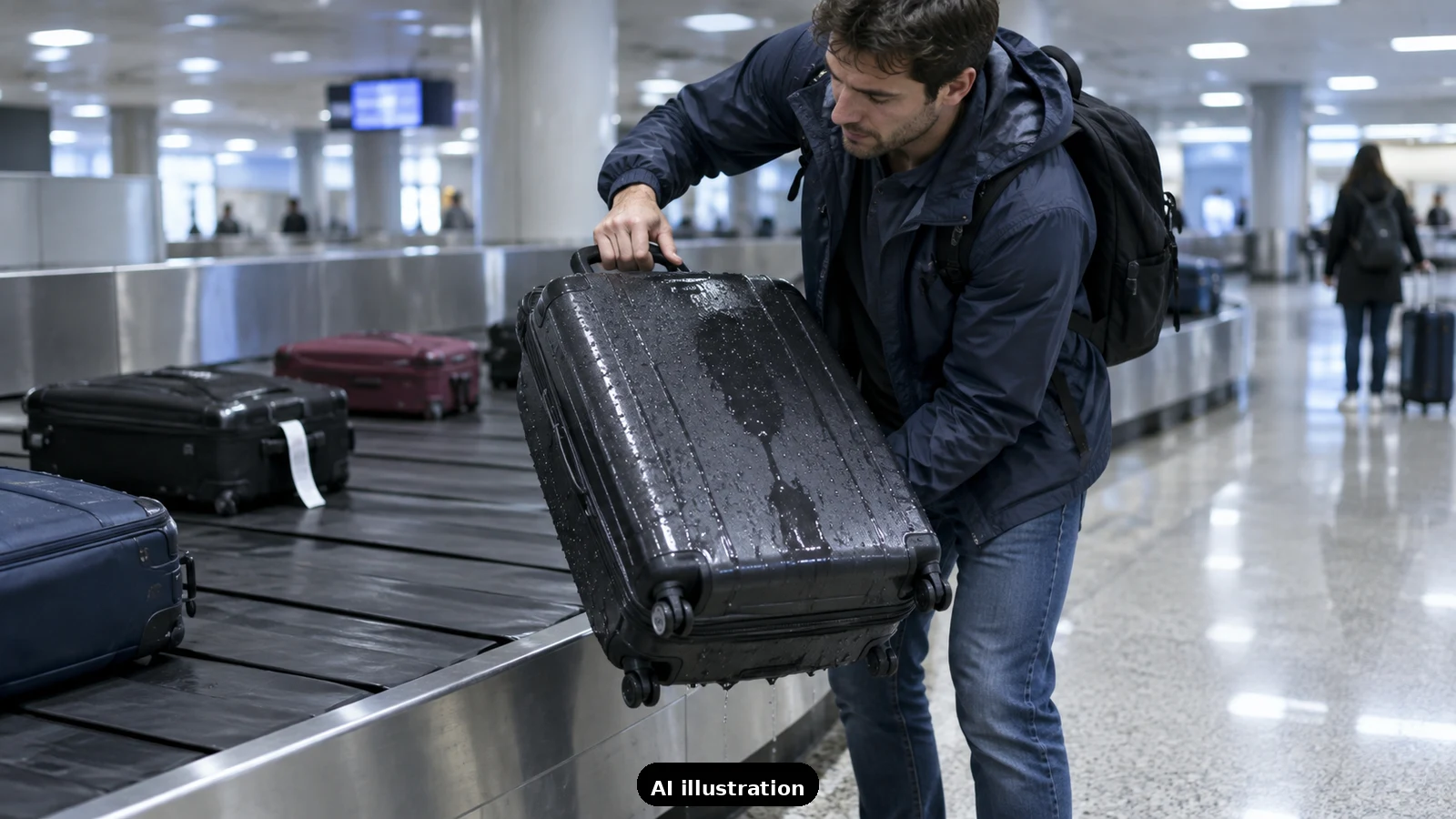
Short answer: treat a wet suitcase as damaged baggage and report it to the airline's desk in the arrival hall before you walk out. IndiGo's Conditions of Carriage are blunt about why: a bag accepted without complaint at delivery is prima facie evidence it arrived in good condition, and the airline requires an irregularity report at the destination airport, at the time of arrival - not after you have left. Everything else - photos, lists, claims - supports that one non-negotiable step.
At the belt, before you touch anything else. Photograph the suitcase while it is still visibly wet, ideally on or next to the belt: the wet patches, the bag tag with its barcode, and your boarding pass in one frame. Water damage is the easiest kind for an airline to dispute later ('it rained after you left'), so time-and-place evidence matters more here than for a broken wheel. Do not open the bag and spread the contents out at the belt - check quickly whether water got inside, note it, and keep everything as it is.
At the airline desk. Every airline has a baggage desk or representative in the arrival hall; IndiGo's own guidance for a damaged bag is exactly this - contact staff at the desk in the arrival hall. Describe what happened plainly: the bag arrived wet and the contents are water-damaged. Ask for a Property Irregularity Report (PIR) or the airline's equivalent written record, and keep the reference number, your bag tag and your boarding pass. If contents are damaged, say so now and have it recorded - a claim for ruined clothes filed later against a dry-sounding report is a weak claim.
What the compensation rules actually say. On domestic Indian flights, IndiGo's liability for loss, damage or delay of checked baggage is limited to Rs 350 per kg, up to Rs 25,000 per passenger, unless you made a special value declaration at check-in - that limit comes from the Ministry of Civil Aviation notification under the Carriage by Air Act, and other Indian carriers work to similar statutory caps. On international flights the Montreal Convention applies, which requires a written complaint for damaged baggage within seven days of receiving the bag. The practical reading: report at the airport always, and put the written claim in well inside a week for international sectors.
After you leave the airport. File the detailed claim with the airline as soon as you can assess the damage: list the affected contents with rough values, attach the belt-side photos, the PIR reference and any receipts you have. Washable clothes that recovered are hard to claim for; a damaged phone, soaked documents or stained formal wear are the substance of a claim. Keep the damaged items until the airline closes the file - some carriers ask for proof or even inspection.
Prevention, quietly. Bags sit on open trolleys on rainy tarmacs, so the veteran habit is a thin waterproof liner or a large garbage bag inside the suitcase around the contents, and electronics or papers always in cabin baggage - airlines exclude liability for valuables in checked bags anyway. A hard-shell case with a gasket-style zip closure survives monsoon transfers far better than soft fabric.
How TripKeeper handles it. On our trips, if baggage trouble hits mid-journey our team helps travellers file the right report at the right desk and keeps the paper trail straight while the holiday continues. If you would rather travel with that backup, send a trip-planning inquiry.

A Miranda House graduate and lawyer who traded courtrooms for slow travel. Cheshta travels with the batches we host ourselves, with a soft spot for travelling alongside elders.
Planning your next trip?
We'll handle insurance, hotels, airport assistance and the itinerary — the same way we do it for every trip.
Questions on this article
asked by readers, answered by us
Was this helpful?
one tap, no sign-up