
Reviewed 18 November 2026. An editorial architectural-interest comparison using Nepal Tourism Board and Bhaktapur Municipality descriptions. Not a route or a report on current interiors or restoration.
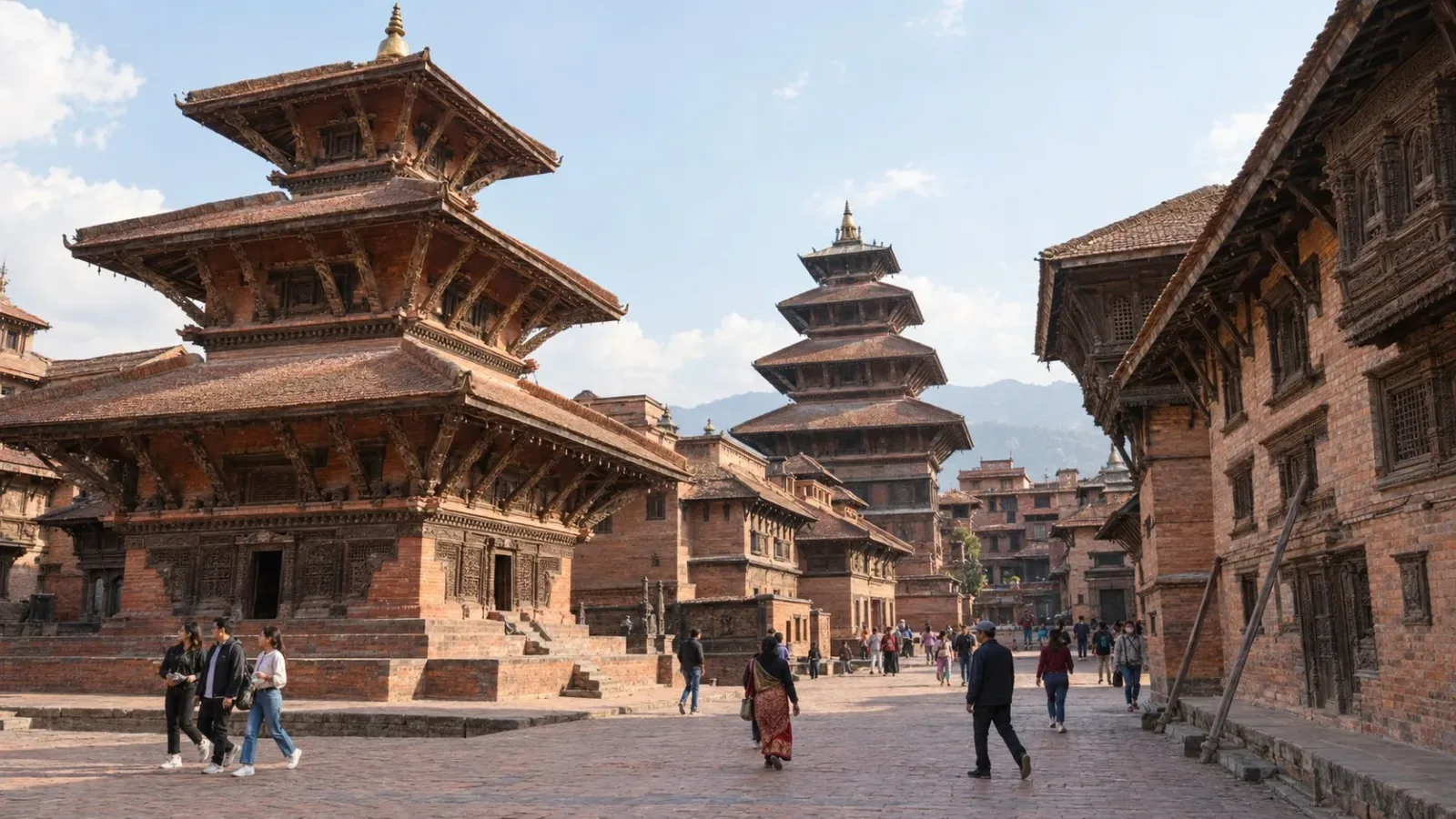
AI illustration: fictional square inspired by Bhaktapur. Not an actual location, person, exact architectural reconstruction or current visitor arrangement.
Choose the scale of your interest
Our suggestion is a palace ensemble at Durbar Square, a rising landmark at Taumadhi, or carved architectural detail at Dattatreya. The interests overlap without becoming identical.
Nepal Tourism Board describes brick-paved streets, red-brick houses and woodcarving. A useful question is which scale you most want to understand, rather than how many monument names you can collect.
Durbar Square: palace, gate and open space
Nepal Tourism Board identifies the Palace of Fifty-Five Windows and the Golden Gate as features of the palace square. The municipality likewise names both among Durbar Square’s architectural subjects.
Choose this interest if you enjoy several elements forming a place together. A windowed frontage, a detailed gateway and the square around them make an ensemble, rather than one isolated object with buildings as background.
Taumadhi: Nyatapola’s rising form
The municipality places Nyatapola in Taumadhi and describes the square through multi-roofed temples and woodcarving. Nepal Tourism Board explains Nyatapola’s name through its five-storeyed form and describes it rising above the cityscape.
Choose the upward composition if that interests you more than a long palace frontage. Repeated roofs give a different architectural question from an ensemble spread across a square. This is about form, not a height record or a structural assessment.
Dattatreya: windows, pillars and courtyards
The municipality connects Dattatreya Square with the peacock window and other carved windows. The tourism board’s museum description places Pujari Math there and describes courtyards with carved windows and pillars.
Choose this subject if you notice a window after others have looked at the skyline. Keep the carving within its architectural setting: an opening in a wall or a pillar contributing to a courtyard, not only a detached decorative pattern.
Brick and worked wood connect the choices
The tourism board’s city account connects red-brick houses and woodcarving with Bhaktapur’s architectural image. The municipality also describes woodcarving in more than one square.
These are different main interests, not exclusive style categories. Choosing Taumadhi does not mean ignoring carved detail; choosing Dattatreya does not make a wider square irrelevant. Let other details enrich the main question.
Give the group concrete choices
Ask whether each person is more curious about a palace and gateway ensemble, an upward roof composition, or carved windows and courtyard pillars. These are clearer preferences than simply asking whether everyone likes heritage.
One main interest can be enough. Check official visitor information separately for any visit. No route, interior, private house, courtyard entry, museum display completeness or current restoration condition is confirmed by this comparison.
Sources
Questions people ask at the gate
Which is suggested for palace architecture?
Durbar Square, for the relationship between the Palace of Fifty-Five Windows, Golden Gate and surrounding square.
Which is suggested for a rising building?
Taumadhi, with Nyatapola’s five-storeyed form as the main architectural subject.
Which is suggested for carved detail?
Dattatreya and the Pujari Math subject, through the published descriptions of carved windows, pillars and courtyards.
Are these exclusive architectural styles?
No. They are different main interests; brick, woodcarving and open spaces can contribute to more than one.
Is a carved window a lesser subject?
Not in this editorial comparison. Choose the scale of architecture that makes you curious.
Does the comparison confirm interiors or restoration?
No. It is not a current assessment of interiors, courtyard access, museum display completeness or restoration conditions.
Next walk starts at a new gate.
Was this helpful?
one tap, no sign-up

A Miranda House graduate and lawyer who traded courtrooms for slow travel. Cheshta travels with the batches we host ourselves, with a soft spot for travelling alongside elders.