



The Trip Keeper The Trip Keeper
three doors, pick the one that fits your family How do you want to travel?
Cheshta Agarwal, founder and host of The Trip Keeper, smiling on a green country road
Hosted by Cheshta

Founder-Hosted Group Tour

the trips where Cheshta travels with you

Our own exclusive group trips. Cheshta is on the trip, from the first flight to the last dinner.

  • Cheshta travels with the group
  • One clear price, inclusions listed
  • Meet your travel family
Next up: Vietnam, 17 DecView →
See founder trips →
A fixed-departure batch on tour

fixed dates, fixed flights

Join a batch of fellow travellers on set dates. Limited seats, flights included, with options. Our team doesn't travel on these.

  • Fixed dates and flights
  • Limited seats per batch
  • Flight options available
See departures →
A private family trip

Private Tour

your dates

just your family, nobody else

Trips planned around your family, your pace and your dates. Milestone birthdays and anniversaries.

  • Travel on your own dates
  • Route shaped around you
Ask for a quote →
← Food guide ☏
Food guide

India food guide for first-time visitors: veg, Jain and street food

Written by The Trip Keeper team Content updated 31 Oct 2026 Facts last checked 31 Oct 2026
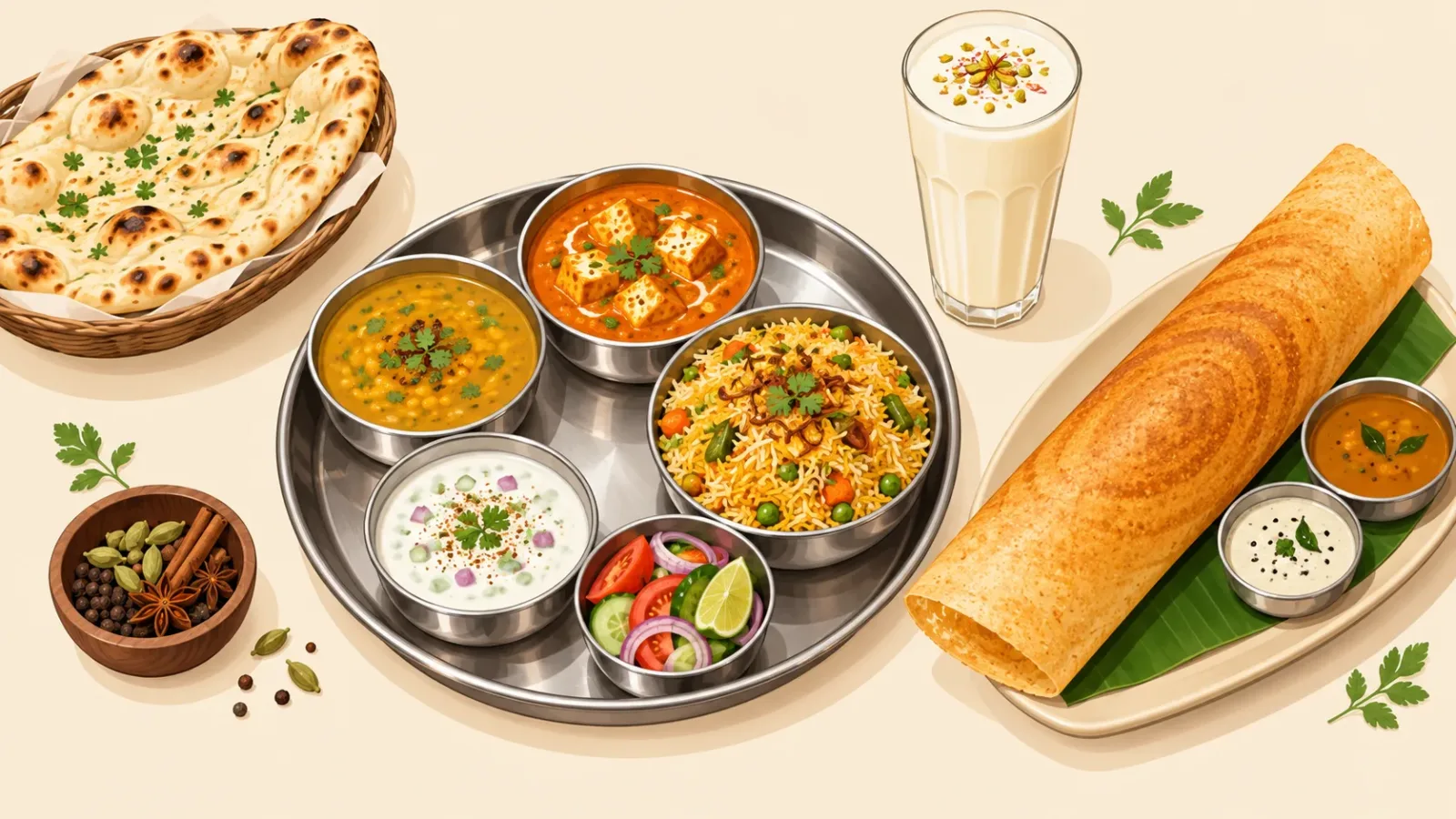
A first-time visitor's Indian thali with dosa, curries, breads and lassi laid out on a table
AI illustration by The Trip Keeper
The short answer

India is one of the easiest countries in the world to eat vegetarian: every menu has veg dishes and "pure veg" restaurants are common. Two habits matter most - drink only sealed or filtered water, and say "kam teekha" (less spicy) until you know a kitchen's heat. Jain travellers can eat well too: say "Jain" and kitchens understand no onion, no garlic, no root vegetables.

Vegetarian-friendlinessEasyOur editorial view
Jain food possibleYesOur editorial view
The one phrase to learnकम तीखा, कृपयाkam TEE-kha, kri-PYA · Less spicy, please
Indian restaurants in main tourist areasYes

Local dishes

Masala dosa मसाला डोसा

Vegetarian Jain with changes

Crisp rice crepe with a spiced potato filling - the south Indian breakfast staple

Watch out for: Often roasted in ghee; ask for oil. Potato is a root vegetable, so Jains should ask first

Chole bhature छोले भटूरे

Vegetarian Jain with changes

Spiced chickpea curry with puffed fried bread - a Delhi favourite

Watch out for: The gravy usually has onion and garlic; heavy at lunch

Paneer tikka पनीर टिक्का

Vegetarian Jain with changes

Char-grilled cottage cheese with peppers and spices

Watch out for: Marinade may include garlic; vegans note it is dairy

Dal makhani दाल मखनी

Vegetarian Jain with changes

Slow-cooked black lentils with butter and cream

Watch out for: Rich with butter and cream; some kitchens add onion or garlic

Vegetable biryani वेजिटेबल बिरयानी

Vegetarian Not Jain

Fragrant rice layered with vegetables, saffron and fried onions

Watch out for: Fried onion is standard; in mixed kitchens the rice may share stock with meat biryani - ask

Butter chicken बटर चिकन

Not vegetarian Not Jain

Tandoori chicken folded into a mild tomato and butter sauce

Watch out for: Mild but rich; the same sauce often comes in a paneer version

Chaat चाट

Vegetarian Jain with changes

Tangy street snacks with yoghurt, tamarind and crunch

Watch out for: Pick busy stalls that cook to order; avoid raw chutneys with ice or unfiltered water

Thali थाली

Vegetarian Jain with changes

A platter of many small dishes - the easiest way to taste a region

Watch out for: Refills are common; spice varies sharply by region, Gujarat is the mildest

Lassi लस्सी

Vegetarian Jain-friendly

Thick yoghurt drink, sweet or salted - the classic cooler with a spicy meal

Watch out for: Sweet versions are sugary; salted is the local remedy for heat. Dairy, so not for vegans

Idli sambar इडली सांभर

Vegan Jain with changes

Steamed rice cakes with a lentil and vegetable stew - the light south Indian breakfast

Watch out for: Usually vegan if the tempering uses oil, not ghee - ask. Sambar can contain onion

How to order vegetarian

Show these lines to the staff. Say them aloud if you like.

Vegetarian
मैं शाकाहारी हूँ
Say it: main sha-kaa-HAA-ree hoon

I am vegetarian (no meat, fish or egg)

Vegan
बिना दूध, घी या पनीर के
Say it: bi-naa DOODH, ghee yaa pa-NEER ke

Without milk, ghee or paneer - no dairy at all

Jain (no onion, no garlic)
जैन भोजन चाहिए: बिना प्याज़, लहसुन
Say it: jain BHO-jan chaa-hi-ye: bi-naa pyaaz, la-ha-sun

Jain food please: no onion or garlic (and no root vegetables)

Other
कम तीखा, कृपया
Say it: kam TEE-kha, kri-PYA

Less spicy, please

About Jain food

Jain food is realistic across India. Many restaurants know "Jain" means no onion, no garlic and no root vegetables (potato, carrot, ginger) - say "Jain" when ordering and staff will guide you. Jain-specific restaurants and counters are common in Gujarat and Rajasthan, and most pure-veg restaurants can adapt dishes.

Backup plans

  • Supermarkets and convenience stores in cities stock sealed snacks, fruit cups, curd and bottled water.
  • International and Indian chains (dosa chains, thali houses, global fast food) are easy fallbacks in every city.
  • Carry familiar snacks and any medication from home for the first days.
  • When in doubt, a "pure veg" restaurant or a busy hotel coffee shop is the safest bet.

For parents and seniors

Spice is adjustable almost everywhere: ask for "kam teekha" (less spicy) and order curd or raita on the side. Familiar comfort food - khichdi, dal-rice, curd rice - is easy to find and gentle. Hotel breakfasts are a safe start to the day, and mealtimes are flexible: lunch runs past 3 pm and dinner starts late in big cities.

Trips to India

We have no open trip to India right now. Tell us your dates and we will help you find one.

Quick questions

Is street food safe in India?

It can be, with the right stalls: choose busy stands where food is cooked hot in front of you, skip raw salads, chutneys with ice and cut fruit, and carry hand sanitiser. A crowded stall with fast turnover is usually the safest one.

What does "pure veg" mean on a restaurant board?

It means the kitchen serves no meat, fish or egg at all. Pure-veg restaurants are common across India, and many are Jain-aware too. "Veg" on a menu means no meat or fish, but egg can still appear - ask.

Can vegans eat well in India?

Yes, with a little care: dairy (ghee, paneer, curd, butter) is common in north Indian cooking. South Indian staples like dosa, idli and sambar are usually vegan - ask for oil instead of ghee. Say "no dairy, no ghee, no paneer" and kitchens understand.

Is the tap water safe to drink?

No - drink sealed bottled water or filtered water from your hotel, and skip ice unless you know it is made from filtered water. Use bottled water for brushing teeth in smaller towns.

How do I ask for food that is not too spicy?

Say "kam teekha, kripya" (less spicy, please) when ordering, and order curd, raita or a sweet lassi on the side - dairy cools heat better than water. Hotel restaurants and chains will tone dishes down on request.

Sources

Help me plan this trip WhatsApp