




Reviewed 18 November 2026. A focused science guide using the museum’s own gallery and attraction descriptions. Check current official visitor information.
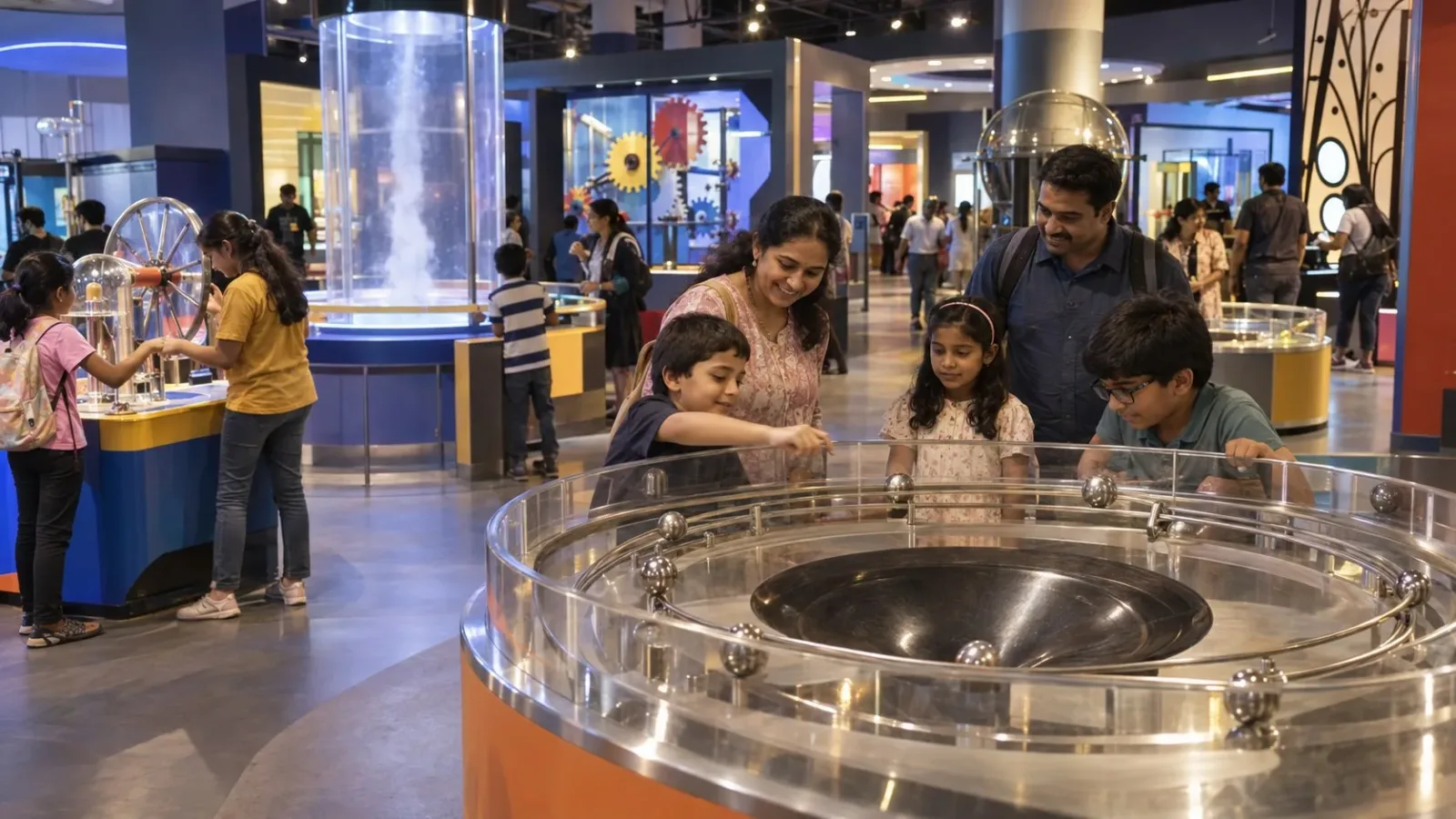
AI illustration: a fictional science museum scene inspired by Bengaluru. Not an actual location, person, exhibit record, route inspection or service.
Choose one science interest first
Visvesvaraya Industrial and Technological Museum, or VITM, describes mechanisms, electricity, space, biotechnology, electronics and children’s science among its subjects. Choose the question the group actually wants to explore.
Our recommendation is one main interest and a few examples, not every exhibit and presentation. Check current official visitor information and keep a meal, a break and the return.
Begin with a mechanism you recognise
The Engine Hall’s How Things Work account names pulleys, gears, levers, inclined planes, wedges, wheels and axles, and screws. It also uses familiar objects such as a ballpoint pen, zipper, and lock and key.
Ask what changes when one part moves and how motion passes to another part. Relating a familiar object to its explanation can be more useful than collecting a large number of exhibit names.
Let children follow a question
The Science for Kids page describes exploration through touch, movement and experimentation. That gives a different learning subject from a long sequence of adult technical explanations.
Let a child explain what they think is happening, then compare the idea with the exhibit’s explanation. The educational description is a starting point for curiosity, not a demand to complete every experiment.
Understand the Wright Flyer as a replica
The museum describes a full-scale reconstruction of the 1903 Wright Flyer, made by its exhibit team in collaboration with National Aerospace Laboratories. Its account distinguishes the reconstruction from the original preserved in Washington.
Use that distinction to ask how a replica helps explain an earlier machine. Do not describe the Bengaluru exhibit as the original aircraft moved to India, or confuse understanding a model with flying an aircraft.
Notice different ways to explain science
The museum describes Science on a Sphere as projected animated data on the outside of a sphere. Its attractions account also describes an IBM 1401 computer using punched cards for input and printed output.
These are different ways to think about information: a globe makes spatial patterns visible, while an older computer raises questions about how data is entered and processed. Choose the idea that interests the group rather than treating every format as compulsory.
Keep the museum a complete outing in itself
VITM identifies itself as a unit of the National Council of Science Museums, established in memory of Sir M. Visvesvaraya. Its models and explanations are science-learning subjects, not a factory visit or industrial training.
A few mechanisms, a child’s question or a replica can start a good conversation. Check current official visitor information, keep food and rest, and leave another Bengaluru attraction as a separate choice.
Sources
Questions people ask at the gate
What should we choose first?
One science interest, such as everyday mechanisms, children’s exploration or early flight.
Which everyday mechanisms does Engine Hall describe?
Pulleys, gears, levers, inclined planes, wedges, wheels and axles, and screws.
What is the children’s science theme?
Exploration through touch, movement and experimentation, according to the museum.
Is the Wright Flyer the original aircraft?
No. The museum describes a full-scale reconstruction and distinguishes it from the original in Washington.
What does Science on a Sphere explain visually?
The museum describes animated data projected onto the outside of a sphere, including planetary subjects.
Must we add another Bengaluru attraction?
No. A few science ideas can be enough, with current official visitor checks, food, rest and the return.
Next walk starts at a new gate.
Was this helpful?
one tap, no sign-up

A Miranda House graduate and lawyer who traded courtrooms for slow travel. Cheshta travels with the batches we host ourselves, with a soft spot for travelling alongside elders.