




The Trip Keeper The Trip Keeper
three doors, pick the one that fits your family How do you want to travel?
Cheshta Agarwal, founder and host of The Trip Keeper, smiling on a green country road
Hosted by Cheshta

Founder-Hosted Group Tour

the trips where Cheshta travels with you

Our own exclusive group trips. Cheshta is on the trip, from the first flight to the last dinner.

  • Cheshta travels with the group
  • One clear price, inclusions listed
  • Meet your travel family
Next up: Vietnam, 17 DecView →
See founder trips →
A fixed-departure batch on tour

fixed dates, fixed flights

Join a batch of fellow travellers on set dates. Limited seats, flights included, with options. Our team doesn't travel on these.

  • Fixed dates and flights
  • Limited seats per batch
  • Flight options available
See departures →
A private family trip

Private Tour

your dates

just your family, nobody else

Trips planned around your family, your pace and your dates. Milestone birthdays and anniversaries.

  • Travel on your own dates
  • Route shaped around you
Ask for a quote →
← Journal ☏
Trip Planning 3 min read

Do US Plugs Work in Japan? Voltage and Adapter Guide

Good news: Japan uses the same flat two-prong plugs as the US, so most American devices plug straight in. The fine print lives in the voltage label on your charger - here is how to read it in ten seconds, and the one category of devices that can still burn out.

share WhatsApp Facebook X
Text size
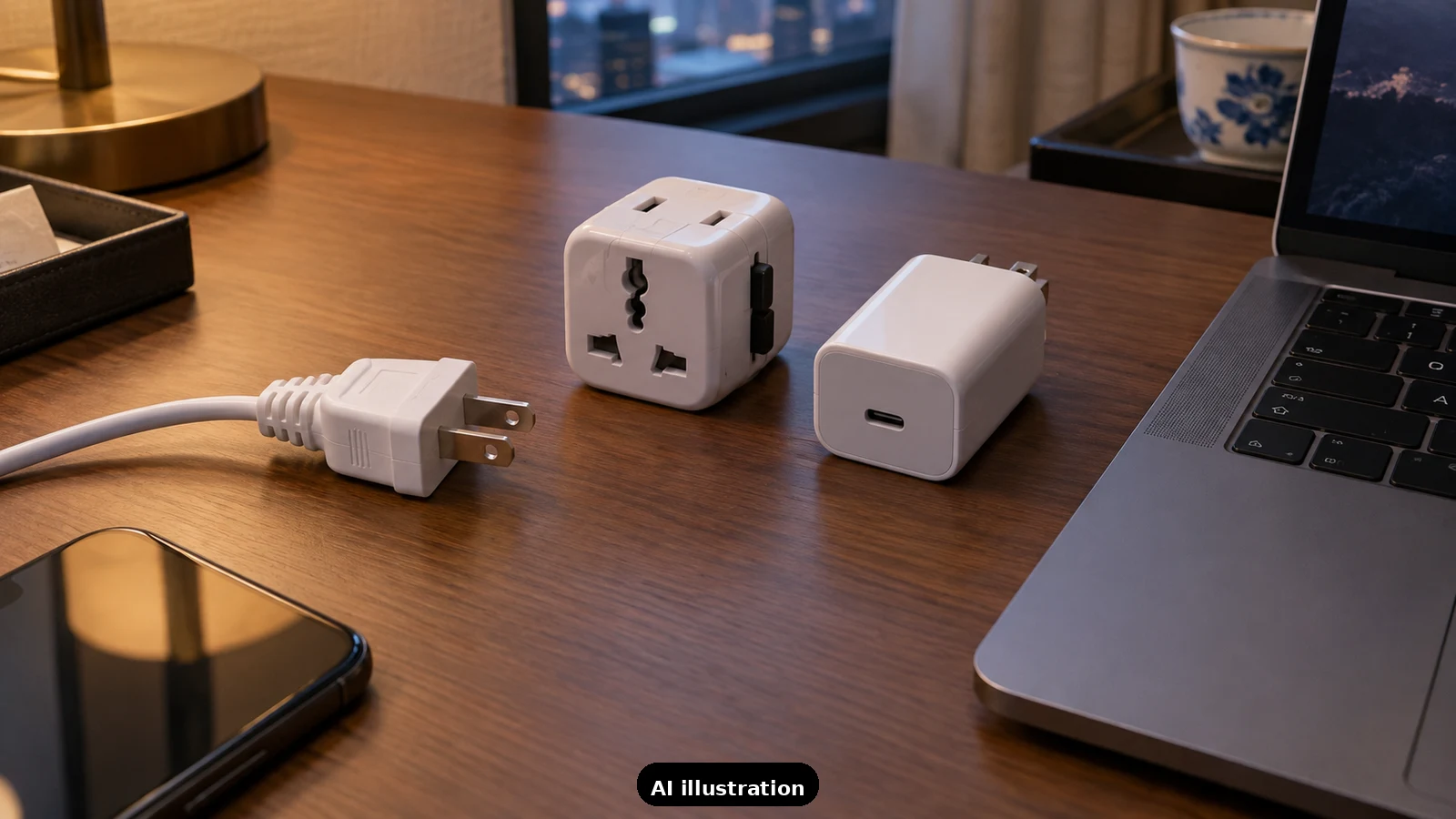
A two-prong US-style plug, travel adapter, phone charger and laptop on a Japanese hotel desk
Send to Mummy-Papa Opens WhatsApp with a short summary — pick who to send it to.

Of all the travel-power questions, the Japan one has the friendliest answer for Americans: yes, your plugs fit. Japan uses the same flat, parallel two-prong outlets (Type A) as the United States, so there is no shape adapter to buy for most of what is in your bag. The real question is not the plug - it is the voltage, and it is answered by a tiny line of print on each charger you own.

The sixty-second voltage check. Japan's grid runs at 100 volts, a notch below the US 120V, with 50Hz in eastern Japan (Tokyo) and 60Hz in the west (Osaka, Kyoto) - the only country split like that. Flip your phone or laptop charger over and look for the word INPUT. If it reads something like "100-240V, 50/60Hz", the device is dual-voltage and handles Japan perfectly with no converter at all. Nearly every phone, laptop, tablet, camera and e-reader charger made in the last decade says exactly that.

What actually needs care. Devices that say only "120V" are the risk: plugging a single-voltage US appliance into Japanese power means it runs a little under-volted - usually just weaker or slower, but heat-producing tools are the exception. Hair dryers, straighteners and curling irons built only for 120V can misbehave or die on 100V, and in the 50Hz east, motor-driven devices run slightly slow. The easy fix: buy a cheap dual-voltage travel hair dryer, use the hotel's, or do without. Never use a bulky voltage converter with heat tools unless you enjoy blown fuses.

The three-prong wrinkle. Older Japanese outlets accept only two prongs. If your laptop brick or appliance has a grounded three-prong US plug (Type B), pack a small, inexpensive 3-to-2 prong adapter - the kind that costs a few dollars, not a converter. Most modern US laptop chargers are two-prong anyway.

Practical charging strategy. Japanese hotel rooms can be outlet-poor, especially in older business hotels and ryokan. A compact multi-port USB charger turns one outlet into a charging station for the whole family, and a slim power strip from home works fine in Japan for your dual-voltage gear. Convenience stores sell charging cables if one dies, and coin-laundry rooms, stations and konbini seating areas increasingly offer USB ports.

The bottom line for your bag. Phone, laptop, camera, headphones, watch: plug straight in, no adapter, no converter. Three-prong devices: a two-dollar prong adapter. Hair tools: check the label twice, and when in doubt leave them home. That is the entire list.

How TripKeeper keeps it simple. Our pre-departure notes include a short, plain-English tech checklist for your specific hotels - which rooms have USB ports at the bedside, which ryokan want you to charge in common areas - and the team answers the small "will this work?" questions before you are standing in front of an outlet at midnight. Small frictions, removed in advance.

Send to Mummy-Papa Opens WhatsApp with a short summary — pick who to send it to.
Cheshta Agarwal
Founder · Travel Creator · Lawyer

A Miranda House graduate and lawyer who traded courtrooms for slow travel. Cheshta travels with the batches we host ourselves, with a soft spot for travelling alongside elders.

or let us do all of it

Planning your next trip?

We'll handle insurance, hotels, airport assistance and the itinerary — the same way we do it for every trip.

Questions on this article

asked by readers, answered by us

Do US plugs work in Japan without an adapter?

Yes, for the common two-prong flat plug. Japan uses Type A outlets identical to American ones, so phone, laptop and camera chargers plug straight in. The exception is three-prong grounded US plugs, which need a cheap 3-to-2 prong adapter (not a voltage converter) because many Japanese outlets lack a ground slot.

Will my US phone charger work in Japan?

Almost certainly. Check the small print for INPUT: if it says 100-240V and 50/60Hz, it is dual-voltage and handles Japan's 100V grid perfectly with no adapter or converter. Nearly every phone, laptop, tablet and camera charger made in the last decade is built this way.

What voltage is Japan, and does the difference matter?

Japan runs on 100 volts, versus 120 in the US, and is split between 50Hz in the east (Tokyo) and 60Hz in the west (Osaka, Kyoto). For dual-voltage electronics the difference is irrelevant. Single-voltage 120V-only appliances run slightly weak, and heat tools like hair dryers can misbehave or burn out - leave those home or use the hotel's.

Can I use my hair dryer or straightener in Japan?

Only if its label says 100-240V dual voltage. A US-only 120V hair dryer or flat iron is the classic Japan casualty: on 100V it runs weak and can overheat or die, and voltage converters are a fire-risky workaround for heat tools. The clean options are a cheap dual-voltage travel model, the hotel's dryer, or air-dried hair.

Do I need a voltage converter for Japan?

Almost never. Converters are only for single-voltage 120V appliances, and the sensible move with those is not bringing them - especially heat-producing tools, where converters are unreliable. If your charger's INPUT line reads 100-240V, you need nothing but the plug you already own.

Are power outlets easy to find in Japanese hotels?

Newer hotels are generous with outlets and bedside USB ports, but older business hotels and traditional ryokan can have just one or two sockets per room. Pack a compact multi-port USB charger to split a single outlet, and a small power strip from home works fine in Japan for dual-voltage devices.

Was this helpful?

one tap, no sign-up

Trips this applies to

Read next

← Journal See our trips