




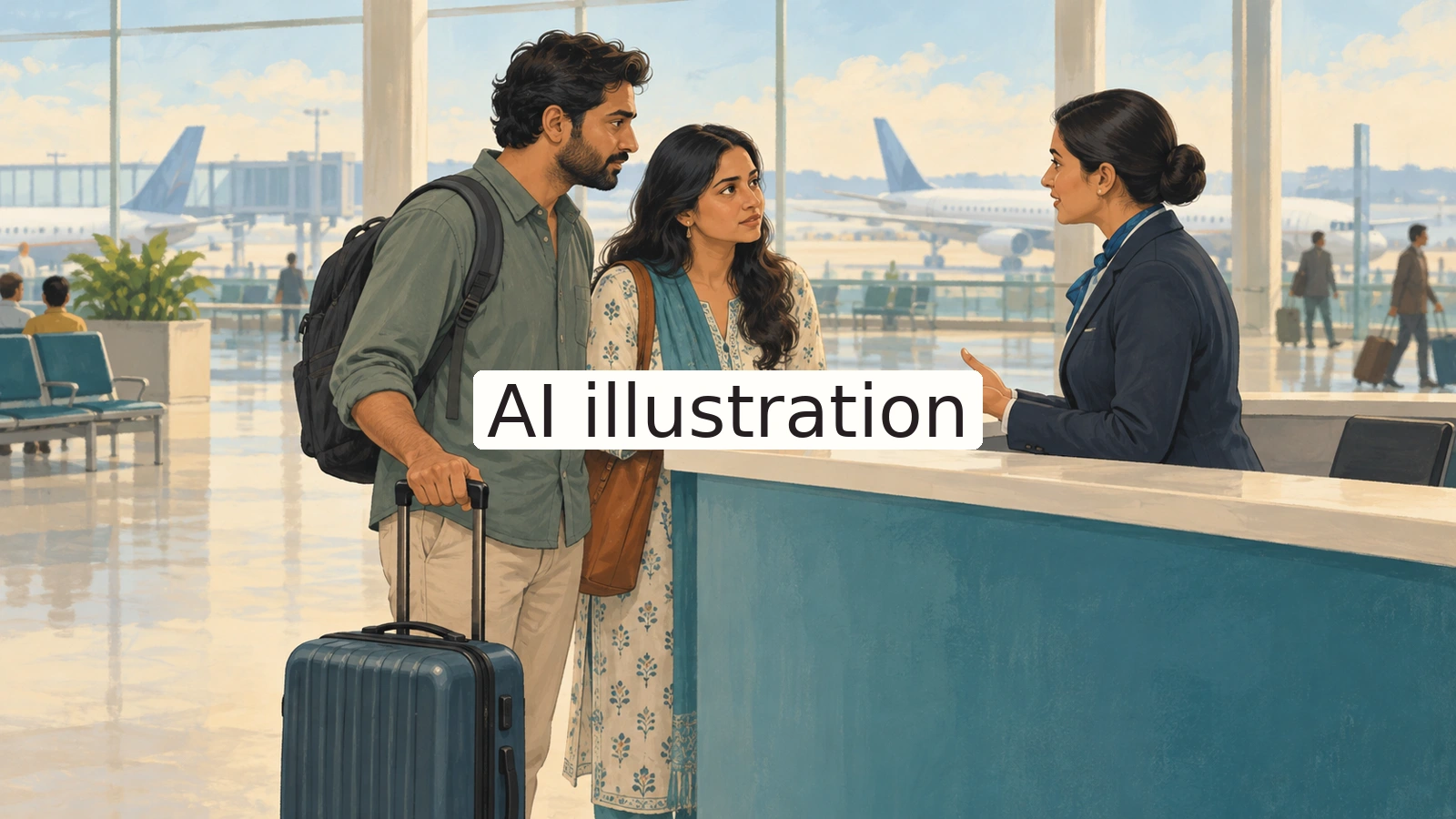
First confirm the cancellation with the operating airline and ask for the supported choices on your actual ticket. Do not start an ordinary paid voluntary cancellation or buy a replacement while assuming the first airline will repay it. At the airport, the immediate job is to settle the flight plan, checked bags and permitted next route.
At the airline desk: establish the facts
Show your booking, flight number, date, destination and issued boarding pass if you have one. Ask whether the flight is cancelled rather than delayed, what reason is recorded and what alternative or refund is available. Note when and how the airline says it notified you. A departure-board change or another passenger's message is not your revised ticket.
Tell staff about a same-ticket connection, separate onward bookings, checked bags, reduced mobility, accompanying carers, children or urgent health needs. The answers can affect which option works. Keep your original itinerary and cancellation message, but do not delay asking for help while trying to assemble a perfect complaint file.
Decision tree: travel on, or request a refund?
Want to continue? Ask for the actual available alternative and who will issue the revised ticket. Compare date, airports, operating airline, connection and arrival, not just a flight number.
Want a refund instead? Ask for the airline-initiated cancellation/refund route for this ticket and booking source. A normal voluntary-cancellation button can have different conditions.
Offer does not work, or no option appears? Ask the staffed airline point to review the booking and explain the applicable choices. Do not treat an unavailable self-service option as proof that all rights have disappeared.
Before accepting, ask what happens to later sectors, return flights, baggage and any paid extras. Get the revised itinerary or refund acknowledgment and retain it. A request is not a completed refund, and a proposed alternative is not a ticket until the carrier confirms the change. A separate train, hotel or tour needs its own contact and terms.
Indian cancellation rights: the notice branch matters
The DGCA CAR, Section 3, Series M, Part IV, effective 15 February 2023, has a cancellation branch separate from delay and denied boarding. Paragraph 3.3.1 describes notice at least two weeks before departure with an alternative or refund acceptable to the passenger. For notice less than two weeks and up to 24 hours before departure, it also specifies an alternative or refund acceptable to the passenger.
Paragraph 3.3.2 covers passengers not informed under that provision, or who missed a connection booked on the same ticket number. It provides an acceptable alternative, or compensation in addition to the full ticket refund, subject to the rule. If you have already reported for the original flight and are waiting for the alternative, it also points to meals and refreshments in relation to waiting time.
For that compensation branch, the figures are Rs 5,000 for block time up to and including one hour, Rs 7,500 for more than one and up to two hours, and Rs 10,000 for more than two hours, each limited to the booked one-way basic fare plus airline fuel charge if that is lower. These are not flat automatic payments for every cancelled flight.
Paragraph 3.3.3 says financial compensation is not payable where adequate contact information was not provided at booking or ticket issue; it sets out refund or reasonable efforts at alternative arrangements, with specified waiting facilities for those choosing the alternative. Paragraph 3.3.4 excludes such compensation for the stated beyond-control extraordinary circumstances. Ask the airline to apply the correct notice, contact and cause branch to your record. This is not a worldwide calculation or a guarantee of a hotel.
Air India: one practical route, not every airline's process
Air India's current cancellation FAQ offers a refund through Manage Booking or self-service re-accommodation when it cancels a flight. Its dedicated re-accommodation FAQ describes eligible Air India-operated bookings, a valid 098-series e-ticket, an email in the reservation and available seats. It lists other eligibility restrictions, so have the actual booking checked rather than assuming everyone receives the same option.
The airline describes that rebooking service as free and usable only once. Review the alternative before confirming. The updated itinerary receipt is sent after rebooking is complete; an email link alone is not proof that the new flight is booked. Its refund FAQ directs travel-agent or third-party bookings back to that seller to initiate a refund. Do not copy agency ticketing instructions into your own booking or promise a fixed bank-credit date.
Before leaving the desk or secure area
Ask where your checked bag will go, whether you must collect it, and which staffed point handles the next step. If already airside or past immigration, ask for the permitted exit and return route. Do not walk backwards through security or assume an airline hotel offer grants entry permission. Check the next check-in and gate instructions on the confirmed plan.
If unresolved, retain the airline's explanation, options offered, revised records and case reference. Air India's rights page gives Customer Support, Nodal Officer and Appellate Authority routes and lists AirSewa; the CAR also provides complaint routes. Complaining can support a later review, but it does not itself confirm a flight, reimbursement or permission to cross a closed barrier.
Sources and related help
Checked 29 October 2026: DGCA CAR, especially 3.3, 3.8 and 3.9; Air India passenger rights; Air India cancellation/refund FAQ; Air India self-service re-accommodation FAQ.
Delay facilities are a different branch. Weather closure and the whole connection.

A Miranda House graduate and lawyer who traded courtrooms for slow travel. Cheshta travels with the batches we host ourselves, with a soft spot for travelling alongside elders.
Planning your next trip?
We'll handle insurance, hotels, airport assistance and the itinerary — the same way we do it for every trip.
Questions on this article
asked by readers, answered by us
Was this helpful?
one tap, no sign-up