




The Trip Keeper The Trip Keeper
three doors, pick the one that fits your family How do you want to travel?
Cheshta Agarwal, founder and host of The Trip Keeper, smiling on a green country road
Hosted by Cheshta

Founder-Hosted Group Tour

the trips where Cheshta travels with you

Our own exclusive group trips. Cheshta is on the trip, from the first flight to the last dinner.

  • Cheshta travels with the group
  • One clear price, inclusions listed
  • Meet your travel family
Next up: Vietnam, 17 DecView →
See founder trips →
A fixed-departure batch on tour

fixed dates, fixed flights

Join a batch of fellow travellers on set dates. Limited seats, flights included, with options. Our team doesn't travel on these.

  • Fixed dates and flights
  • Limited seats per batch
  • Flight options available
See departures →
A private family trip

Private Tour

your dates

just your family, nobody else

Trips planned around your family, your pace and your dates. Milestone birthdays and anniversaries.

  • Travel on your own dates
  • Route shaped around you
Ask for a quote →
← Journal ☏
Money & Payments 3 min read

How Much Japanese Yen Cash Should Two Indians Carry for a 10-Day Trip?

There is no magic number, but there is a sensible range. A scenario table by travel style, what still needs cash in Japan, and how to adjust for city-only versus mixed itineraries.

share WhatsApp Facebook X
Text size
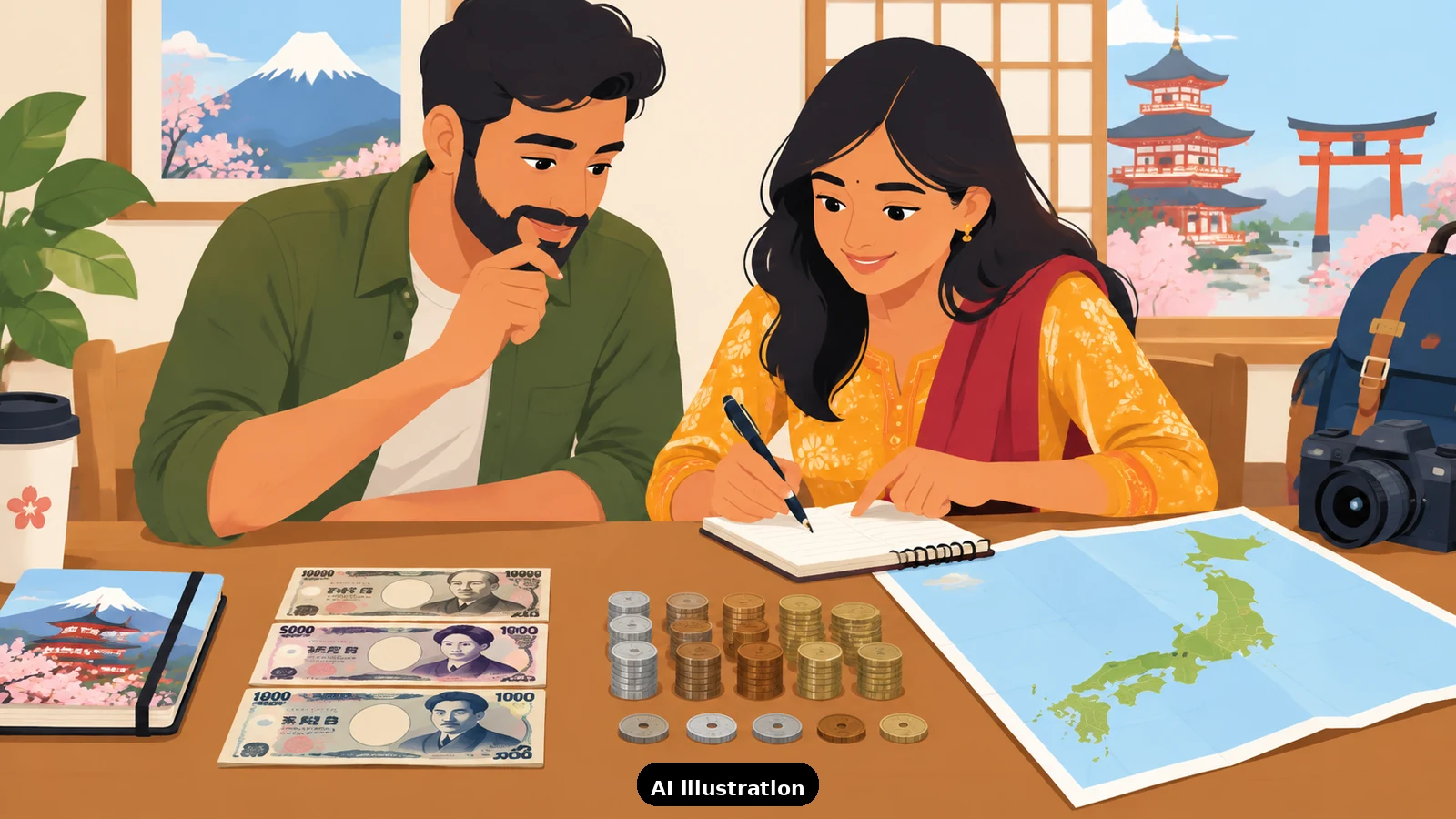
Illustration of two Indian travellers planning a Japan budget with stacks of yen banknotes and a notebook
Send to Mummy-Papa Opens WhatsApp with a short summary — pick who to send it to.

Ask ten travellers how much cash to carry in Japan and you will get ten numbers, all confidently wrong for your trip. The honest answer is a range that depends on where you are going and how you pay for things. For two Indians on a 10-day trip, a sensible working band is 40,000 to 80,000 yen per person in cash over the whole trip - with the lower end fitting a Tokyo-Kyoto-Osaka city circuit and the upper end fitting itineraries with rural stops, family-run inns and cash-only restaurants. Here is how to place yourself inside that band.

Start from what still needs cash. Japan is far more card-friendly than its reputation suggests, but cash remains the only option at a long tail of places: small ramen shops and izakaya, temple and shrine offerings and goshuin stamps, market stalls, coin lockers, some private railway ticket machines, many rural buses, and a surprising number of highly rated family-run restaurants. Entrance fees at smaller attractions are often cash-only too. None of these are expensive individually - a few hundred to a couple of thousand yen - which is exactly why people underestimate the total.

A scenario table that actually maps to real trips. City-only, mostly card-friendly spending, hotels and big meals on card: about 3,000-4,000 yen per person per day in cash, so 30,000-40,000 per person for 10 days. Mixed itinerary with a day trip or two (Nikko, Nara, Arashiyama) and several casual local meals: 5,000-6,000 yen per person per day, so 50,000-60,000 each. Rural or traditional-heavy route with ryokan extras, local buses and market grazing: 7,000-8,000 yen per person per day, so 70,000-80,000 each. These bands assume your hotels, Shinkansen and big-city dinners go on a card; if you prefer paying more in cash, scale up.

Do not carry it all from India. Buying your full yen requirement in India usually means accepting the wider margins that a less-stocked currency carries there, plus the security worry of travelling with a thick envelope. The pattern that works: fly in with a starter float of 20,000-30,000 yen per couple, bought a few days ahead from a dealer whose rate you compared against mid-market, and withdraw the rest in two or three larger pulls at Seven Bank or Japan Post Bank ATMs as you go. Flat per-withdrawal fees make fewer, bigger withdrawals cheaper.

Signals that you should top up. You are below 10,000 yen with a rural leg ahead. Tomorrow includes a cash-famous stop - a market breakfast, a temple town, an onsen town with coin lockers and footbaths. Or a restaurant card terminal has just "happened to be broken" once already. Japan rewards the traveller who treats the konbini ATM as a five-minute errand rather than an emergency.

How TripKeeper handles this. On our founder-hosted Japan departures, the pre-departure briefing includes a per-family cash plan based on the actual route - which days are cash-heavy, where the group stops near ATMs, and how much buffer to hold for the cash-only dinner spots the itinerary includes. Private tour travellers get the same calculation through the "Plan your trip" inquiry, tuned to their hotels and day trips, and the support team can re-advise mid-trip if plans change.

Send to Mummy-Papa Opens WhatsApp with a short summary — pick who to send it to.
Cheshta Agarwal
Founder · Travel Creator · Lawyer

A Miranda House graduate and lawyer who traded courtrooms for slow travel. Cheshta travels with the batches we host ourselves, with a soft spot for travelling alongside elders.

or let us do all of it

Planning your next trip?

We'll handle insurance, hotels, airport assistance and the itinerary — the same way we do it for every trip.

Questions on this article

asked by readers, answered by us

How much yen cash should two people carry for 10 days in Japan?

A working band is 40,000 to 80,000 yen per person for the whole trip. City-only itineraries with most spending on cards sit near the lower end; trips with rural stops, family-run inns and cash-only restaurants sit near the upper end. This assumes hotels, Shinkansen and large meals go on a card.

Is Japan still a cash-based country for tourists?

Less than its reputation, but cash is still the only option at many small eateries, temples and shrines, market stalls, coin lockers, some private railway ticket machines and rural buses. Plan a cash layer for these and pay for everything else by card or IC card.

Should I buy all my yen in India before flying?

No. JPY is a less-stocked currency in India and often carries wider margins, and carrying a large amount is a security risk. Fly with a starter float of about 20,000-30,000 yen per couple, then withdraw in two or three larger transactions at Seven Bank or Japan Post Bank ATMs in Japan.

Where can I withdraw yen in Japan with an Indian card?

Seven Bank ATMs - over 28,000 of them in 7-Eleven stores and at Narita, Haneda and Kansai airports - and Japan Post Bank ATMs accept international Visa and Mastercard cards. Overseas cards are typically limited to 100,000 yen per transaction on chip transactions, and a flat local ATM fee applies.

How much cash per day should I budget in Tokyo and Kyoto?

For a city circuit with hotels and bigger meals on a card, about 3,000-4,000 yen per person per day covers cash-only meals, temple entries, coin lockers and small purchases. Add a day trip or several local restaurants and 5,000-6,000 yen per person per day is safer.

What should I do if I run out of cash mid-trip in Japan?

Withdraw more at any 7-Eleven's Seven Bank ATM using your Indian debit card - they are open around the clock in cities and most towns. Choose to be charged in yen, not INR, when the ATM offers currency conversion, and keep withdrawals large and few to minimise flat fees.

Was this helpful?

one tap, no sign-up

Read next

← Journal See our trips