




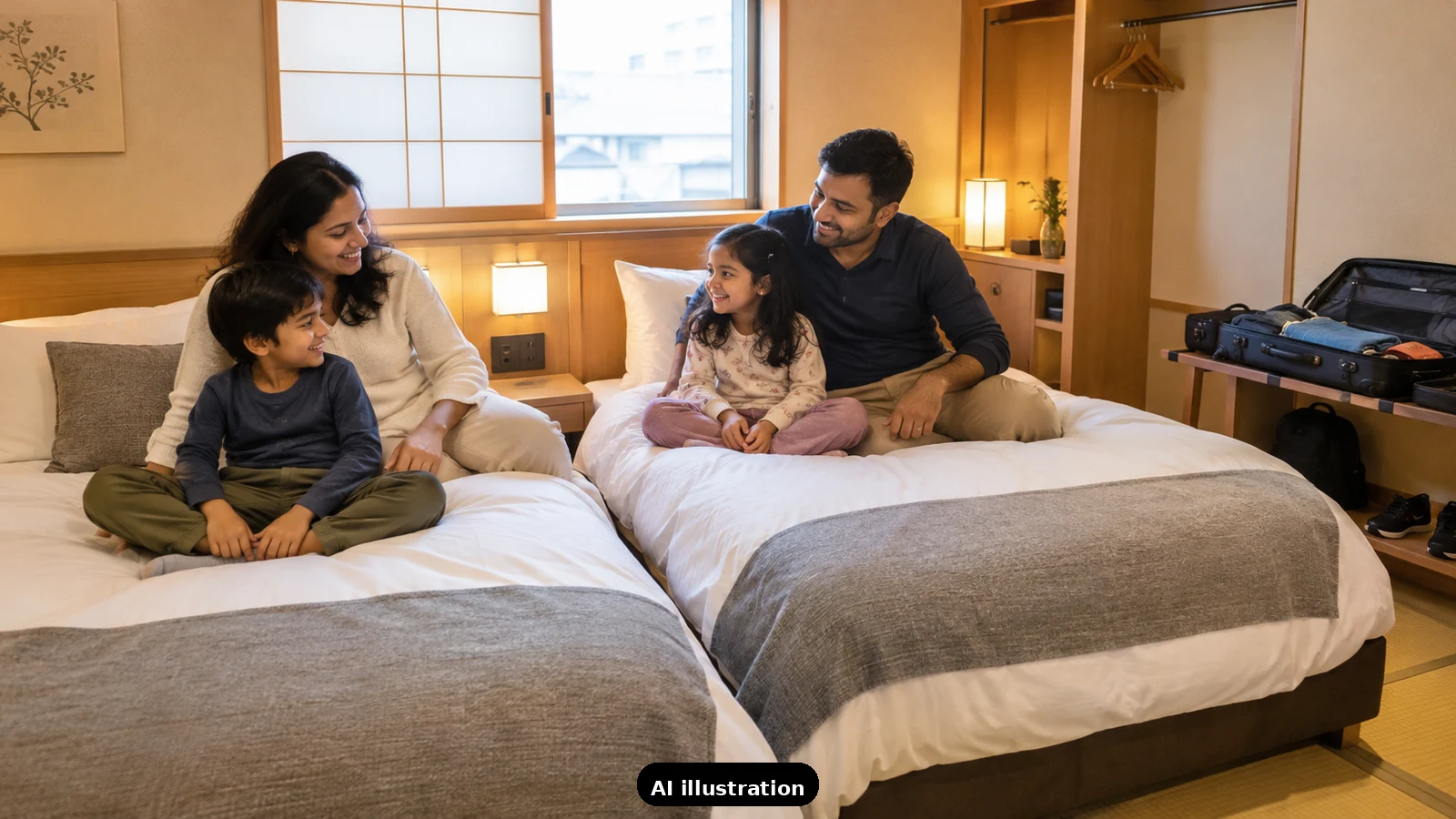
The most common booking mistake Indian families make in Japan is assuming a hotel room is a room - pay for the space, sleep whoever fits. Japan does not work that way. Rooms are priced per person, children count as people, and the maximum occupancy printed on the listing is not the hotel being fussy. It is a licensed number, and understanding it is the difference between a smooth check-in and a lobby argument at 10 pm with two tired kids.
Occupancy is a law, not a preference. Under Japan's Inns and Hotels Act enforcement rules, every guest room is registered with a maximum number of occupants, and that number is tied to the building's fire and evacuation design - how many people the escape routes and alarms on that floor were specified to handle. The law even sets minimum floor areas per guest. So when the listing says "capacity: 2", no charm, negotiation or extra payment at the front desk changes it. The hotel legally cannot put four people in it.
Pricing is per person, and children are people. The standard pattern on Japanese booking platforms: children aged 13 and over pay the adult rate; children 12 and under pay a child rate; and children roughly 5 and under are priced by category - with meals and bed, with bed only, with meals only, or neither, where the last is often free or nearly so as a bed-sharing infant. Every property sets its own cutoffs, which is why you must declare each child's exact age when booking, not at check-in.
What this means for 2 adults and 2 children. A standard Japanese double room - often 13 to 19 square metres with one 140 cm bed - is licensed for two. You cannot legally or practically sleep four in it. Your real options are these. A family room or large twin registered for four, with two proper beds plus an extra bed or sofa bed. Connecting rooms, which give you two bathrooms and a door between. Or the option Indian families end up loving most: an apartment-hotel.
The apartment-hotel answer. Japan's apartment-hotel chains build units for exactly this case: four or more proper beds, a small kitchen, a dining table, usually a washing machine. For an Indian family the kitchen is not a luxury - it is dal, khichdi, Maggi and warm milk on demand, on a trip where restaurant hunting with children twice a day gets old fast. Priced per unit rather than per head, these often beat two hotel rooms on cost while giving you far more space.
Ryokan are priced per person too. The traditional inn stay you are dreaming of charges per person including children, with child rates bundled around kaiseki meals. A ryokan room is open tatami space, so a family of four fits beautifully - but expect four futons and four meal sets on the bill, with modest discounts for young children.
The booking checklist that prevents trouble. One, enter every guest including children with their exact ages on the booking - a "2 adults" reservation that arrives as four people can be refused or repriced on the spot. Two, read the maximum occupancy line on the room, not the room's photo. Three, check the bed-sharing policy: many hotels allow one child under a set age per existing bed free. Four, when in doubt, email the property - Japanese hotels answer precisely and honestly.
How TripKeeper handles family rooms. We book Japan for Indian families every week, and occupancy rules are one of the first things we check: which properties genuinely register four to a room, which apartment-hotels are near the stations your itinerary needs, and where connecting rooms are worth the upgrade. Our team verifies the room fit before you pay, not after you land. Send a "Plan your trip" inquiry with your children's ages, and we will come back with rooms that actually fit your family.

A Miranda House graduate and lawyer who traded courtrooms for slow travel. Cheshta travels with the batches we host ourselves, with a soft spot for travelling alongside elders.
Planning your next trip?
We'll handle insurance, hotels, airport assistance and the itinerary — the same way we do it for every trip.
Questions on this article
asked by readers, answered by us
Was this helpful?
one tap, no sign-up
