




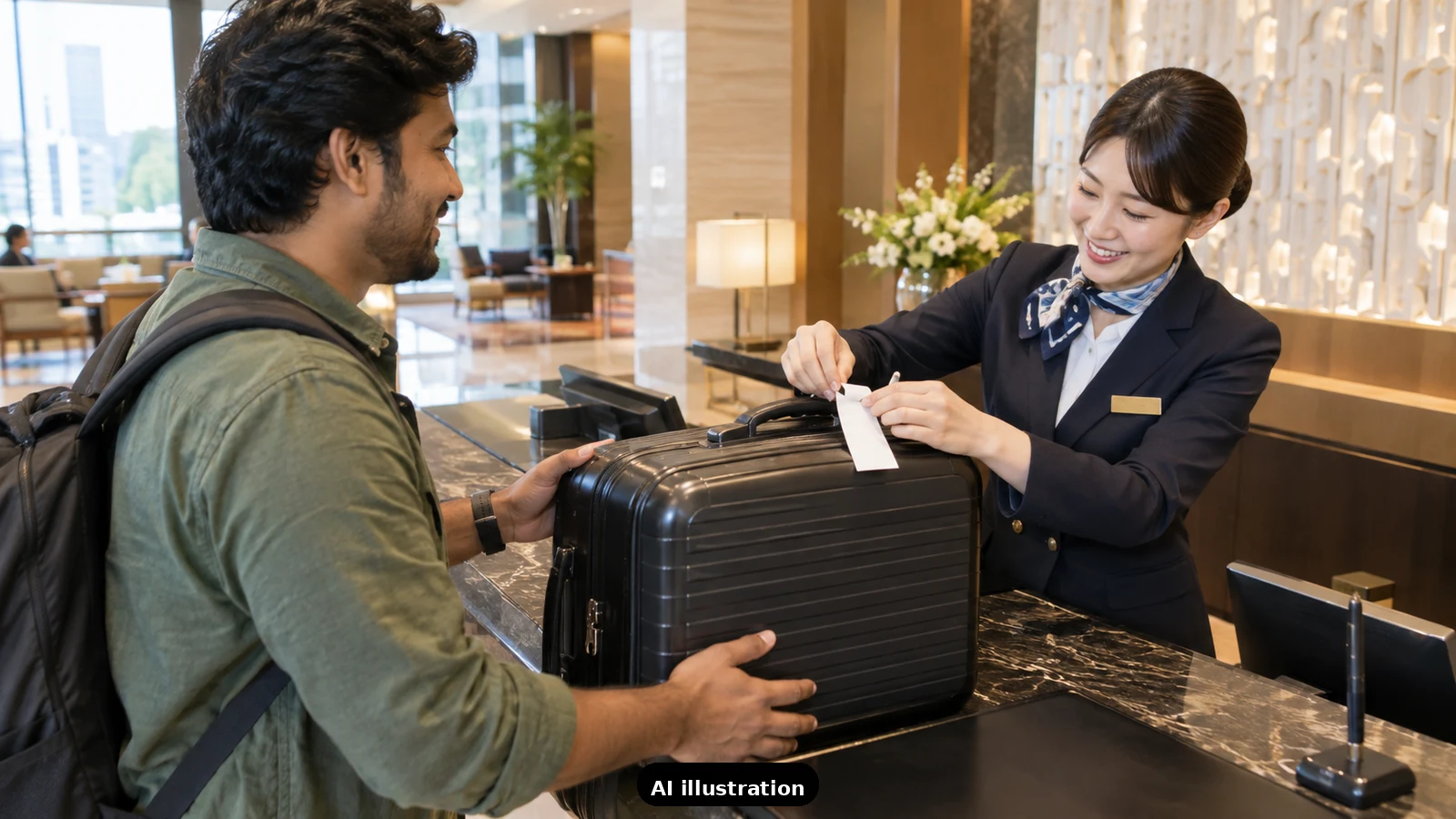
Of all Japan's small miracles, luggage forwarding is the one travellers talk about on the flight home. Takkyubin - door-to-door parcel and suitcase delivery - lets you hand your big bag to your hotel's front desk in the morning, board the Shinkansen with just a daypack, and find the suitcase waiting at your next hotel that evening or the next day. No lifting bags onto train racks, no dragging wheels across temple gravel, no locker hunts. Yamato Transport's TA-Q-BIN is the biggest network; Sagawa is the other national player.
How hotel-to-hotel forwarding works. The evening before you move cities - or at breakfast at the latest - tell the front desk you want to send your suitcase. Staff fill out the delivery slip, you pay, and the bag enters the network. Standard delivery takes at least one day, which is why the golden rule is: send the bag the day before you travel, not the morning of. Keep two days of clothes, medicines and chargers in your day bag, and photograph the slip before you let go of it.
What it costs. Pricing is by parcel size and distance. For a real benchmark: a large suitcase (the 160 size) sent Tokyo to Kyoto or Osaka cost ¥3,160 paying cash in October 2026, and ¥3,060 if you drop it at a counter yourself. Smaller bags cost less, and per-parcel weight is capped at 30 kg. Sending to an airport adds a surcharge (¥660) and must go at least two days before your flight. For most families, one or two forwarded suitcases at these prices are the best money spent on the whole trip.
Same-day options when timing is tight. The standard service is next-day, but pockets of same-day exist. At Haneda, the Keikyu counter sends bags to Tokyo hotels from around ¥1,600, arriving the same day. In Kyoto and Osaka, JR West's station-based service delivers bags to your hotel by evening if you drop them in the morning. Ask at the station tourist counter; these services are poorly signposted in English but genuinely useful.
Airport to hotel on arrival. The counters also work the other way: land at Narita, Haneda or Kansai, hand your suitcases to the delivery counter in arrivals, and ride the airport train into the city with only your day bag. After a long flight from India, this is a kindness to your future self, and it means your first day can start with sightseeing instead of a hotel detour.
The Shinkansen reason. Forwarding also sidesteps a rule that catches many visitors: on the Tokaido and Sanyo Shinkansen (the Tokyo-Kyoto-Osaka-Hiroshima spine), any bag whose three dimensions total more than 160 cm needs a reserved oversized-baggage seat, or you pay a ¥1,000 fee on board. A forwarded suitcase skips the whole issue - and frees you from watching the luggage area at every stop.
Practical notes. Convenience stores handle drop-offs too, which helps on weekends and evenings, though very large sizes cannot go from every store. Fragile and valuable items belong in your day bag, not the network. Cutoff times vary by counter, so send in the morning when you can. And keep the receipt half of the slip - the tracking number on it lets you watch your suitcase cross Japan on your phone.
How TripKeeper uses forwarding. On our Japan itineraries, inter-city days are planned around takkyubin: our team tells you which evening to hand over which bag, our tour leaders help with the slips at the front desk, and your day bag is the only thing between you and the train window view. If you are planning your own route, send a "Plan your trip" inquiry - we will map the forwarding days into it so you never lift a big bag onto a train.

A Miranda House graduate and lawyer who traded courtrooms for slow travel. Cheshta travels with the batches we host ourselves, with a soft spot for travelling alongside elders.
Planning your next trip?
We'll handle insurance, hotels, airport assistance and the itinerary — the same way we do it for every trip.
Questions on this article
asked by readers, answered by us
Was this helpful?
one tap, no sign-up
