




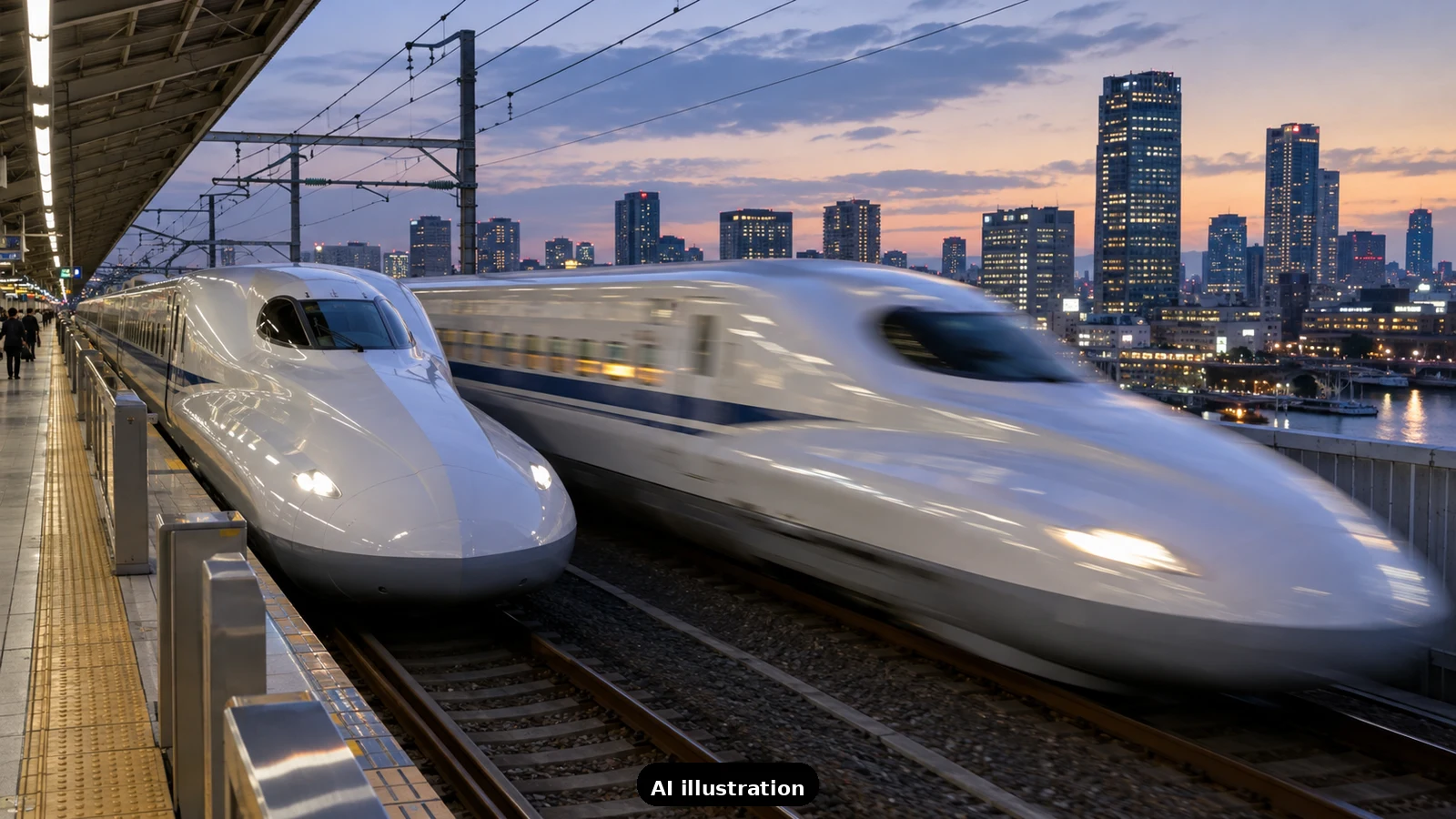
On the Tokaido Shinkansen between Tokyo, Kyoto and Osaka, three train names share the same tracks: Nozomi, Hikari and Kodama. Same bullet trains, same seats, same route - the difference is how many stations each one stops at, and that changes everything about your trip.
The 20-second answer. Booking individual tickets? Take the Nozomi. Riding on a nationwide JR Pass? Take the Hikari. Making short hops between nearby cities? The Kodama often serves stations the others skip.
What separates them. The Nozomi is the express: it stops only at the biggest stations - Tokyo, Shinagawa, Shin-Yokohama, Nagoya, Kyoto, Shin-Osaka - and covers Tokyo to Kyoto in about 2 hours 20 minutes at up to 285 km/h. It is also the only service that runs through to Hakata (Fukuoka) on the Sanyo line, hitting 300 km/h on that stretch. The Hikari stops at a few more stations and takes about 2 hours 40 minutes to Kyoto. The Kodama stops at every single station and needs about 3 hours 40 minutes for the same run.
The JR Pass line you cannot cross. The nationwide Japan Rail Pass covers Hikari and Kodama but not Nozomi (or the Mizuho on the Sanyo-Kyushu line). Pass holders boarding a Nozomi need a special supplement ticket for the full segment. Since Nozomi trains run up to a dozen times an hour at peak and Hikari only two or so, pass holders should check the Hikari timetable rather than just showing up.
Peak-season catch: all-reserved Nozomi. During the year's busiest stretches - Golden Week, Obon in mid-August, and the New Year period - every seat on every Nozomi becomes reserved-only. No unreserved cars, no standing. If you are traveling then, book the moment reservations open (one month ahead) or plan around those dates.
When the Kodama wins. The slow train has its fans. It is the one that stops at stations like Shin-Fuji (the closest station for Mount Fuji views from the platform), Atami and Shizuoka. On quiet weekdays, unreserved Kodama cars are nearly empty, and you can sometimes string together an unhurried local-style ride through the countryside. There is also the Platt Kodama, a discounted advance ticket that undercuts regular fares if you are not in a hurry - book through JR Central's members site.
Seats and luggage are identical. Whichever name you ride, you get the same N700-series trains: 2+3 seating in ordinary cars, 2+2 in Green Car, power outlets at window seats, and the same oversized baggage rule - bags over 160cm total dimensions need a free oversized-baggage seat reservation on all three services.
A note on times. Schedules shift slightly with the March timetable revisions, so treat these times as the reliable ballpark and check JR Central's current timetable when you book. The pattern itself - Nozomi fastest, Hikari middle, Kodama everywhere - never changes.
How TripKeeper books it. On our planned Japan trips, the team picks the train type per segment, not per habit: Nozomi when tickets are individual and time is tight, Hikari on pass days, Kodama when a smaller station is the actual destination. Seat reservations, oversized baggage seats and connection timing come bundled into the plan, so the only decision left for you is bento or sandwich at the platform kiosk.

A Miranda House graduate and lawyer who traded courtrooms for slow travel. Cheshta travels with the batches we host ourselves, with a soft spot for travelling alongside elders.
Planning your next trip?
We'll handle insurance, hotels, airport assistance and the itinerary — the same way we do it for every trip.
Questions on this article
asked by readers, answered by us
Was this helpful?
one tap, no sign-up
