



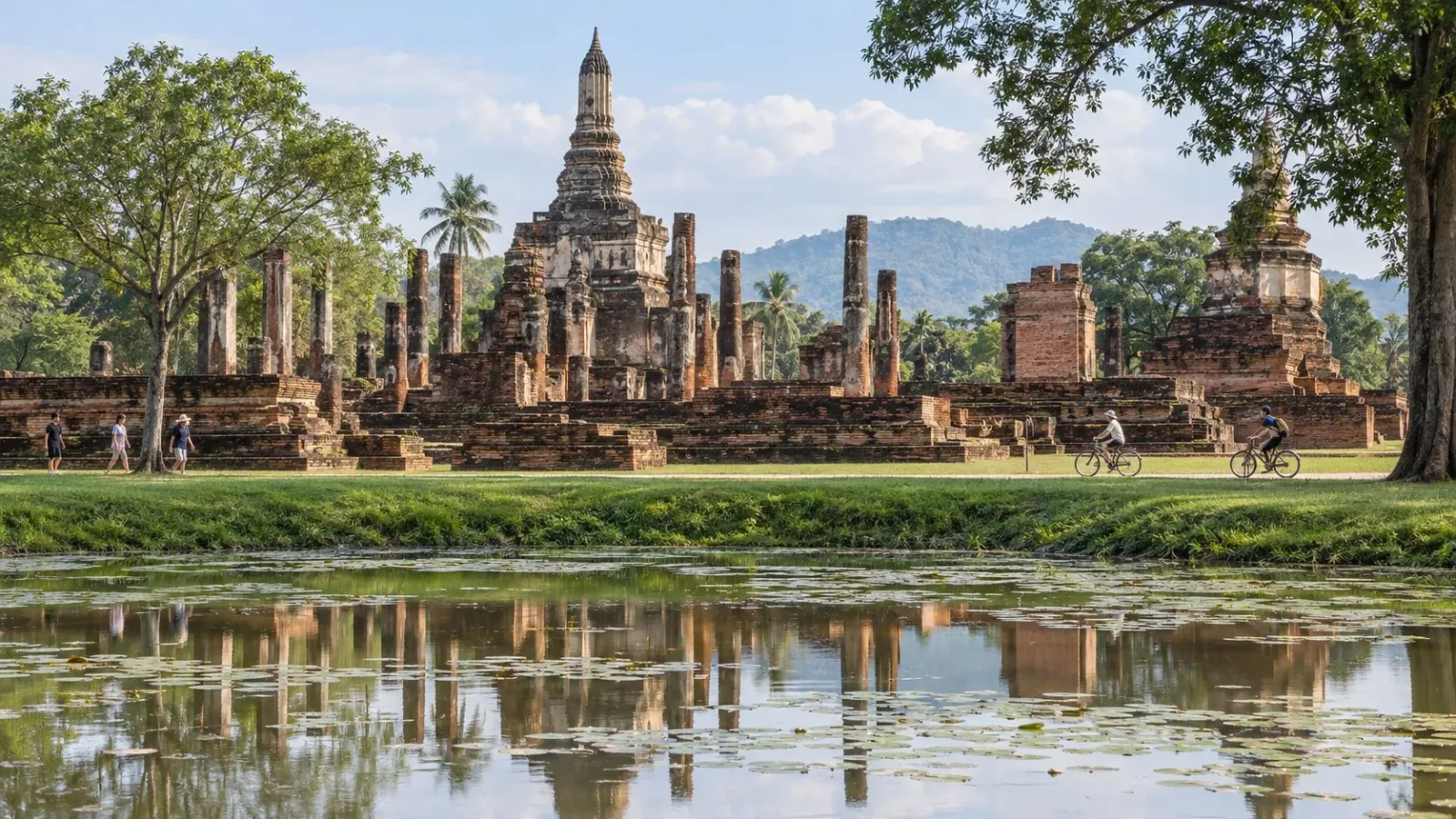

Reviewed 18 November 2026. An editorial architecture-versus-regional-ceramics comparison using UNESCO and Thai tourism and government descriptions. Historical engineering is not a claim about present function.
AI illustration: fictional Sukhothai-inspired architectural scene. Not an actual location, person, exact reconstruction, route or current condition.
Choose the scale of your curiosity
Our suggestion is architectural remains for buildings and the planned town, or regional ceramics for objects, production and exchange. A monumental structure and a vessel do not ask the same questions.
Choose one interest before collecting names. These are editorial starting points, not an official ranking or a proposed circuit through several historical parks.
Architecture: distinguish structure and surface
UNESCO’s account describes monasteries constructed in brick covered with carved stucco within Sukhothai and its associated historic towns. That gives the architectural interest a relationship between construction and surface treatment.
Ask how a building’s larger form differs from its decoration. This is a question for attention, not a material diagnosis of every ruin or a claim that every structure has the same construction history.
Historic town planning gives a wider subject
UNESCO describes historical landscape engineering involving reservoirs, ponds and canals. Thailand’s government background likewise identifies city planning among the region’s historical interests.
Keep buildings and the wider planned landscape as different scales of construction. This is historical context, not a current water-system assessment, a continuous visible network or an invitation to follow a canal route.
Ceramics: keep Si Satchanalai named
UNESCO identifies Si Satchanalai with the historic kingdom’s ceramic export industry. The Thai government account also names pottery from Si Satchanalai, while the national tourism description associates the place with ceramic craft.
Choose this interest when objects and the work behind them make history more compelling. Keep the production statement attached to Si Satchanalai rather than moving it inside Sukhothai’s archaeological site.
An object can open a different question
A ceramic vessel can prompt questions about shape, decoration, use and the movement of goods. These are our suggested questions for a ceramics interest, not an identification of any particular piece.
The regional production account does not authenticate an object, date a glaze or establish where an item was made. No museum display, working kiln, demonstration, workshop or purchase is promised here.
Connect the towns without merging them
The UNESCO account concerns Sukhothai, Si Satchanalai and Kamphaeng Phet. Their historical connection does not make them one place or prove a combined visit fits a day.
Lead with buildings and planning if that is your interest, or with the regional story of objects and production if that draws you more. Check official visitor information separately. No route, admission, ritual, current condition or service is established.
Sources
Questions people ask at the gate
What is the architectural interest?
The relationship between buildings, surface treatment and the historically planned town.
What construction does UNESCO describe?
Brick covered with carved stucco in its regional account, not an identical material history for every structure.
What does the ceramics interest add?
A regional story of objects, production and exchange, including Si Satchanalai’s historic ceramic industry.
Is Si Satchanalai another name for Sukhothai’s site?
No. Keep the named towns and their historical roles distinct.
Does an export history authenticate a ceramic object?
No. It does not establish a particular piece’s date, origin, material or authenticity.
Does this confirm a combined route or workshop?
No. No same-day circuit, working kiln, museum presentation, workshop or current visitor service is established.
Next walk starts at a new gate.
Was this helpful?
one tap, no sign-up

A Miranda House graduate and lawyer who traded courtrooms for slow travel. Cheshta travels with the batches we host ourselves, with a soft spot for travelling alongside elders.