




The Trip Keeper The Trip Keeper
three doors, pick the one that fits your family How do you want to travel?
Cheshta Agarwal, founder and host of The Trip Keeper, smiling on a green country road
Hosted by Cheshta

Founder-Hosted Group Tour

the trips where Cheshta travels with you

Our own exclusive group trips. Cheshta is on the trip, from the first flight to the last dinner.

  • Cheshta travels with the group
  • One clear price, inclusions listed
  • Meet your travel family
Next up: Vietnam, 17 DecView →
See founder trips →
A fixed-departure batch on tour

fixed dates, fixed flights

Join a batch of fellow travellers on set dates. Limited seats, flights included, with options. Our team doesn't travel on these.

  • Fixed dates and flights
  • Limited seats per batch
  • Flight options available
See departures →
A private family trip

Private Tour

your dates

just your family, nobody else

Trips planned around your family, your pace and your dates. Milestone birthdays and anniversaries.

  • Travel on your own dates
  • Route shaped around you
Ask for a quote →
← Journal ☏
Money & Payments 3 min read

Will Indian 2-Pin and 3-Pin Chargers Work in Japan?

No Indian plug fits a Japanese socket without an adapter. The good news: voltage is rarely a problem. What to check on your charger label, which adapter to buy, and when a transformer is unnecessary.

share WhatsApp Facebook X
Text size
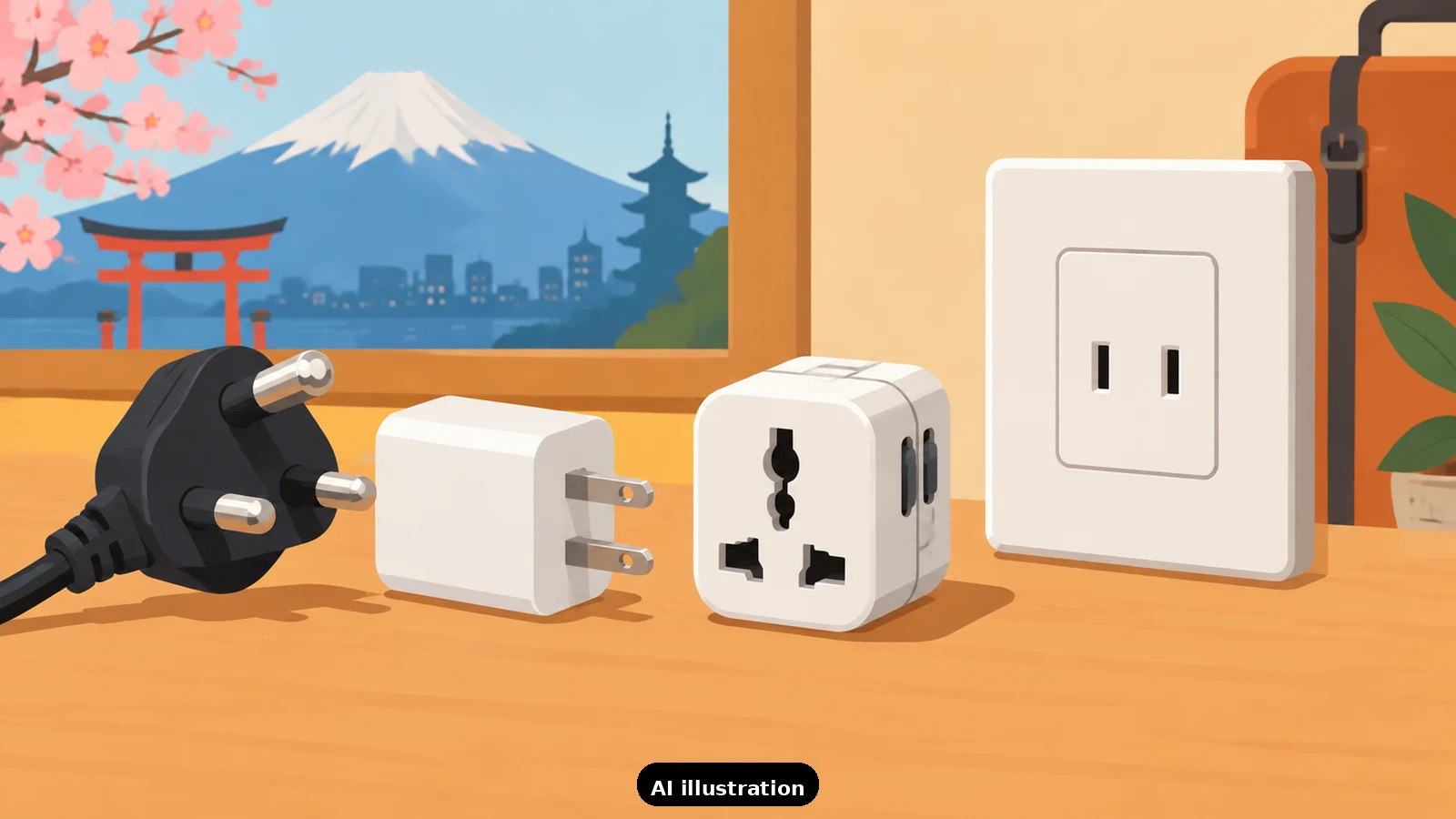
Illustration of Indian 2-pin and 3-pin plugs beside a Japanese two-flat-slot outlet with a travel adapter
Send to Mummy-Papa Opens WhatsApp with a short summary — pick who to send it to.

The short answer: no Indian plug - neither the two-round-pin phone charger nor the three-pin Type D plug - fits a Japanese wall socket directly. You will need a small adapter for everything you bring. The better news is that voltage, the part that can actually destroy a device, is almost never a problem for Indian travellers. Here is the whole picture in two checks.

Check 1: the shape. Japan's outlets are Type A - two flat parallel slots - sometimes with a third grounding hole (Type B), per Japan's official tourism guide. India's common plugs are the two round pins of Type C and the three round pins of Type D, and neither matches. What you need is a simple India-to-Type-A adapter: a passive piece of plastic and metal, no electronics, available for a few hundred rupees online or at any large electronics store. Buy two or three - one for the room, one for the day bag - and a universal adapter with USB ports covers most families in one unit.

Check 2: the label. Japan runs on 100 volts, with frequency at 50 or 60 hertz depending on the region. Now flip your Indian charger over and read the fine print. If it says INPUT: 100-240V, 50/60Hz - and virtually every phone, laptop, camera and tablet charger made in the last decade does - it is already compatible with Japan's 100V supply. The adapter handles the shape; the charger handles the voltage by itself. No transformer, no converter, no risk.

When you would actually need a converter. Only for single-voltage appliances marked 230V or 220-240V only - think some hair dryers, straighteners, electric kettles and older shavers. Even then, a converter is usually the wrong answer: Japanese hotels lend or install hair dryers, and buying a cheap dual-voltage travel appliance beats carrying a heavy transformer. Leave single-voltage heating appliances at home.

Practical packing list. A Type A adapter per traveller, a multi-port USB charger to fight over fewer sockets, and a power strip if the family travels with many devices - Japanese business hotel rooms can be stingy with outlets. Adapters are also sold at Japanese airports, Bic Camera and Yodobashi stores, and even large convenience stores, so forgetting one is a ten-minute errand, not a crisis.

The TripKeeper touch. Small practicalities like adapters are baked into the pre-departure checklist every traveller gets on our founder-hosted Japan departures, and the team answers these exact "will my charger work" questions before you fly. Independent travellers get the same checklist through the "Plan your trip" inquiry - so the first evening in Tokyo is about dinner, not hunting for a socket.

Send to Mummy-Papa Opens WhatsApp with a short summary — pick who to send it to.
Cheshta Agarwal
Founder · Travel Creator · Lawyer

A Miranda House graduate and lawyer who traded courtrooms for slow travel. Cheshta travels with the batches we host ourselves, with a soft spot for travelling alongside elders.

or let us do all of it

Planning your next trip?

We'll handle insurance, hotels, airport assistance and the itinerary — the same way we do it for every trip.

Questions on this article

asked by readers, answered by us

Do Indian phone chargers work in Japan?

Yes, with a plug adapter. Japan uses Type A outlets (two flat slots), which Indian round-pin chargers do not fit. But since virtually all phone chargers accept 100-240V input, and Japan runs at 100V, only a cheap passive India-to-Type-A adapter is needed - no voltage converter.

What plug type does Japan use?

Japan uses Type A outlets - two flat parallel slots - and sometimes Type B with a grounding hole, according to Japan's official tourism guide. The standard voltage is 100V, with frequency at 50Hz or 60Hz depending on the region.

Is Japan's voltage safe for Indian devices?

For nearly everything you carry, yes. Japan supplies 100V. Any charger or device labelled INPUT: 100-240V works safely there with just a plug adapter. Only single-voltage appliances marked 220-240V only - some hair dryers, kettles and straighteners - are at risk, and those are better left at home.

Do I need a voltage converter for Japan from India?

Almost never. Phone, laptop, camera and tablet chargers are dual-voltage (100-240V) and need only a shape adapter. A converter matters only for single-voltage 230V heating appliances, and even then, buying a dual-voltage travel version or using the hotel's hair dryer is easier than carrying a transformer.

Where can I buy a plug adapter in Japan if I forget one?

Adapters are sold at airport electronics counters, large chains like Bic Camera and Yodobashi Camera, and many convenience stores and drugstores. Forgetting an adapter is a minor errand in any Japanese city, not a trip problem.

Can I use an Indian 3-pin laptop charger in Japan?

The charger's brick is almost certainly dual-voltage (check for 100-240V on the label), so electrically it is fine. The 3-pin plug itself will not fit Japanese sockets, so carry an India-to-Type-A adapter - or a universal adapter - and plug the laptop charger through it.

Was this helpful?

one tap, no sign-up

Read next

← Journal See our trips