




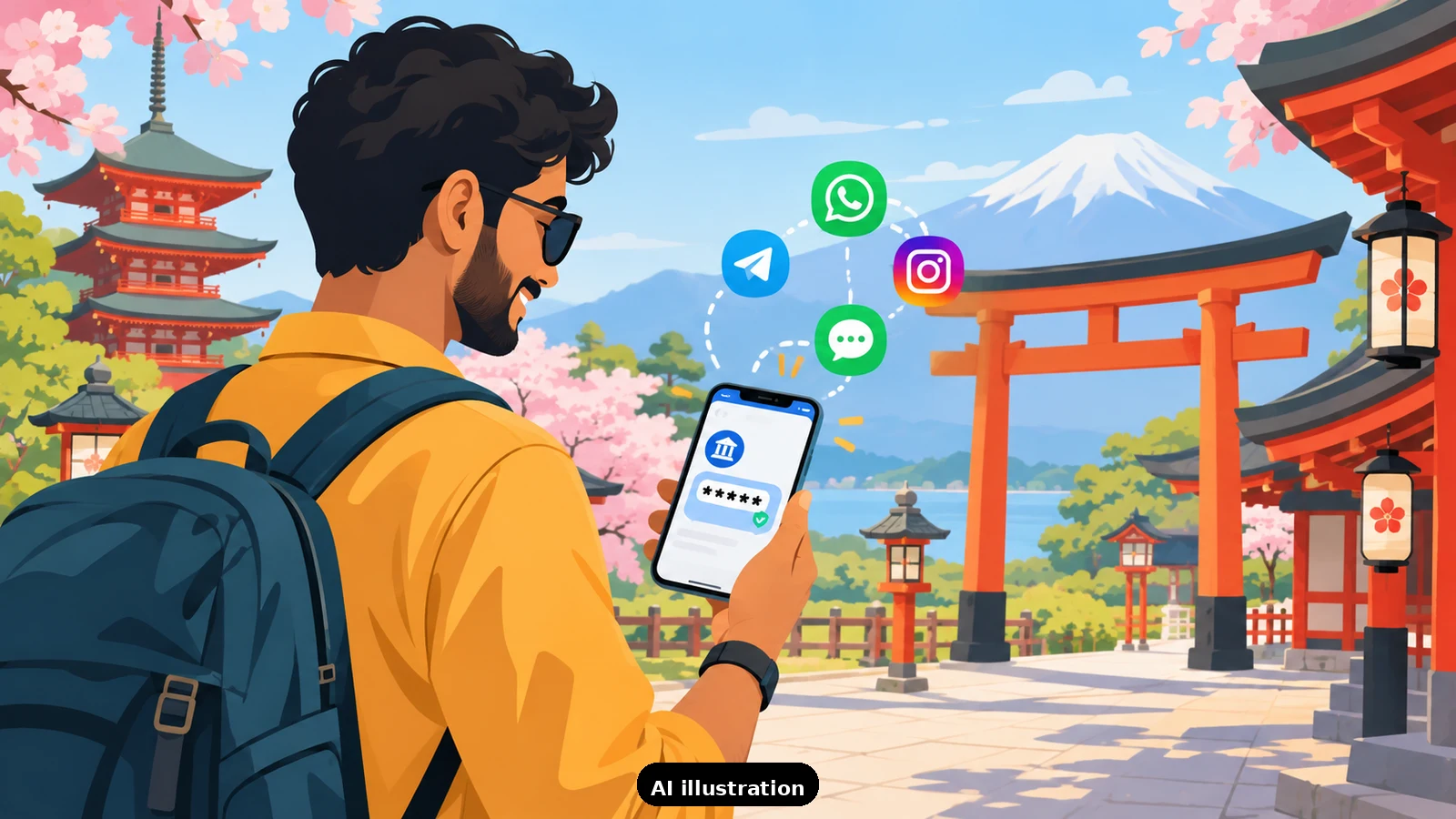
This question has two separate halves, and mixing them up is how travellers end up locked out of net banking in a Kyoto hotel. Half one: WhatsApp. Half two: bank OTPs. They behave completely differently on a travel eSIM, because one lives in the cloud and the other lives on your Indian SIM card.
WhatsApp: yes, completely unaffected. WhatsApp is registered to your phone number but runs on data. The moment your phone has any internet - a Japan travel eSIM, pocket Wi-Fi, hotel Wi-Fi - WhatsApp works exactly as at home: same chats, same Indian number, same groups. You do not need to re-register, and you should not: keep the account on your Indian number and let the eSIM simply feed it data. WhatsApp calls home also work over the eSIM's Japanese data without touching roaming minutes. The one caution: do not tap "change number" or re-verify WhatsApp with a temporary travel SIM's number; there is no benefit and real ways to confuse your account.
Bank OTPs: yes, but only through your Indian SIM. OTPs arrive as SMS to your Indian mobile number. A travel eSIM has its own foreign number (or no number at all) and will never receive your bank's SMS. So the real question is not "do OTPs work on an eSIM" but "is my Indian SIM alive while the eSIM handles data". The reliable setup: keep your physical Indian SIM in the phone with international roaming active - even the cheapest pack that includes incoming SMS - and run data on the eSIM. Incoming SMS while roaming is typically free or cheap with most Indian operators once roaming is on; verify your operator's current terms before flying.
The dual-SIM settings that matter. In your phone's SIM settings: set the eSIM as the default line for mobile data, keep the Indian SIM enabled for calls and SMS, and turn OFF data roaming on the Indian SIM to avoid accidental roaming data charges. With that split, an OTP lands on the Indian number while your maps run on Japanese data - the best of both SIMs.
What breaks in practice. Three failure modes travellers report. First, the roaming pack lapses mid-trip - OTPs stop instantly; buy a pack that outlasts your return date. Second, some banks now send OTPs through their apps instead of SMS, which need the app logged in and data access - set that up and test it before leaving India. Third, a few travellers swap the Indian SIM out entirely to "save roaming fees" and discover the cost of that saving when UPI or net banking demands verification at the worst moment.
Contingencies worth thirty minutes at home. Register your bank app's in-app OTP or token feature. Note your bank's international helpline that works from abroad. If a second phone travels with you, put the Indian SIM in it as a dedicated OTP receiver with roaming on. And test everything the evening before departure: eSIM installed, roaming active, one real OTP received.
How TripKeeper helps. On our founder-hosted Japan departures, the pre-departure checklist covers exactly this two-SIM setup - which line carries data, which carries OTPs, and what to test before the flight - and the tour leader helps sort out anyone's phone on arrival day. Independent travellers get the same checklist through the "Plan your trip" inquiry, so a bank login never decides your itinerary.

A Miranda House graduate and lawyer who traded courtrooms for slow travel. Cheshta travels with the batches we host ourselves, with a soft spot for travelling alongside elders.
Planning your next trip?
We'll handle insurance, hotels, airport assistance and the itinerary — the same way we do it for every trip.
Questions on this article
asked by readers, answered by us
Was this helpful?
one tap, no sign-up